01Facts
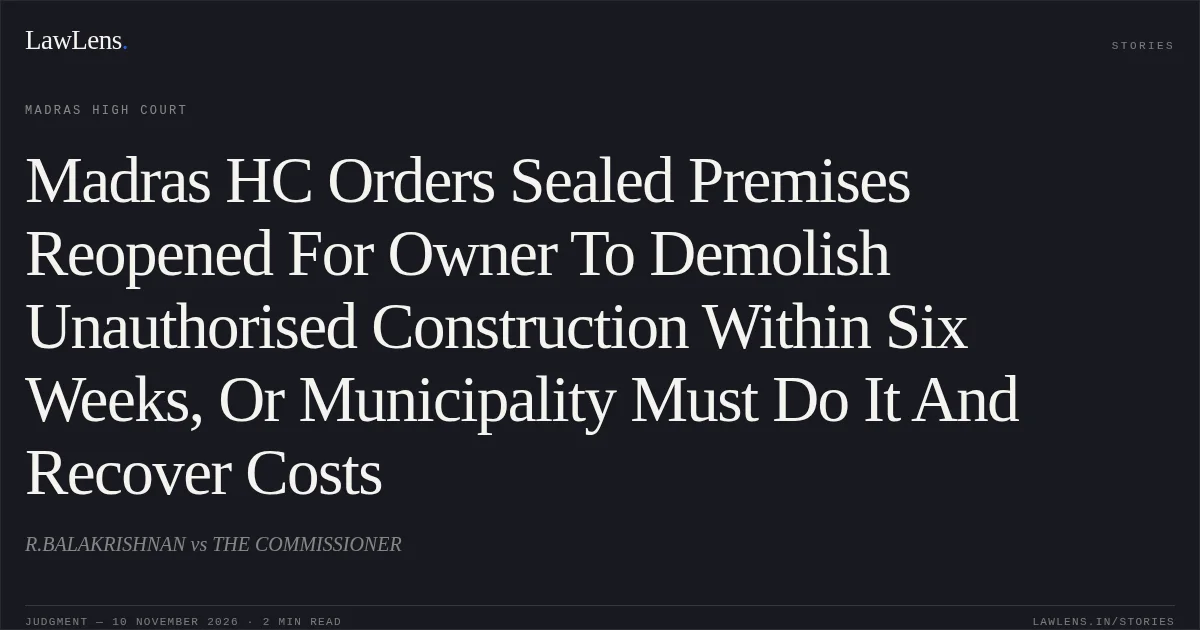
The petitioner sought a mandamus directing the Municipality to remove the lock and seal on premises at Plot Nos. 29, 30 and 31, Kamarajar Salai, Kundrathur, so he could access the property and remove his belongings
p. 1The dispute followed prior litigation concerning unauthorised construction; the Court had directed enforcement action, and the petitioner’s appeal under Section 80A of the Tamil Nadu Town and Country Planning Act, 1971, had been unsuccessful
p. 2After the Municipality locked and sealed the premises, the petitioner undertook by sworn affidavit to demolish the unauthorised permanent and temporary construction within six weeks of de-sealing
pp. 2–302Issues
i.1. Whether the premises should be de-sealed to enable the petitioner to undertake demolition of the unauthorised construction pursuant to his undertaking
pp. 3–4ii.2. Whether the Municipality should be authorised to complete the demolition and recover the costs if the petitioner failed to do so within the stipulated period
p. 403Law Applied
The petition was brought under Article 226 of the Constitution of India, which empowers the High Court to issue writs, including mandamus
p. 1The judgment also records that the petitioner’s appeal under Section 80A of the Tamil Nadu Town and Country Planning Act, 1971, had been decided against him
p. 2The Court cited no precedent or separate statutory test; it resolved the matter on the petitioner’s sworn undertaking and the Municipality’s submission that it would de-seal the premises to permit demolition
pp. 3–4Provisions in the judgment · 1
Tamil Nadu Town and Country Planning Act, 1971 Section 80A
04Reasoning
In light of the prior enforcement proceedings and the petitioner’s undertaking to remove the unauthorised construction in its entirety, the Court directed de-sealing to facilitate that work rather than grant unrestricted access for removal of belongings
pp. 2–4To ensure compliance, it directed the Municipality to monitor the demolition and provided that, if the petitioner failed to complete it within six weeks, the Municipality could demolish the construction and recover the charges from him
p. 405Holding
The Court disposed of the writ petition by directing the Commissioner to de-seal the premises on 11 November 2026, enabling the petitioner to commence demolition.
p. 4The petitioner was required to demolish all unauthorised permanent and temporary construction within six weeks from that date, under the Municipality’s monitoring; on default, the Municipality was to carry out the demolition and recover its charges from the petitioner
p. 4No costs were awarded
p. 4Original Court PDF
R.BALAKRISHNANvsTHE COMMISSIONER
Click to open original judgment
Original judgment, available to read, download and summarize on LawLens.in