Facts
The deceased, Krishna Prasad @ Pahalwan, operated a snack shop in Patna, where the appellant had previously worked.
Source reference: pp. 2–8On 25 August 2017, after an alleged altercation concerning the appellant carrying a pistol, the appellant allegedly fired at the deceased while he was proceeding home from the shop. The bullet struck the deceased in the back. He was taken to hospital, where he allegedly identified the appellant as the assailant before several persons, and died approximately two days later.
Source reference: pp. 2–8The post-mortem examination established death from a firearm injury to the chest. The appellant was charged under Sections 302 IPC and 27 of the Arms Act and was convicted by the learned 6th Additional District and Sessions Judge, Patna City, who sentenced him to life imprisonment under Section 302 IPC and three years’ rigorous imprisonment under Section 27 of the Arms Act, with the sentences to run concurrently. The present appeal challenged the conviction and sentence.
Source reference: pp. 2–8Issues
1. Whether the prosecution proved beyond reasonable doubt that the appellant intentionally caused the death of Krishna Prasad by firing a firearm at him on 25 August 2017?
Source reference: p. 14, para. 6(i)2. Whether the oral statements allegedly made by the deceased naming the appellant constituted reliable and admissible dying declarations under Section 32(1) of the Indian Evidence Act, 1872?
Source reference: p. 14, para. 6(ii)3. Whether the evidence of PW-2 as an alleged eyewitness, and of PW-3 and PW-5 as immediate post-occurrence witnesses, was natural, consistent, reliable and sufficient to establish the appellant’s complicity?
Source reference: p. 15, para. 6(iii)Law Applied
The Court applied Sections 302 IPC and 27 of the Arms Act to the alleged murder by firearm and unlawful use of a firearm.
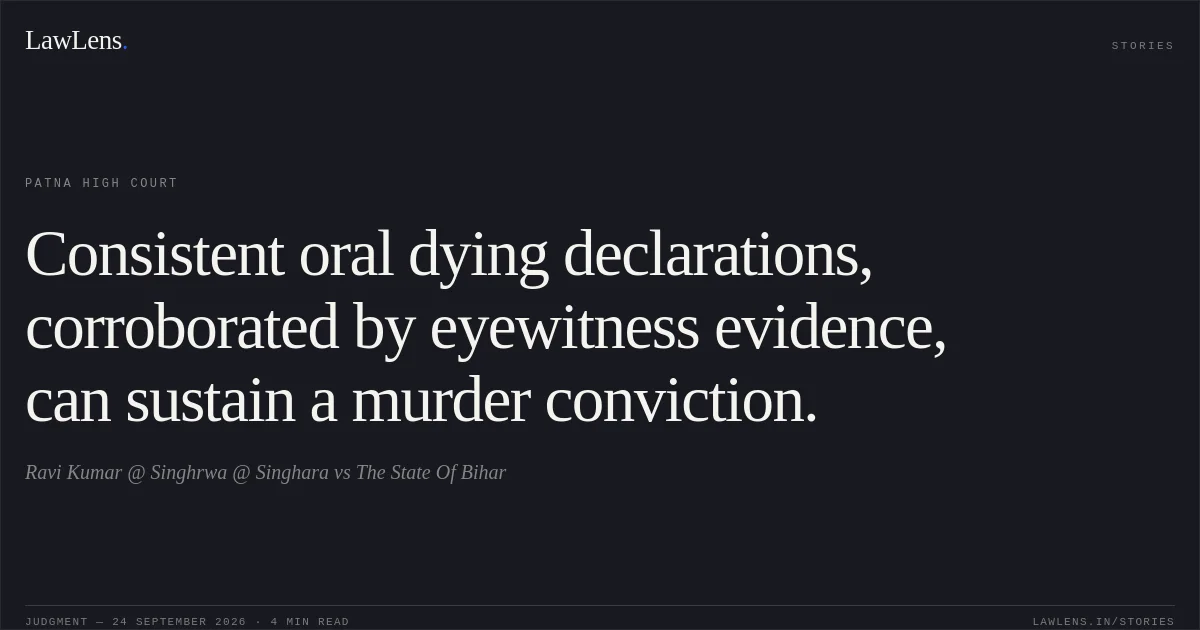
Source reference: pp. 26–37Under Section 32(1) of the Indian Evidence Act, a statement by a deceased concerning the cause of death or circumstances of the transaction resulting in death is admissible; relying on Khushal Rao v. State of Bombay , AIR 1958 SC 22, and Paniben v. State of Gujarat , (1992) 2 SCC 474, the Court held that a voluntary, truthful and reliable dying declaration may independently support conviction, although oral declarations require heightened scrutiny.
Source reference: pp. 26–37Evidence of related or interested witnesses is not inadmissible merely because of their relationship, but must be carefully assessed, as explained in State of Rajasthan v. Kalki , (1981) 2 SCC 752, and Raju v. State of T.N. , (2012) 12 SCC 701.
Source reference: pp. 26–37Non-recovery of the weapon is not necessarily fatal where reliable ocular evidence exists, consistent with Rakesh v. State of U.P. , (2021) 7 SCC 188.
Source reference: pp. 26–37The confessional statement made to the Investigating Officer was excluded under Section 25 of the Evidence Act.
Source reference: pp. 26–37The Court also reiterated that an appellate court must independently reappraise the evidence in an appeal against conviction.
Source reference: pp. 26–37Reasoning
The Court accepted the medical evidence as conclusively establishing a homicidal death caused by a firearm injury to the deceased’s back, although it did not itself identify the assailant.
Source reference: pp. 16–17PW-2 was treated as a natural eyewitness whose presence at the deceased’s shop was explained; his account that the appellant threatened the deceased, fired at him while he attempted to flee, and caused the back injury was found consistent with the medical evidence.
Source reference: pp. 17–18, 38PW-3 corroborated the immediate aftermath and the deceased’s identification of the appellant, while PW-5 saw the appellant fleeing shortly after the gunshot, furnishing proximate corroborative circumstances.
Source reference: pp. 18–20, 38The Court also accepted the oral dying declarations allegedly made to PW-2, PW-3, PW-4 and PW-6 as materially consistent and sufficiently reliable, notwithstanding that the witnesses were related or closely associated with the deceased.
Source reference: pp. 23–24, 38–39Variations concerning the date and time, non-recovery of the weapon and projectile, and investigative omissions were treated as shortcomings that did not undermine the core prosecution case.
Source reference: pp. 21–24, 39The appellant’s confession to the police was not relied upon, and the deceased’s prior criminal antecedents did not establish any defence or alternative theory of the crime.
Source reference: pp. 21–24, 39Holding
The Court answered the issues in favour of the prosecution and held that the appellant’s identity as the assailant was proved beyond reasonable doubt through the reliable testimony of PW-2, corroborative evidence from PW-3 and PW-5, the oral dying declarations, and the medical evidence.
The appeal was dismissed. The judgment of conviction dated 29 June 2018 and order of sentence dated 5 July 2018 were affirmed, including life imprisonment and fine under Section 302 IPC and three years’ rigorous imprisonment and fine under Section 27 of the Arms Act, with concurrent sentences.
Source reference: p. 40Acts & Sections Cited
9 provisions across 3 statutes referred to in this judgment. Each provision opens on LawLens.
Indian Penal Code, 18606
Arms Act, 19591
Code of Criminal Procedure, 19732
Original Court PDF
Ravi Kumar @ Singhrwa @ SingharavsThe State Of Bihar
Click to open original judgment
Original judgment, available to read, download and summarize on LawLens.in