Facts
The 1st respondent filed a money suit (CS.No.874/2001) against the petitioner, resulting in an ex-parte decree dated 23.06.2009 for Rs.29,79,848.86
Source reference: para 4After various transfers and unsuccessful attempts by the petitioner to set aside the ex-parte decree—which attained finality after the dismissal of CRP.No.680/2021—the respondents filed Execution Petition (EP) No.688/2020
Source reference: para 4, 8The petitioner filed a counter to the EP and a subsequent application under Section 47 of the CPC (EA.No.2/2022) to dismiss the EP, which was dismissed by the Executing Court and confirmed by the High Court in CRP.No.1455/2023
Source reference: para 8The petitioner then filed the present application (EA.No.3/2025) under Order 21 Rule 23 of the CPC, alleging non-compliance with Order 21 Rule 11[A] regarding the filing of a means affidavit and challenging the validity of the original decree
Source reference: para 4, 10The Executing Court dismissed this application on 30.01.2026, leading to the current revision petition
Source reference: para 1, 4Issues
1. Whether the Execution Petition was maintainable in light of alleged procedural non-compliance with Order 21 Rule 11[A] of the CPC regarding the filing of a means affidavit.
Source reference: para 5, 102. Whether the petitioner was barred by the principles of res judicata or constructive res judicata from raising new objections in execution proceedings that were available during previous stages/applications.
Source reference: para 11, 12Law Applied
The Court applied Order 21 Rule 11[A] of the CPC, which requires certain procedures for execution involving arrest, and Order 21 Rule 41, regarding the disclosure of assets
Source reference: para 10It applied the principle that an Executing Court cannot go behind a decree that has attained finality
Source reference: para 9the Court relied on the doctrine of constructive res judicata as applicable to execution proceedings, citing the Supreme Court precedents in Pradeep Mehra v. Harijivan J. Jethwa (2023 INSC 958) and Barkat Ali v. Badrinarain (2008 [4] SCC 615), which established that if a judgment-debtor fails to raise an objection at an appropriate stage, they are precluded from raising it at a subsequent stage of the same proceeding
Source reference: para 12Reasoning
The Court found that the petitioner's claim regarding the absence of a means affidavit was factually incorrect, as both the EP and the affidavit were dated 20.01.2020 and present in the record
Source reference: para 10The Court noted that this objection was not raised in the initial counter to the EP or in the previous Section 47 application, characterizing it as an "afterthought" intended to delay proceedings
Source reference: para 10Applying the principle of constructive res judicata, the Court reasoned that because the grounds now urged were available during the pendency of EA.No.2/2022 (the Section 47 petition), the petitioner was legally barred from raising them in a fresh application under Order 21 Rule 23
Source reference: para 11, 12The Court further emphasized that the petitioner had consistently failed to comply with earlier directions to disclose assets under Order 21 Rule 41, demonstrating a lack of bona fides
Source reference: para 10Holding
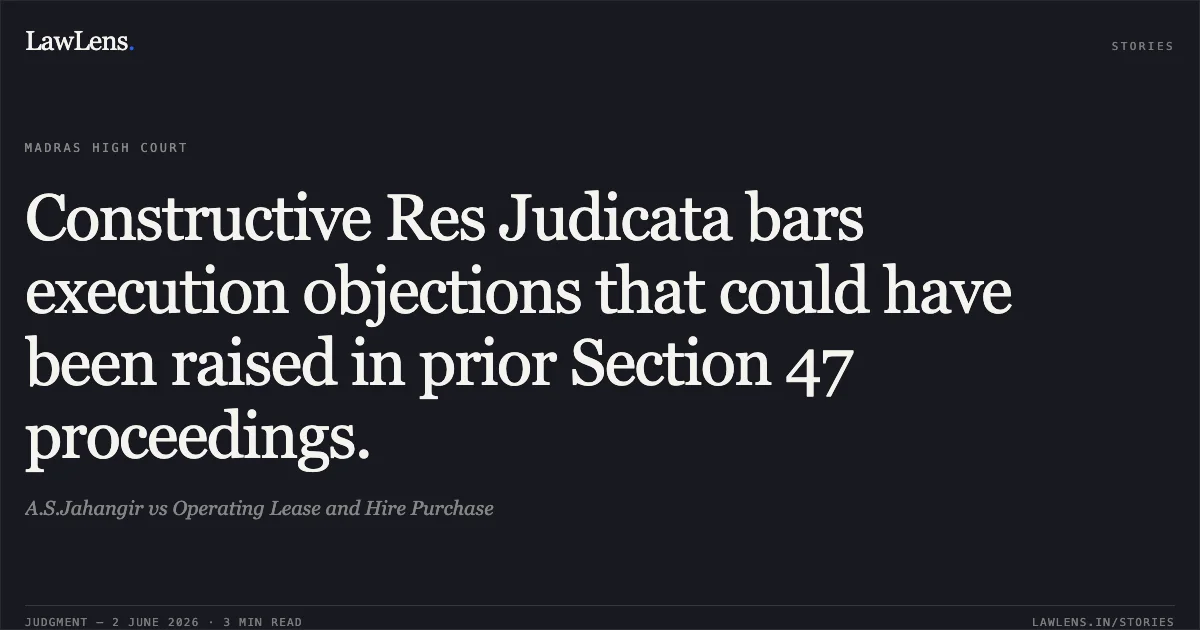
The Court held that the application was a dilatory tactic and was legally barred by the principles of constructive res judicata
The Court dismissed the Civil Revision Petition, confirming the Executing Court’s order
Source reference: para 14The Court affirmed that the Executing Court cannot go behind the decree and that the petitioner had failed to prove any procedural or jurisdictional infirmity in the execution proceedings
Source reference: para 9, 10Acts & Sections Cited
2 provisions across 1 statute referred to in this judgment. Each provision opens on LawLens.
Code of Civil Procedure, 19082
Original Court PDF
A.S.JahangirvsOperating Lease and Hire Purchase
Click to open original judgment
Original judgment, available to read, download and summarize on LawLens.in