Facts
Respondent No. 2’s Consumer Complaint No. 494/2016 against M/s. Sanchaya Land and Estate Pvt. Ltd. was allowed by the District Consumer Commission on 15 March 2017.
Source reference: paras. 2–3The complainant thereafter filed Execution Application No. 10/2024 under Section 71 of the Consumer Protection Act, 2019 (“CP Act”) read with Order XXI Rule 11 CPC, seeking recovery of approximately Rs.16,95,013/- and attachment, sale, arrest and detention of the judgment-debtor.
Source reference: paras. 2–3During the execution proceedings, the complainant filed a complaint under Section 200 CrPC alleging non-compliance with the consumer order.
Source reference: para. 4After recording the complainant’s sworn statement, the District Commission formed a prima facie opinion that an offence under Section 72 of the CP Act was made out and took cognisance on 8 February 2024, issuing summons.
Source reference: para. 4The summons was returned with the endorsement “left”; thereafter, Non-Bailable Warrants (“NBWs”) were issued and repeatedly re-issued between April and September 2024.
Source reference: paras. 5–6The warrants remained unexecuted, with the final report stating that the judgment-debtor had vacated the premises.
Source reference: paras. 5–6The petitioners challenged the order taking cognisance and all consequential proceedings under Articles 226 and 227 of the Constitution.
Source reference: no citationIssues
Whether the District Consumer Commission could take cognisance of an offence under Section 72 of the CP Act on the basis of proceedings arising from an execution application under Section 71 read with Order XXI CPC, or whether a separate complaint before a criminal court was required.
Source reference: para. 10(i)Whether the District Commission complied with the procedural requirements under Section 72 of the CP Act and the CrPC before taking cognisance and issuing process.
Source reference: para. 10(ii)Whether the NBWs issued against the petitioners were legally sustainable when the summons had allegedly not been duly served and the ordinary process had not secured their appearance.
Source reference: para. 10(iii)Whether the petitioners, as Directors of the judgment-debtor company, could be proceeded against under Section 72 of the CP Act in the absence of a prior finding of their personal responsibility, wilful disobedience or vicarious liability.
Source reference: para. 10(iv)Whether the order dated 8 February 2024 and the consequential proceedings warranted interference under Articles 226 and 227 of the Constitution.
Source reference: para. 10(v)Law Applied
Section 71 of the CP Act permits enforcement of Consumer Commission orders as if they were decrees of a civil court, with Order XXI CPC applying as far as practicable.
Source reference: para. 12.9Section 72 creates a distinct penal consequence for failure to comply with such orders; Section 72(2) confers on the Consumer Commission the powers of a Judicial Magistrate First Class, and Section 72(3) requires the offence to be tried summarily.
Source reference: paras. 12.10–12.11The CrPC applies subject to the special procedure prescribed by the CP Act under Sections 4(2) and 5.
Source reference: paras. 12.22–12.23For cognisance on complaint, the Commission was required to examine the complainant under Section 200 CrPC and determine whether a prima facie case existed; a detailed trial or final finding of guilt was not required at that stage.
Source reference: paras. 13.18–13.21The principle in Inder Mohan Goswami v. State of Uttaranchal, (2007) 12 SCC 1, requires NBWs to be issued cautiously and generally only after ordinary process has failed and the accused appears to be intentionally avoiding the proceedings.
Source reference: paras. 14.11–14.12Jolly George Varghese v. Bank of Cochin, (1980) 2 SCC 360, concerning arrest in civil execution for non-payment, was distinguished from criminal process issued under Section 72.
Source reference: paras. 14.17–14.20Although a company is a separate legal person, its Directors or persons responsible for its affairs may be proceeded against for the company’s alleged non-compliance where their responsibility for compliance is prima facie disclosed; however, designation as a Director alone does not establish guilt.
Source reference: paras. 15.22–15.23, 15.31–15.35Reasoning
The Court held that Sections 71 and 72 provide separate but complementary remedies: Section 71 concerns civil enforcement, while Section 72 concerns penal proceedings for non-compliance.
Source reference: paras. 12.12–12.17Since the complainant had filed a complaint under Section 200 CrPC and the Commission had recorded the sworn statement before forming a prima facie opinion, the proceedings were not an impermissible conversion of an execution petition into a criminal case.
Source reference: paras. 12.16, 12.24–12.26The Commission therefore had jurisdiction to take cognisance and was not required to refer the matter to a separate criminal court.
Source reference: no citationThe procedural challenge also failed because the threshold requirements—receipt of the complaint, examination of the complainant and prima facie satisfaction—were met; questions concerning wilfulness, ability to comply and the petitioners’ individual roles were matters for the proceedings, not for adjudication conclusively at the cognisance stage.
Source reference: paras. 13.18–13.31The NBWs were issued only after summons had failed to secure appearance and were repeatedly pursued after unsuccessful execution attempts.
Source reference: paras. 14.13–14.25Accordingly, they were treated as process to secure presence in the Section 72 proceedings, not as a civil mechanism for recovering the company’s debt.
Source reference: paras. 14.13–14.25Finally, the Court found that the petitioners could not defeat the proceedings merely by invoking the company’s separate legal personality.
Source reference: paras. 15.16–15.36Their ultimate liability depended on proof of their individual responsibility for the company’s affairs and compliance, but that issue could be examined during the proceedings under Section 72.
Source reference: paras. 15.16–15.36Holding
The writ petition was dismissed.
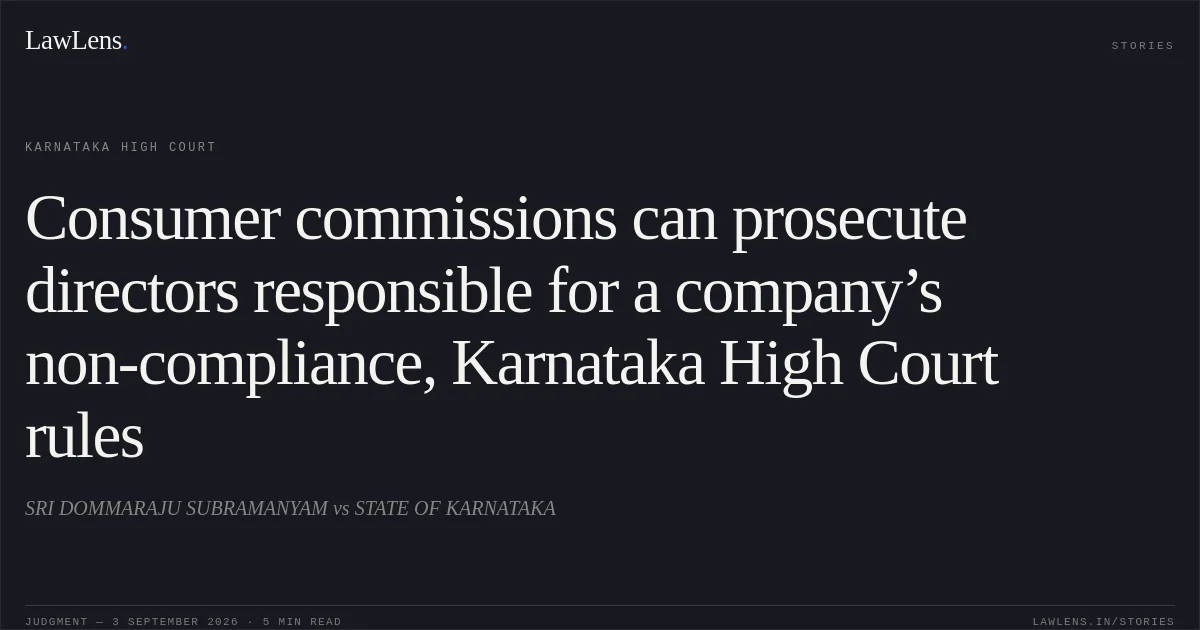
The Court held that the District Consumer Commission had jurisdiction under Section 72 of the CP Act to take cognisance, conduct summary proceedings and issue criminal process; the proceedings under Sections 71 and 72 could proceed independently.
Source reference: paras. 12.26, 16.21–16.22The NBWs were not illegal merely because the matter originated in an execution application, since they were issued after cognisance under Section 72 to secure the petitioners’ presence.
Source reference: para. 14.29The petitioners were directed to appear before the II Additional District Consumer Disputes Redressal Commission, Bengaluru Urban, and were permitted to raise all available defences, including the absence of personal responsibility for the company’s default.
Source reference: para. 17.1The Commission was directed to determine their liability in accordance with law.
Source reference: para. 17.1Independent enforcement of the consumer order under Section 71 read with Order XXI CPC was also permitted to continue.
Source reference: para. 17.1Acts & Sections Cited
14 provisions across 4 statutes referred to in this judgment. Each provision opens on LawLens.
Consumer Protection Act, 20192
Code of Criminal Procedure, 1973
Code of Civil Procedure, 19081
Bharatiya Nagarik Suraksha Sanhita, 20231
Original Court PDF
SRI DOMMARAJU SUBRAMANYAMvsSTATE OF KARNATAKA
Click to open original judgment
Original judgment, available to read, download and summarize on LawLens.in