01Facts
The Petitioners, teachers in Delhi schools, filed a contempt petition under Sections 11 and 12 of the Contempt of Courts Act, 1971, alleging wilful disobedience of the Order dated 15.07.2009 in W.P.(C) 451/2009.
¶ 1That order directed Respondents 3 and 4 not to terminate the Petitioners without due process of law, to continue paying salary and allowances, and to pay outstanding dues within one month.
¶ 2The Petitioners contended that their services were terminated in violation of the Delhi School Education Act, 1973 (DSEA), and that they were entitled to continue until superannuation, so salaries for the intervening period remained outstanding.
¶ 3The Respondents argued that the Petitioners had earlier filed W.P.(C) 11248/2009 against the termination orders dated 28.07.2009, which was withdrawn on 18.10.2010 with liberty to approach the Tribunal under Section 8 of the DSEA, with limitation under Section 8(3) to be disregarded.
¶ 4Pursuant to that liberty, the Petitioners instituted proceedings before the Delhi School Education Tribunal, which remain pending sine die because the Petitioners have not pursued them.
¶ 5, 9In reliance on Paragraph 45.6 of a later order (referred to in the judgment as dated 15.10.2026), the Petitioners argued that their entitlement to arrears was recognised.
¶ 1202Issues
i.1. Whether the legality of the termination, including compliance with due process, can be determined in contempt proceedings when the same question is pending before the statutory Tribunal.
¶ 9–10, 14ii.2. Whether the Petitioners' claim to salary up to superannuation, being consequential to the legality of termination, can be examined in contempt proceedings and, if unpaid, constitutes wilful disobedience.
¶ 10–11iii.3. Whether Paragraph 45.6 of the later order recognises or declares an entitlement to arrears of salary.
¶ 12–1303Law Applied
Sections 11 and 12 of the Contempt of Courts Act, 1971, form the statutory basis for contempt jurisdiction, which is confined to determining wilful disobedience of the specific directions in the operative order.
¶ 1, 14The directions of the order dated 15.07.2009, which restrain termination without due process and require payment of salary and allowances in accordance with law, were the operative directions applied by the Court.
¶ 2Section 8 and Section 8(3) of the DSEA, 1973, under which the Tribunal is the statutory forum for adjudicating the legality of termination, as recorded in the order dated 18.10.2010.
¶ 4, 14A consequential claim for salary cannot be adjudicated before the antecedent question of the legality of termination is decided.
¶ 11No precedent was cited in the judgment.
Provisions in the judgment · 3 · Linked ones open on LawLens
Contempt of Courts Act, 1971 Section 11Section 12
Delhi School Education Act, 1973 Section 8
04Reasoning
The Petitioners, having elected to challenge termination on procedural grounds, were bound to pursue the Tribunal proceedings to conclusion, and their failure to do so did not entitle them to seek the same determination in contempt.
¶ 9Because the Petitioners' salary claim up to superannuation depended entirely on a finding that termination was illegal, the consequential claim could not be examined independently in contempt.
¶ 10–11Contempt jurisdiction could not be used to decide a substantive question pending before the statutory Tribunal, since doing so would render those proceedings otiose.
¶ 14On Paragraph 45.6, the Court read the provision plainly: it required only that the Petitioners file concise claim statements and that the Respondents produce records before a nominated officer, who would adjudicate the claims. It therefore conferred no entitlement and could not be treated as an acknowledgment of arrears.
¶ 12–1305Holding
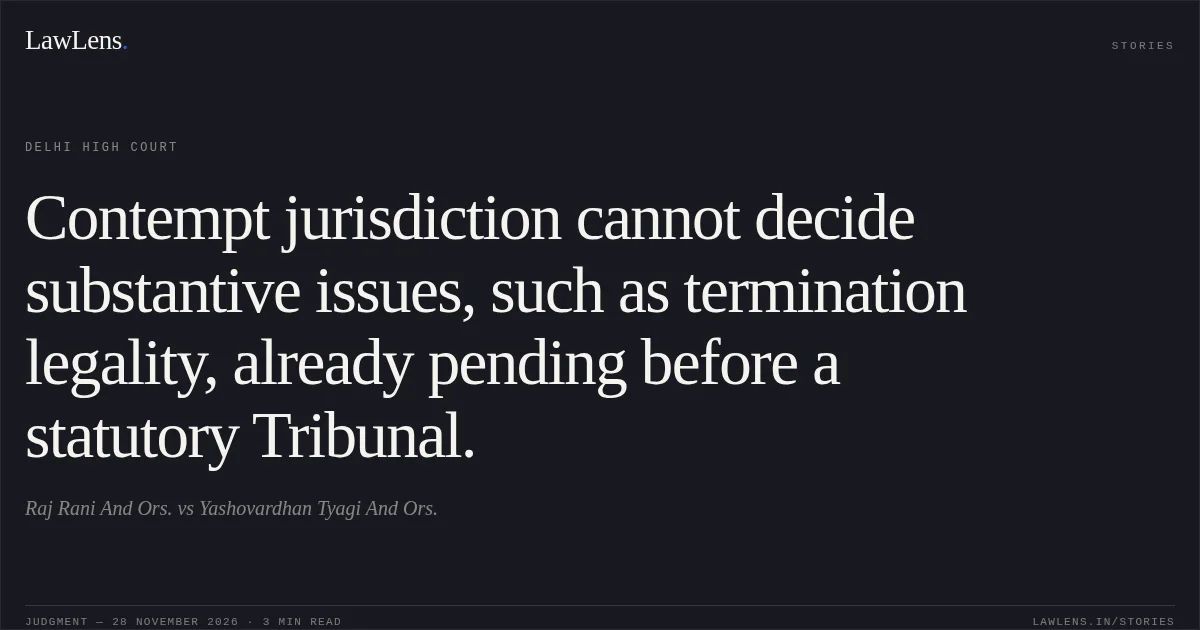
The question of whether due process was followed in terminating the Petitioners is yet to be determined by the competent Tribunal, and contempt jurisdiction cannot be deployed to decide it. Paragraph 45.6 does not recognise any entitlement to arrears of salary.
¶ 13, 14The contempt petition was found to lack merit and was dismissed, and the pending applications stood disposed of in the same terms. No further orders were passed.
¶ 14–15Original Court PDF
Raj Rani And Ors.vsYashovardhan Tyagi And Ors.
Click to open original judgment
Original judgment, available to read, download and summarize on LawLens.in