01Facts
On 22.04.2014, the appellant, Waseem Akhtar, allegedly stabbed his brother, Mohd. Aslam (PW-11), at the family residence in Shahganj, Delhi, after a quarrel while he was consuming liquor.
¶ 2 · p. 2The prosecution case was that the appellant went downstairs after two neighbours (PW-8 and Mukhtar) were called to pacify him, returned with a knife, and inflicted knife blows on the injured.
¶ 2 · p. 2The injured was taken to LNJP Hospital, where the MLC recorded a superficial incised wound (3 x 1 inches) on the lower left chest and a deep incised wound (1.5 x 2 inches) on the left abdomen.
¶ 2 · p. 2FIR No. 131/2014 was registered under Section 307 IPC at P.S. Kamla Market.
¶ 3 · p. 2The prosecution examined 13 witnesses. The complainant-injured (PW-11) turned hostile and attributed the injury to slipping against a door with protruding nails.
¶ 13 · pp. 6–7PW-7, the doctor, described the injury as "simple sharp" and admitted it could be caused by a protruding nail.
¶ 34–35 · pp. 20–21PW-8 admitted that the knife was not recovered in his presence.
¶ 40–43 · pp. 23–24The FSL report recorded no blood on the knife.
¶ 38 · p. 22The Trial Court convicted the appellant under Section 307 IPC and sentenced him to six years' RI and a fine of Rs. 10,000 by order dated 29.01.2018.
¶ 7–8 · pp. 9–11The appellant challenged both orders in this appeal.
¶ 902Issues
i.1. Whether the prosecution proved beyond reasonable doubt that the appellant committed an overt act of stabbing the complainant with the intention or knowledge required under Section 307 IPC.
¶ 29–33 · ¶ 49–50 · pp. 17–18 · p. 26ii.2. Whether the medical and forensic evidence establishes that the complainant's injuries were caused by the appellant with the alleged knife, or whether they are consistent with the alternative explanation of a fall against a door.
¶ 34–39 · pp. 20–22iii.3. Whether the alleged recovery of the knife at the appellant's instance is credible.
¶ 40–44 · pp. 23–24iv.4. Whether the hostile testimony of the injured complainant (PW-11) can be relied upon to sustain the conviction.
¶ 45–47 · p. 2503Law Applied
The Court applied Section 307 IPC, which requires an act done with intention or knowledge that, if death ensued, would amount to murder.
¶ 30 · p. 17Relying on Surinder Singh v. State (UT of Chandigarh), (2021) 20 SCC 24, which in turn cites State of M.P. v. Saleem, (2005) 5 SCC 554, and State of M.P. v. Kashiram, (2009) 4 SCC 26, the Court held that the two ingredients are (i) intention or knowledge to cause death and (ii) an overt act in execution of that intention, with intent deducible from the conduct, the weapon, and the nature of injury.
¶ 31 · pp. 17–19Injury capable of causing death is not a sine qua non, though the act attributable to the accused must be proved through cogent and reliable evidence.
¶ 32–33 · pp. 19–20The testimony of a hostile witness may be relied upon only where its reliable portions are consistent with other evidence.
¶ 46 · p. 25Benefit of doubt must arise from a reasonable assessment of the evidence, not from conjecture.
¶ 48 · p. 25Provisions in the judgment · 4 · Linked ones open on LawLens
Code of Criminal Procedure, 1973 Section 374Section 313Section 428
Indian Penal Code, 1860 Section 307
04Reasoning
The Court first held that the complainant, the most material eyewitness, did not attribute the stabbing to the appellant and instead gave an explanation of an accidental fall against a door with protruding nails.
¶ 36, 45–46 · p. 21 · p. 25The medical evidence did not exclude this explanation: PW-7 classified the wound as superficial and "simple sharp," and admitted it could be caused by a protruding nail.
¶ 35–37 · p. 21The Court treated the forensic finding of no blood on the knife as a relevant, though not conclusive, circumstance.
¶ 38 · p. 22It then found the recovery doubtful, because PW-8 denied that the knife was recovered in his presence, the sketch and disclosure were prepared at the police station, and the recovery site (the Machhan/Tand) was absent from the site plan.
¶ 41–44 · pp. 23–24Taken together, the Court held that these infirmities left a reasonable doubt on whether the appellant inflicted the injuries with the knife.
¶ 41–44 · pp. 23–24Because the overt act was not established, the Court did not need to finally decide the intention element, though it noted that the nature of the injury alone is not determinative under Section 307.
¶ 31–33, 49 · pp. 17–20 · p. 26The Court observed that the doubts were not speculative but arose from material aspects of the prosecution evidence.
¶ 48 · p. 2505Holding
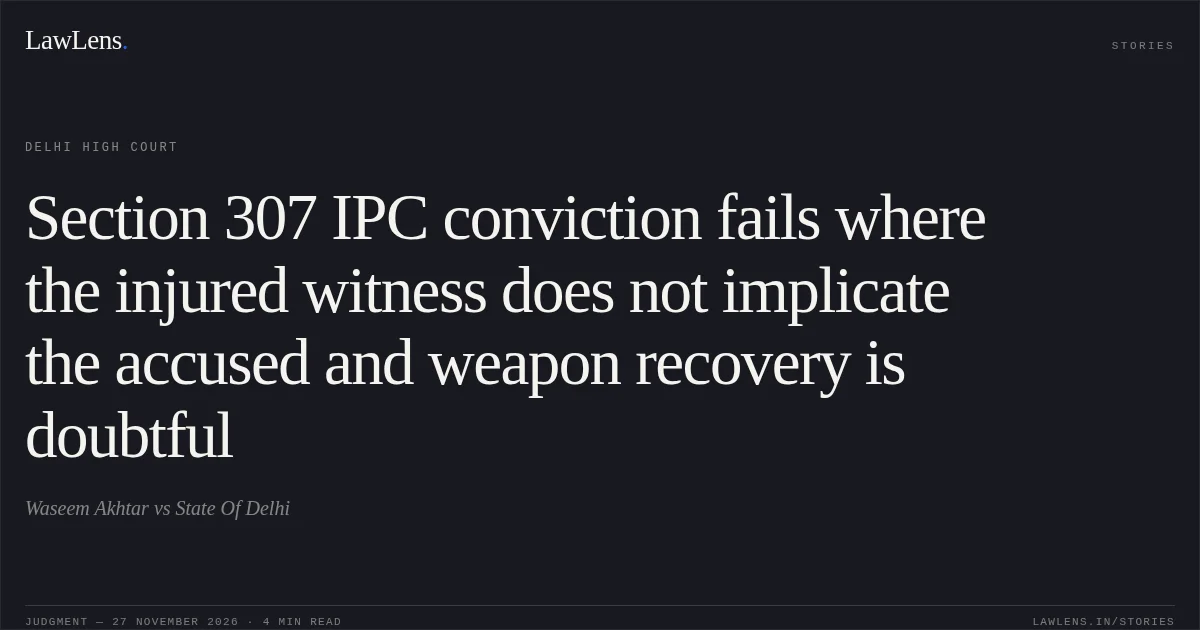
The Court held that the prosecution failed to prove beyond reasonable doubt that the appellant committed the overt act of stabbing the complainant with the intention or knowledge required under Section 307 IPC.
¶ 49–50 · p. 26The appeal is allowed. The judgment of conviction dated 16.01.2018 and the order on sentence dated 29.01.2018 are set aside, and the appellant is acquitted of the charge under Section 307 IPC.
¶ 51 · p. 26Since the sentence had already been suspended on 28.05.2019, the bail bonds and sureties stand discharged.
¶ 52A copy of the judgment is to be sent to the Trial Court and the Jail Superintendent.
¶ 53Original Court PDF
Waseem AkhtarvsState Of Delhi
Click to open original judgment
Original judgment, available to read, download and summarize on LawLens.in