01Facts
Appellant no. 1, Basant Kumar, was an Assistant in Establishment Section II of the Department of Industrial Development, and he processed Staff Selection Commission (SSC) nominations for LDC posts.
The Department forwarded a list of 25 candidates from the Clerks' Grade Examination, 1984, in which Tapash Kumar Haldar (PW-2), rank no. 4937 (SC), appeared at serial no. 19.
¶ 3A cyclostyled list marked 'X' showed appellant no. 2, Satish Kumar (brother of appellant no. 1), at serial no. 19 with the same rank and category, and the other 24 entries were identical.
¶ 4 · ¶ 44Appellant no. 1 was posted out of the section from 27.01.1986 to 04.04.1986, and a letter dated 17.02.1986 bearing the signature of L.D. Toora, Under Secretary, was issued during this interval.
¶ 5 · ¶ 58After returning, appellant no. 1 opened a personal file on 18.08.1986 and proposed a reminder, which was approved and issued on 21.08.1986.
¶ 5 · ¶ 61Provisional appointment was proposed on 09.09.1986 pending verification, and appellant no. 2 joined on 24.09.1986.
¶ 6The CBI registered the case in April 1990.
¶ 7The Trial Court (Special Judge, Delhi, judgment 25.09.2003; sentence 29.09.2003) convicted both appellants under s. 120-B r/w ss. 420, 467, 471 IPC and s. 5(2) r/w s. 5(1)(d) PC Act, and appellant no. 1 additionally under ss. 467 IPC and 5(2) r/w 5(1)(d) PC Act.
¶ 1 · ¶ 13 · ¶ 16Appellant no. 2 claimed to have appeared in the 1985 examination, which was not proved.
¶ 11 · ¶ 12 · ¶ 83Neither appellant led defence evidence.
¶ 12The appellants were released on bail subject to bonds on 20.11.2003.
¶ 1702Issues
i.1. Whether the prosecution proved that the list marked 'X' and the letter dated 17.02.1986 were forged and that appellant no. 1 made them.
¶ 43 · ¶ 44 · ¶ 49 · ¶ 55 · ¶ 56 · ¶ 57 · ¶ 58 · ¶ 59 · ¶ 60 · ¶ 67ii.2. Whether appellant no. 1 used the forged documents as genuine with knowledge or reason to believe they were forged, so as to sustain convictions under ss. 471 and 420 IPC and s. 5(2) r/w 5(1)(d) PC Act.
¶ 73 · ¶ 74 · ¶ 75 · ¶ 76 · ¶ 77iii.3. Whether the documents were "valuable securities" so as to attract s. 467 IPC against appellant no. 1.
¶ 70 · ¶ 71 · ¶ 72iv.4. Whether appellant no. 2 knowingly used the forged list as genuine, so as to sustain convictions under ss. 420 and 471 IPC.
¶ 78 · ¶ 79 · ¶ 80 · ¶ 81 · ¶ 82 · ¶ 83 · ¶ 85v.5. Whether an agreement between the appellants under s. 120-B IPC was proved by circumstantial evidence, including the 313 CrPC explanations, the claimed 1985 candidature, the resignation and non-refund of salary.
¶ 45 · ¶ 48 · ¶ 68 · ¶ 79 · ¶ 84 · ¶ 8503Law Applied
Circumstantial evidence must form a complete chain consistent only with guilt, and where two views are reasonably possible the accused benefits, citing Sharad Birdhichand Sarda (1984) 4 SCC 116 and Kali Ram (1973) 2 SCC 808.
¶ 46Section 106 of the Evidence Act does not shift the prosecution's primary burden, citing Shambu Nath Mehra (1956) 1 SCC 337.
¶ 47A false explanation or defence cannot fill gaps in an incomplete chain, citing Perumal Raja (2024 SCC OnLine SC 12).
¶ 48 · ¶ 68Statements under s. 313 CrPC are not substantive evidence and cannot supply missing proof, citing Raj Kumar Singh (2013) 5 SCC 722.
¶ 79Forgery under s. 467 requires proof that the accused made the false document, citing Sheila Sebastian (2018) 7 SCC 581.
¶ 49Section 471 requires proof of knowing or reason-to-believe use as genuine, and Section 420 requires dishonest inducement, citing A.S. Krishnan (2004) 11 SCC 576 and Deepak Gaba (2023) 3 SCC 423.
¶ 50Negligence or procedural irregularity does not establish criminal intent, citing L. Chandraiah (2003) 12 SCC 670 and Anil Kumar Bose (1974) 4 SCC 616.
¶ 51 · ¶ 53Conspiracy requires a meeting of minds shown by outward acts, and association or relationship is insufficient, citing Ram Sharan Chaturvedi (2022) 16 SCC 166 and State of U.P. v. A.K. Gaba (2026 SCC OnLine SC 967).
¶ 52Adverse inference under s. 114(g) may arise where best evidence is withheld, citing Tomaso Bruno (2015) 7 SCC 178.
¶ 54A "valuable security" under s. 30 IPC must itself create, extend, transfer, restrict, extinguish or release a legal right.
¶ 70Inclusion in a select list confers no indefeasible right, citing Shankarsan Dash (1991) 3 SCC 47 and, on s. 467, Shriniwas Pandit Dharamadhikari (1980) 4 SCC 551.
¶ 71Provisions in the judgment · 9 · Linked ones open on LawLens
Code of Criminal Procedure, 1973 Section 374Section 313Section 437
Indian Penal Code, 1860 Section 420Section 467Section 471Section 464Section 470Section 30
04Reasoning
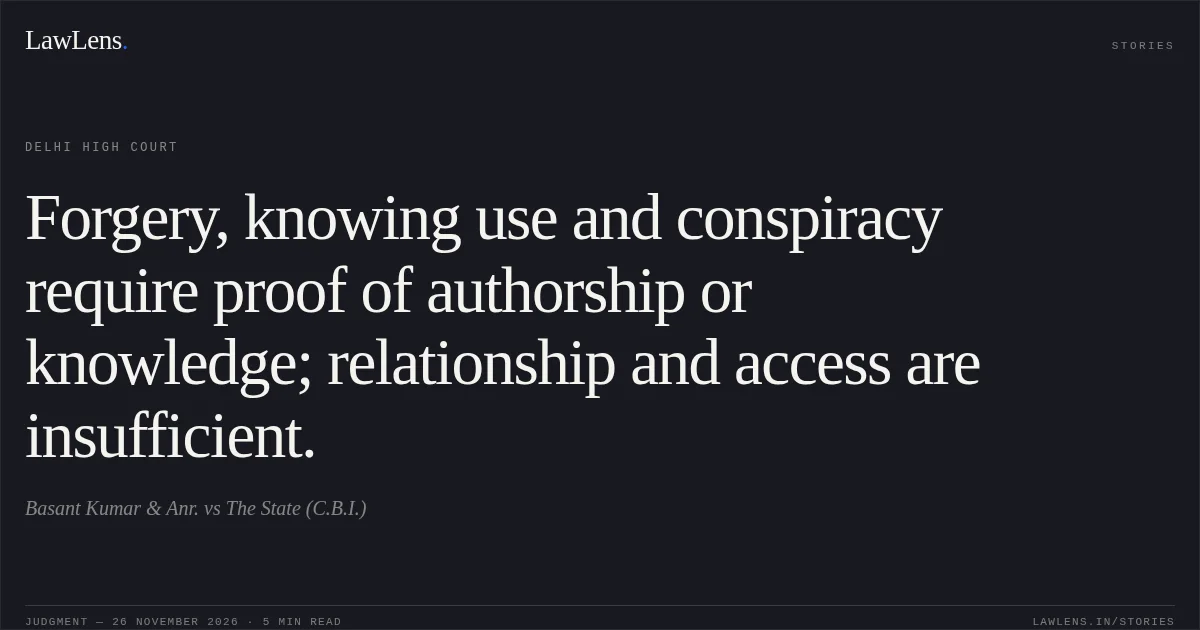
The substitution of appellant no. 2's name for PW-2's in list 'X' rendered that list spurious, but this established only falsity, not authorship or knowledge.
¶ 44The prosecution did not prove who typed or cyclostyled the list. PW-3 had no knowledge of its preparation, PW-10 testified that typing and cyclostyling were not appellant no. 1's functions, and the handwriting expert (PW-7) linked him only to admitted notes and initials.
¶ 55 · ¶ 56 · ¶ 64The Trial Court's inference of authorship from motive and opportunity could not substitute for proof, and the "blank pre-signed letter" theory was conjecture.
¶ 57 · ¶ 59The letter of 17.02.1986 was issued while appellant no. 1 was absent, and no evidence traced its preparation to him.
¶ 58His subsequent notes relied on material already on file, and the approvals by superior officers were ordinary departmental steps, so processing did not prove knowledge of falsity.
¶ 61 · ¶ 62 · ¶ 63The SSC primary record, which could have resolved the 1985 candidature question, was never seized. The Court did not treat this omission as proof of fabrication, but it weakened the prosecution's chain.
¶ 65 · ¶ 66For s. 467, Mark 'X' was not a valuable security under s. 30 IPC.
¶ 70 · ¶ 71 · ¶ 72For s. 471, 420 and PC Act charges, mere processing of a file, and at most a failure to verify, did not establish knowledge or dishonest intent.
¶ 73 · ¶ 74 · ¶ 75 · ¶ 76 · ¶ 77As to appellant no. 2, the departmental references to 1984 and rank no. 4937 did not prove that he knew of the fabrication, and his explanation was reasonably possible and not excluded by the prosecution evidence.
¶ 78 · ¶ 82 · ¶ 83The Court distinguished A.S. Krishnan because appellant no. 2 never tendered the list or certified the rank.
¶ 82The s. 313 answers, the resignation and the non-refund of salary could not supply the missing links, and brotherhood and benefit did not prove an agreement.
¶ 68 · ¶ 79 · ¶ 80 · ¶ 8405Holding
The Court answered the issues in the negative. The prosecution failed to prove authorship of list 'X' and letter dated 17.02.1986, knowing use, dishonest inducement, valuable-security character for s. 467, or an agreement under s. 120-B.
¶ 85 · ¶ 86The appeal is allowed. Both appellants' convictions and sentences under ss. 120-B, 420, 467 and 471 IPC and s. 5(2) r/w 5(1)(d) PC Act are set aside, and both are acquitted. Fines, if deposited, are to be refunded after verification. The appellants are to be released if in custody and not wanted in another case, and bail and surety bonds are discharged subject to s. 437A CrPC. The judgment is to be sent to the Jail Superintendent and the Trial Court and uploaded.
¶ 86 · ¶ 87 · ¶ 88 · ¶ 90 · ¶ 91 · ¶ 94 · ¶ 95Original Court PDF
Basant Kumar & Anr.vsThe State (C.B.I.)
Click to open original judgment
Original judgment, available to read, download and summarize on LawLens.in