01Facts
The petitioner was convicted under Section 138 of the Negotiable Instruments Act, 1881 ("NI Act") by judgment dated 12.12.2023 in a complaint filed in 2011.
¶ 3On appeal, the Sessions Court on 07.03.2024 directed him to deposit 20% of the compensation within 60 days.
¶ 3A petition under Section 482 CrPC against that order was disposed of by a coordinate bench on 21.10.2024, which set aside the direction and permitted the petitioner to plead exceptional circumstances before the appellate court.
¶ 3By order dated 24.09.2026, the Sessions Court declined exemption from the 20% deposit.
¶ 1, 3Before the Sessions Court, the petitioner relied on his age and medical conditions, unemployment since 2018, and his resignation as director on 18.11.2009, while the cheque was issued in 2011.
¶ 4Before the High Court, only the resignation ground was pressed.
¶ 5The petitioner admittedly signed the cheque as "authorised signatory," and his claimed resignation is a disputed fact for trial.
¶ 6At trial, he did not cross-examine the complainant or lead evidence on Form-32, and his defence was that the cheque was a blank security cheque, not that he was never a director.
¶ 7–8The trial court recorded repeated protraction of proceedings by the petitioner.
¶ 902Issues
i.1. Whether the petitioner's alleged resignation from directorship before the cheque was issued constitutes an "exceptional circumstance" warranting exemption from depositing 20% of the compensation under Section 148 NI Act.
¶ 5–7ii.2. Whether the petition under Section 482 CrPC merits notice or interference, or is a frivolous attempt to protract proceedings.
¶ 2, 9–1003Law Applied
Section 148 NI Act, under which the appellate court may require deposit of a minimum of 20% of the fine or compensation, and exemption requires "exceptional circumstances" (the judgment does not reproduce the statutory text).
¶ 1, 3A director's resignation or non-involvement is a question of fact that the accused must prove during trial, including through Form-32 filings under the Companies law.
¶ 6–7A plea not raised at the Section 313 CrPC stage or during trial is not readily available at a later stage.
¶ 8Inherent jurisdiction under Section 482 CrPC, under which the court may dismiss frivolous petitions with costs (no authority cited for costs).
¶ 2, 10Provisions in the judgment · 4 · Linked ones open on LawLens
Negotiable Instruments Act, 1881 Section 148Section 138
Code of Criminal Procedure, 1973 Section 482Section 313
04Reasoning
The resignation claim did not meet the threshold of exceptional circumstances. The petitioner had signed the cheque and had never denied being a director; the resignation was a disputed fact that he had failed to prove at trial, having neither cross-examined the complainant nor produced Form-32 evidence.
¶ 6–7His shifting defence, from a blank security cheque at trial to resignation now, further weakened the claim.
¶ 8The trial record showed deliberate protraction of a 2011 case, which the court viewed as a factor against relief and as evidence that the petition was a further attempt to exhaust the complainant.
¶ 9–10The court found the petition devoid of merit and not worth issuing notice.
¶ 2, 10The other grounds (age, health, unemployment) were not pressed and were not considered.
¶ 505Holding
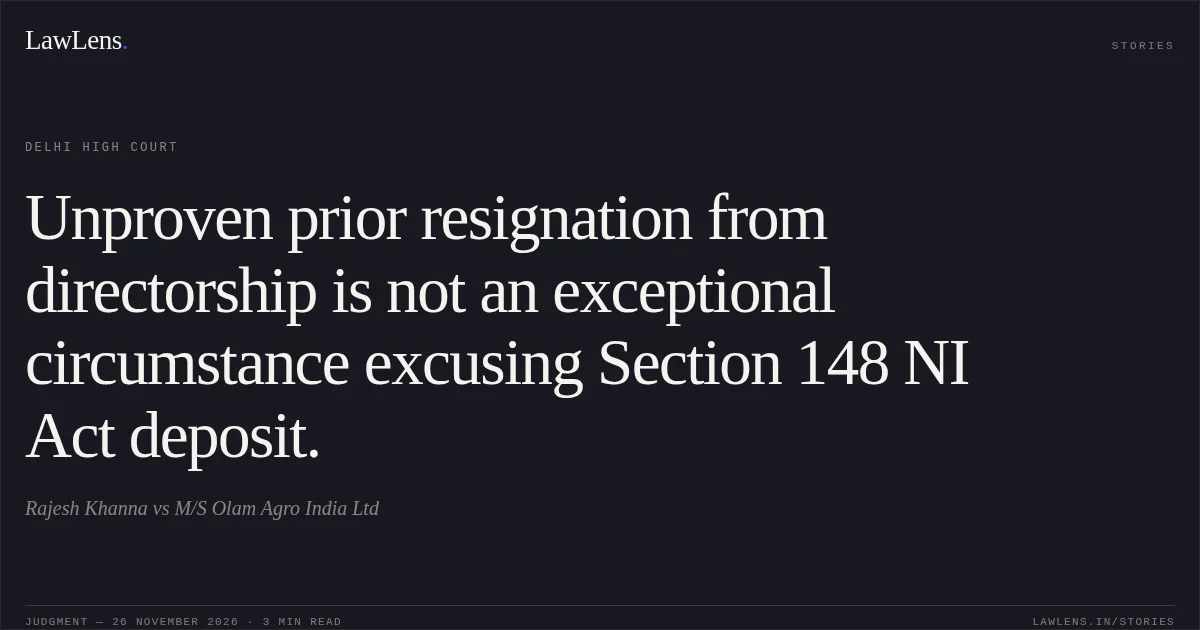
The alleged prior resignation, which was unproven and inconsistent with the petitioner's conduct at trial, is not an exceptional circumstance justifying exemption from the 20% deposit under Section 148 NI Act.
¶ 5–8The petition was dismissed at the threshold as frivolous and an attempt to protract proceedings. The petitioner was directed to pay costs of Rs. 20,000 online within one week, the connected applications were dismissed, and a copy of the order was directed to be sent to the Sessions Court.
¶ 2, 9–10Original Court PDF
Rajesh KhannavsM/S Olam Agro India Ltd
Click to open original judgment
Original judgment, available to read, download and summarize on LawLens.in