01Facts
The petitioner was convicted under Section 138 of the Negotiable Instruments Act, 1881 ("NI Act") by judgment dated 12.12.2023 in a complaint filed in 2011
¶ 3 · p. 1The appellate Sessions Court, by order dated 07.03.2024, directed him to deposit 20% of the fine or compensation within 60 days
¶ 3 · pp. 1–2A coordinate bench, by order dated 21.10.2024 under Section 482 CrPC, set aside that direction and permitted the petitioner to plead exceptional circumstances before the appellate court
¶ 3 · p. 2On reconsideration, the appellate court, by order dated 24.09.2026, declined exemption, holding that the grounds advanced were not exceptional
¶ 3–4 · p. 2Those grounds were: senior-citizen status with diabetes, hypertension and high uric acid; unemployment since 2018; and resignation from directorship of the company on 18.11.2009, before the cheque was issued in 2011
¶ 4 · p. 2Before this Court, the petitioner pressed only the resignation ground
¶ 5 · p. 3The cheque was admittedly signed by the petitioner, who described himself as authorised signatory
¶ 6 · p. 3At trial, the petitioner did not cross-examine the complainant, led no evidence on his resignation, and did not raise the plea of non-directorship in his notice-of-accusation response or Section 313 CrPC statement
¶ 7–8 · pp. 3–4His consistent plea was that the cheque was a blank security cheque
¶ 7–8 · pp. 3–4The trial judgment records repeated protraction of proceedings by the petitioner
¶ 9 · p. 402Issues
i.1. Whether the petitioner's claimed resignation from directorship in 2009, prior to issuance of the cheque in 2011, constitutes an exceptional circumstance warranting exemption from depositing 20% of the compensation under Section 148 of the NI Act.
¶ 5–7 · p. 3ii.2. Whether the petition under Section 482 CrPC merits issuance of notice or interference with the appellate court's order dated 24.09.2026, given the petitioner's conduct of the proceedings.
¶ 2, 9–10 · p. 1 · p. 403Law Applied
Section 148 of the NI Act, under which the appellate court may direct the convict to deposit a minimum of 20% of the fine or compensation as a condition for suspending sentence, subject to exceptional circumstances justifying exemption
¶ 1 · p. 1 · ¶ 3 · pp. 1–2The settled principle that a plea of fact, such as non-directorship at the time of the offence, must be established by evidence and is a matter for trial
¶ 6 · p. 3The principle that a party must raise its defence at the earliest stage, here the notice of accusation and Section 313 CrPC examination, and that an unproven or belatedly raised plea carries little weight
¶ 7–8 · pp. 3–4The power under Section 482 CrPC, as exercised by the coordinate bench on 21.10.2024, and the authority to impose costs on frivolous petitions that protract proceedings
¶ 3, 10 · p. 2 · p. 4The judgment does not expressly cite any other precedent
Provisions in the judgment · 4 · Linked ones open on LawLens
Negotiable Instruments Act, 1881 Section 148Section 138
Code of Criminal Procedure, 1973 Section 482Section 313
04Reasoning
The only ground pressed, resignation from directorship, was not an exceptional circumstance. The petitioner admitted signing the cheque and did not dispute that he was a director, so his resignation claim was a disputed fact requiring proof at trial
¶ 6 · p. 3The trial record showed that he neither cross-examined the complainant nor led evidence on Form-32 or on resignation, and that his only consistent defence was that the cheque was a blank security cheque
¶ 7–8 · pp. 3–4Because the plea was absent from his accusation response and Section 313 statement, the court treated it as an afterthought with no evidentiary foundation, and therefore it could not support exemption
¶ 7–8 · pp. 3–4The court also considered the long delay in a 2011 dispute and the petitioner's documented pattern of protracting proceedings at each stage, which led it to view the petition as an attempt to exhaust the complainant
¶ 9 · p. 4On this basis, the court found no infirmity in the appellate order and no need to issue notice
¶ 2, 10 · p. 1 · p. 405Holding
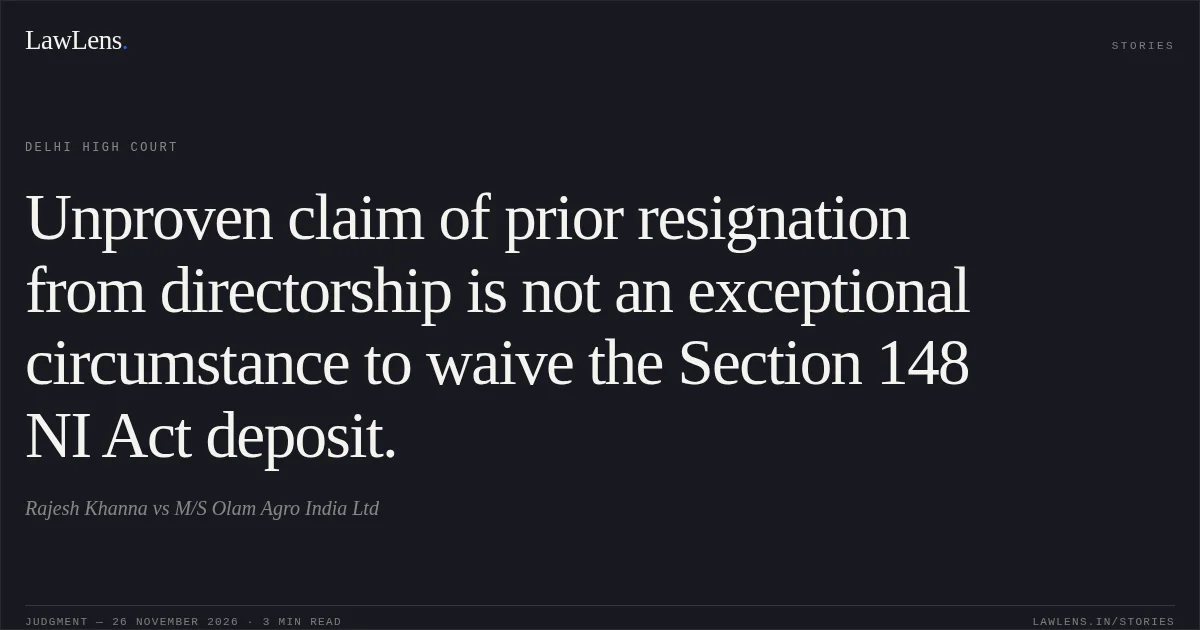
The petitioner's claim of resignation before the cheque was issued is a disputed question of fact to be determined at trial and does not constitute an exceptional circumstance for exemption under Section 148 of the NI Act
¶ 6–7 · p. 3The petition was found devoid of merits and frivolous, and was dismissed without issuing notice. The court imposed costs of Rs. 20,000, payable by the petitioner online through the designated government portal within one week. The accompanying applications were dismissed, and a copy of the order was directed to be sent to the appellate court. The 20% deposit direction therefore stands.
¶ 2, 10 · p. 1 · p. 4Original Court PDF
Rajesh KhannavsM/S Olam Agro India Ltd
Click to open original judgment
Original judgment, available to read, download and summarize on LawLens.in