01Facts
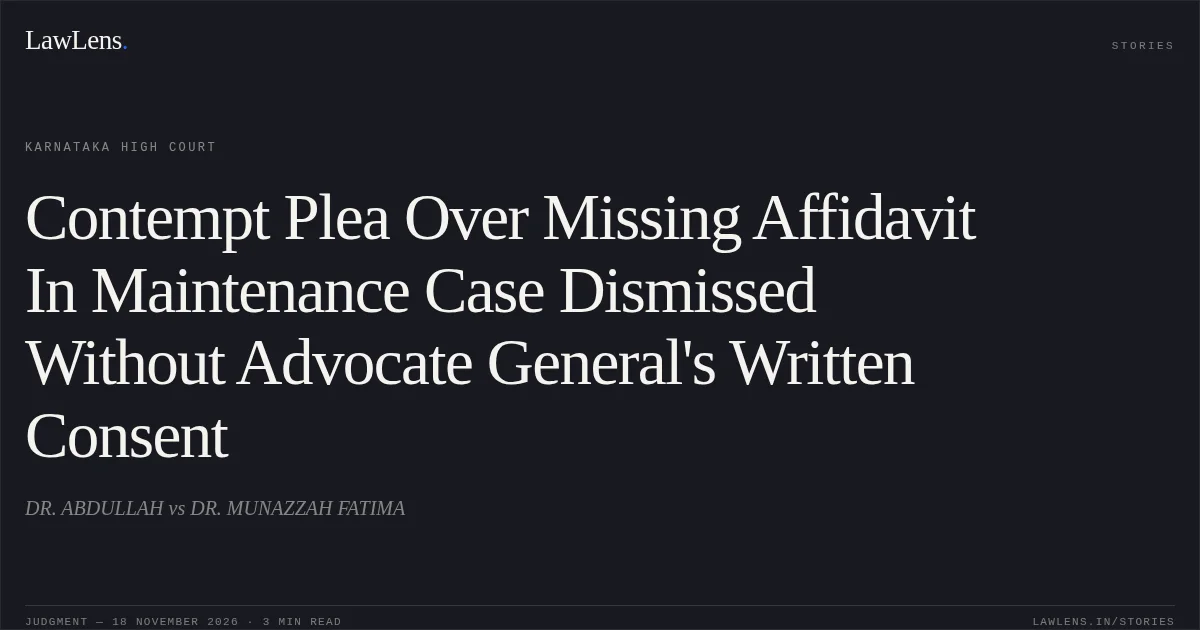
The petitioner, a doctor appearing in person, filed a criminal contempt petition under Sections 2(c), 10 and 16 of the Contempt of Courts Act, 1971 against Respondent No. 1 and the Presiding Officer of the Additional Principal Family Court, Kalaburagi (Respondent No. 2).
pp. 2–3 · ¶ 1The grievance was that the Family Court decided Crl. Misc. No. 70 of 2025, a maintenance claim, without requiring an affidavit of disclosure of assets and liabilities as mandated by Rajnesh v. Neha.
p. 3 · ¶ 2The petitioner further alleged that a non-bailable warrant was issued in Crl. Misc. No. 392 of 2025 without first exhausting lesser coercive measures.
pp. 4–5 · ¶ 3At the hearing, the petitioner appeared by video conferencing. The Court directed his physical appearance because he resides in Kalaburagi, but he persisted in appearing virtually.
p. 5 · ¶ 4The Court perused the records and heard the petitioner.
p. 6 · ¶ 602Issues
i.1. Whether a criminal contempt petition under Section 15 of the Contempt of Courts Act, 1971 is maintainable where the complainant has not obtained the prior written consent of the Advocate General.
pp. 12–13 · ¶ 10–11ii.2. Whether the Family Court Presiding Officer's failure to insist on an affidavit of disclosure of assets and liabilities, in alleged violation of Rajnesh v. Neha, constitutes criminal contempt.
pp. 5–6 · ¶ 503Law Applied
The directions in Rajnesh v. Neha (2021) 2 SCC 324 require parties to file affidavits of disclosure of assets and liabilities in maintenance proceedings, with a respondent's delay addressed through strike-off or adverse inference, and the Family Court's discretion to modify the format.
pp. 6–9 · ¶ 7 (paras. 72, 72.1–72.11)An able-bodied husband must disclose income, failing which an adverse inference may be drawn.
pp. 9–10 · ¶ 7.1 (para. 90.4)Section 114(g) of the Indian Evidence Act, 1872 permits an adverse inference where a party does not file the affidavit and the default is wilful and contumacious.
p. 10 · ¶ 8Section 15(1) of the Contempt of Courts Act, 1971 governs cognizance of criminal contempt. Under Section 15(1)(a)–(b), the High Court may act on a motion by the Advocate General, or by any other person with the Advocate General's prior written consent, and the motion must specify the contempt alleged.
pp. 11–12 · ¶ 9The written consent requirement is a mandatory prerequisite, serving as a filter against vexatious or personally motivated motions.
pp. 12–13 · ¶ 10Provisions in the judgment · 6 · Linked ones open on LawLens
Contempt of Courts Act, 1971 Section 2Section 10Section 14Section 15Section 16
Code of Criminal Procedure, 1973 Section 340
04Reasoning
The Court first recorded the petitioner's contention that the Presiding Officer's omission to insist on the affidavit violated Rajnesh and therefore amounted to contempt. It did not test that contention on the merits.
pp. 5–6 · ¶ 5Instead, the Court held that the petitioner had not obtained the Advocate General's prior written consent, which is mandatory under Section 15, and so the motion did not conform to the statute.
p. 13 · ¶ 11The Court reasoned that the consent requirement exists so that the Advocate General can screen out motions that are vexatious or driven by personal vendetta rather than public interest, and that this purpose would be defeated if the requirement were relaxed.
pp. 12–13 · ¶ 10The judgment does not examine whether the Family Court's handling of the affidavit requirement falls within the judicial discretion that Rajnesh expressly preserves (para. 72.4 and para. 8), nor whether any non-compliance was wilful, which is the threshold for contempt.
The Court also did not decide the complaint about the non-bailable warrant.
pp. 4–5 · ¶ 305Holding
The criminal contempt petition is not maintainable because it was filed without the prior written consent of the Advocate General as required by Section 15 of the Contempt of Courts Act, 1971.
p. 13 · ¶ 11The petition is dismissed on that ground alone. The Court made no finding on the merits of the alleged violation of Rajnesh v. Neha, and it issued no directions to the Family Court or the Respondents.
p. 14 · ¶ 12Original Court PDF
DR. ABDULLAHvsDR. MUNAZZAH FATIMA
Click to open original judgment
Original judgment, available to read, download and summarize on LawLens.in