01Facts
The complainant (R-2) attended three interviews with the petitioners, who are employees of Cognizant Technology Solutions India Pvt. Ltd. (Petitioner 1 as Hiring Manager; Petitioner 2 as recruiter).
¶ 3During the process they collected his personal, employment, and bank details, and he was appointed.
¶ 3He alleges that in March 2020 he was detained at an accommodation location for 14 days and that, when he called Petitioner 2 to a face-to-face meeting in the HR office, he was pushed, slapped, and physically assaulted.
¶ 3 · ¶ 11He further alleges that the petitioners forwarded his personal details to multiple vendors, that verification calls continued, and that a person was sent to his house, which amounted to trespass.
¶ 3He resigned on 14.10.2020, effective 16.10.2020, which the petitioners say was voluntary.
¶ 4 · ¶ 5The complaint was lodged on 19.11.2020, about a month later, and FIR Crime No. 164/2020 was registered at Sampigehalli Police Station for offences under Sections 323, 448, 406 and 420 IPC.
¶ 3 · ¶ 5The petitioners sought quashing under Section 482 CrPC.
¶ 5They argued that the complaint is belated, that their role was limited to recruitment within a contractual relationship, that they cannot be liable in their individual capacity, and that the dispute is civil in nature.
¶ 502Issues
i.1. Whether the petitioners have made out a case for quashing the FIR and complaint (Crime No. 164/2020) under Section 482 CrPC, given the allegations of assault, trespass, and the offences under Sections 406 and 420 IPC.
¶ 10, Point No. (1)03Law Applied
The court applied Section 482 CrPC, under which the High Court may quash proceedings, but its scope is limited to examining the contents of the complaint and FIR at the threshold.
¶ 12 · ¶ 13It relied on Sunil Bharti Mittal v. CBI (2015) 4 SCC 609, which holds that a company director may be proceeded against only where there is sufficient incriminating evidence of criminal intent or where a statute attracts vicarious liability, and that the "alter ego" principle applies.
¶ 6 · ¶ 12It relied on Prof. R.K. Vijayasarathy v. Sudha Seetharam (2019) 16 SCC 739, which holds that quashing is warranted where the absence of ingredients of an offence shows that a civil dispute is being cloaked as a criminal matter.
¶ 7 · ¶ 12It also relied on Delhi Race Club (1940) Ltd. v. State of U.P. (2024) 10 SCC 690, which distinguishes criminal breach of trust (s.406) from cheating (s.420) and holds that both cannot be invoked on the same facts without the required ingredients.
¶ 8 · ¶ 12Finally, it relied on Dineshbhai Chandubhai Patel, which holds that the court should not quash an FIR where the complaint discloses a cognizable offence.
¶ 13Provisions in the judgment · 6 · Linked ones open on LawLens
Code of Criminal Procedure, 1973 Section 482
Indian Penal Code, 1860 Section 323Section 448Section 406Section 420Section 496
04Reasoning
The court held that the complaint specifically alleges physical assault on 13.03.2020 at a stated time, and trespass at the complainant's house.
¶ 11These allegations disclose the ingredients of Sections 323 and 448 IPC, so quashing is not warranted for those offences.
¶ 11 · ¶ 13The complainant's allegations of misuse of personal data and continued verification calls, along with the claim that he was detained and forced to resign, could not be dismissed as a purely civil dispute on the face of the complaint.
¶ 11 · ¶ 12The delay of about one month was noted, but the court did not treat it as decisive.
¶ 11The vicarious liability and "alter ego" principles from Sunil Bharti Mittal could not be applied at this stage, because no material had yet been collected by the Investigating Officer and the case rests only on the complaint.
¶ 12The court also treated Vijayasarathy and Delhi Race Club as dependent on evidence, because whether the ingredients of cheating or criminal breach of trust are made out, and whether both sections can stand together, could be determined only after investigation and the filing of a final report.
¶ 12The voluntariness of the resignation and the petitioners' motive were disputed questions of fact that could only be resolved through investigation.
¶ 11 · ¶ 1405Holding
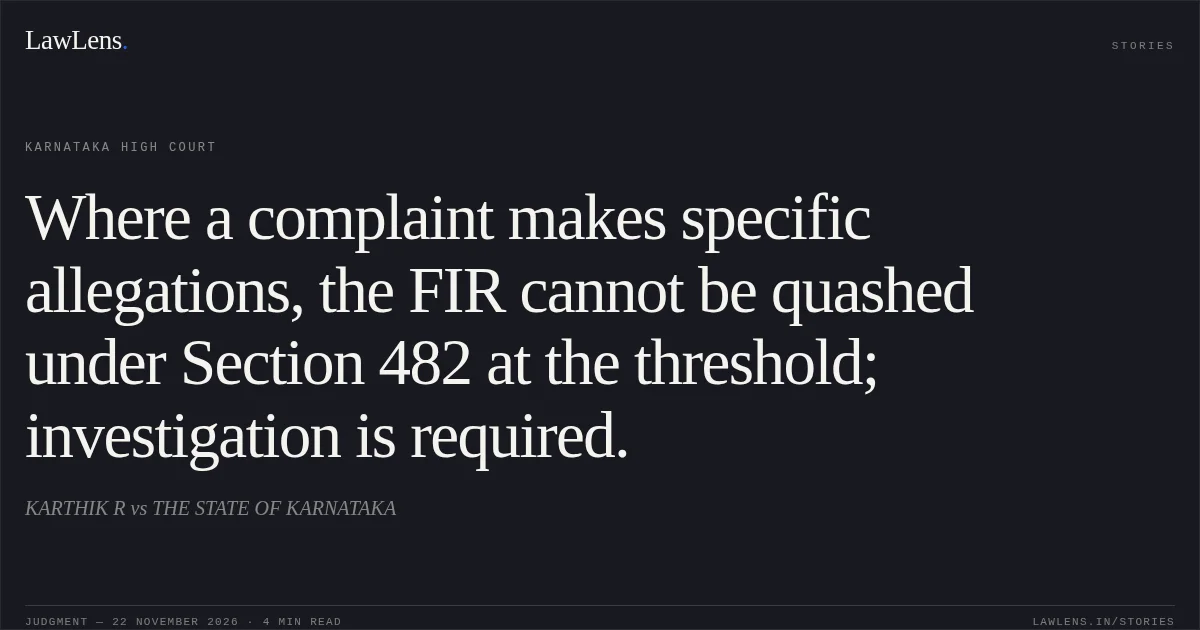
The court held that the petitioners had not made out a ground for quashing under Section 482 CrPC.
¶ 13 · ¶ 14The complaint discloses prima facie offences under Sections 323 and 448 IPC, and the offences under Sections 406 and 420 IPC require investigation before they can be assessed.
¶ 13 · ¶ 14Whether the allegations were made with an oblique motive, and whether the offences are sustainable, must be decided by the Investigating Officer and in the final report.
¶ 14Both Criminal Petitions (Crl.P Nos. 7491/2020 and 7474/2020) are dismissed, and the FIR and complaint in Crime No. 164/2020 are not quashed.
¶ 15Original Court PDF
KARTHIK RvsTHE STATE OF KARNATAKA
Click to open original judgment
Original judgment, available to read, download and summarize on LawLens.in