01Facts
The petitioners (accused Nos. 1 to 16, though the cause title lists 15 petitioners) sought quashing under s.482 CrPC / s.528 BNSS of the entire proceedings in C.C. No. 422/2024 (arising from Crime No. 54/2023, Yelburga PS, Koppal) before the Senior Civil Judge and JMFC, Yelburga, for offences under ss. 143, 147, 148, 323, 324, 354, 504, 506 and 149 IPC.
p. 3, para 2The complainant alleged that on 23.04.2023, during a Basava Jayanti fair, a dispute arose over wastage of food; the accused, allegedly as an unlawful assembly, abused and assaulted her and her son, attempted to outrage her modesty by dragging her saree, and threatened her and another woman who intervened.
p. 5, application para 2Charge-sheet was filed.
p. 5During the proceedings, both parties filed I.A. No. 1/2026 under s.320(2) CrPC / s.359 BNSS for compounding, supported by the complainant's affidavit stating that the dispute was settled through village elders, that she acted "with misconception of facts and in a fit of anger," that settlement was voluntary, and that she had no objection to quashing.
pp. 4–6, application paras 3–5 · affidavit paras 1–4 · pp. 13–14, para 6The State (HCGP) and counsel for both sides were present.
p. 4, para 402Issues
i.1. Whether the High Court can quash criminal proceedings for offences the court itself records as non-compoundable, on the basis of a settlement between the parties, under its inherent power under s.482 CrPC / s.528 BNSS, where compounding under s.320 CrPC / s.359 BNSS is not available.
p. 7, para 5 · p. 8, para 6 (Narinder Singh principles)ii.2. Whether, on the facts, the settlement justifies quashing because continuation would be an abuse of process and the chances of conviction are remote.
pp. 13–14, para 6 · p. 14, para 603Law Applied
The court relied on s.482 CrPC (s.528 BNSS), which preserves inherent power to prevent abuse of process and secure the ends of justice.
p. 7, para 5The court relied on s.320 CrPC (s.359 BNSS), which governs compounding and under which the offences here are non-compoundable.
p. 7, para 5The court applied the principles in Narinder Singh & Ors. v. State of Punjab (2014) 6 SCC 466: inherent power to quash non-compoundable offences exists but is to be exercised sparingly and with caution.
p. 8, principle I · pp. 8–12, para 6 quoting paras 31–35Under Narinder Singh, the guiding considerations are the ends of justice or prevention of abuse of process.
p. 8, principle IIUnder Narinder Singh, heinous offences of mental depravity or offences like murder and rape, and offences under special statutes or by public servants, are excluded from quashing.
p. 9, principle IIIUnder Narinder Singh, predominantly civil or family disputes may be quashed once fully resolved.
p. 9, principle IVUnder Narinder Singh, the court must assess whether conviction is remote and whether continuation would cause oppression.
pp. 9–10, principle VUnder Narinder Singh, s.307 IPC is treated as a serious offence, requiring a prima facie assessment of injuries and evidence.
pp. 10–11, principle VIUnder Narinder Singh, the stage of proceedings is relevant, with greater liberality at early stages.
p. 11, principle VIIProvisions in the judgment · 15 · Linked ones open on LawLens
Code of Criminal Procedure, 1973 Section 482Section 320
Bharatiya Nagarik Suraksha Sanhita, 2023 Section 528Section 359
Indian Penal Code, 1860 11 provisions
Section 143Section 147Section 148Section 323Section 324Section 354Section 504Section 506Section 149Section 307Section 3404Reasoning
The court treated the matter as a private dispute between neighbours that arose from a single incident at a community fair.
The court noted that the offences are non-compoundable, so it did not act under s.320, but chose to exercise inherent power.
p. 7, para 5The court found that the dispute was settled voluntarily through village elders without coercion, and that the complainant, in her sworn affidavit, admitted she had filed the complaint in a fit of anger on a misconception of facts.
pp. 6, affidavit paras 2–4 · pp. 13–14, para 6Applying Narinder Singh principle IV, the court treated the case as one of predominantly personal character, and noted that the offences are not of the kind excluded under principle III, since none is alleged to be murder, rape, or a special-statute offence.
p. 9Applying principle VII, the court noted that the charge-sheet is filed but evidence has not commenced.
p. 14, para 6The court reasoned that the complainant and the independent witnesses are unlikely to support the prosecution after the settlement, so the chance of conviction is "very remote," and that continuing the proceedings would be unnecessary.
pp. 13–14, para 6The court did not address the medical evidence or the severity of the s.354 allegation separately.
The court noted that the parties had agreed to live peacefully, which favoured accepting the compromise.
p. 13, para 605Holding
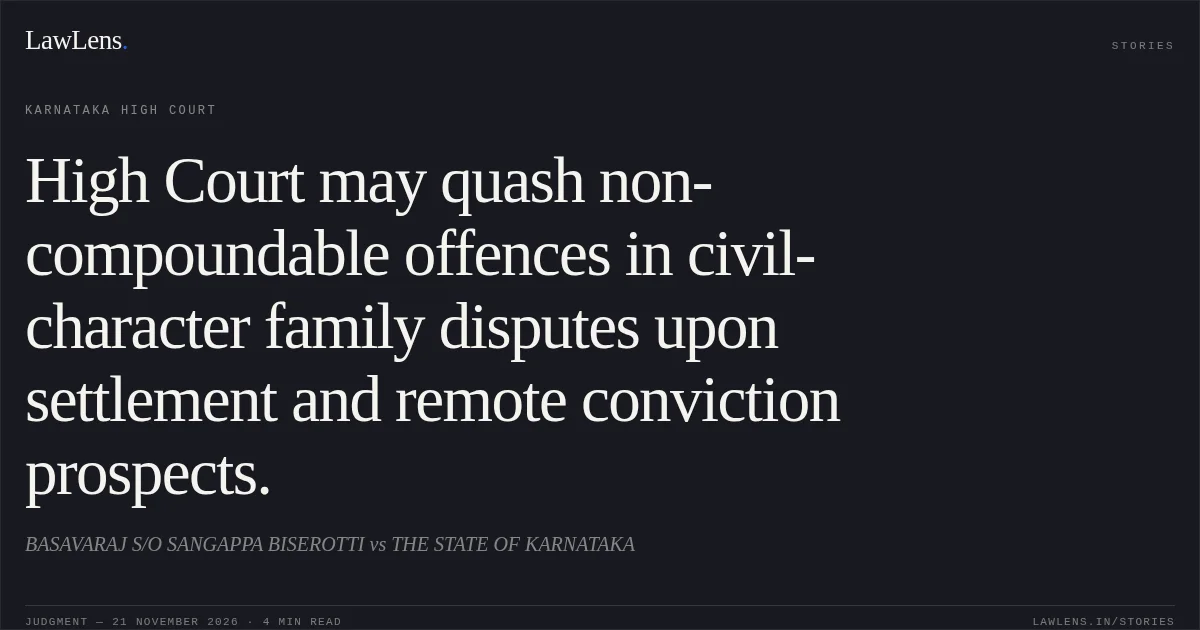
The court held that the compromise between the parties should be accepted and that continuation of the prosecution would be an abuse of process, because conviction appears remote and the dispute is essentially personal and settled.
pp. 14–15, para 6–7The court allowed the criminal petition and quashed the entire proceedings in C.C. No. 422/2024 (Crime No. 54/2023, Yelburga PS) under ss. 143, 147, 148, 323, 324, 354, 504, 506 and 149 IPC against petitioners/accused Nos. 1 to 16. I.A. No. 1/2026 was allowed accordingly, and other pending I.A.s were disposed of. The order was made under inherent power and does not record a formal compounding under s.320 CrPC / s.359 BNSS.
pp. 15–16, order · p. 16, orderOriginal Court PDF
BASAVARAJ S/O SANGAPPA BISEROTTIvsTHE STATE OF KARNATAKA
Click to open original judgment
Original judgment, available to read, download and summarize on LawLens.in