01Facts
The complainant, Ravi Kumar, filed a complaint under Section 138 of the Negotiable Instruments Act, 1881, registered as C.C. No. 10193/2009 before the XV Additional CMM, Bengaluru.
¶ 2 · pp. 2–3The accused, Smt. D. Valli, was convicted and sentenced to pay a fine of ₹2,10,000.
¶ 2 · pp. 2–3On her appeal (Crl.A. No. 705/2014), the LX Additional City Civil and Sessions Judge, Bengaluru, acquitted her on 02.01.2016.
¶ 3 · p. 3The complainant appealed to the High Court under Section 378(4) CrPC.
¶ 1 · p. 2 · ¶ 3 · p. 3The respondent was served but remained absent and unrepresented.
¶ 5 · p. 4The accused pleaded not guilty; the complainant examined himself as PW.1 and produced Exs. P1–P10.
¶ 6 · pp. 4–5The accused denied PW.1's evidence but led the evidence of DW.1 and DW.2 by way of affidavit.
¶ 6 · pp. 4–5The trial court's Section 313 CrPC statement was recorded in a typed format that the Presiding Officer had not filled in.
¶ 7 · p. 502Issues
i.1. Whether defence evidence led by way of affidavit (DW.1 and DW.2) is admissible in a Section 138 NI Act trial.
¶ 4 · p. 3 · ¶ 6 · pp. 4–5ii.2. Whether the recording of the accused's Section 313 CrPC statement in a pre-typed format, not filled in by the Presiding Officer, vitiates the trial and requires remand.
¶ 7 · pp. 5–6iii.3. Whether the trial and appellate courts erred in failing to appreciate the evidence in accordance with law, such that the acquittal warrants interference and remand.
¶ 7 · p. 603Law Applied
Section 378(4) CrPC, under which the complainant appealed the acquittal.
¶ 1 · p. 2M/s. Mandvi Co-operative Bank Ltd. v. Nimesh B. Thakore [(2010) 3 SCC 83], as followed by a Co-ordinate Bench in W.P. No. 3519/2024 (decided 19.07.2024), holding that evidence by affidavit is not permissible in such proceedings and that defence witnesses must be examined orally.
¶ 4 · p. 3 · ¶ 6 · pp. 4–5Kalicharan & Ors. v. State of Uttar Pradesh (Crl.A. No. 122 of 2021, decided 14.12.2022), holding that examination under Section 313 CrPC is not an empty formality, that the accused must be put each incriminating circumstance so that he can explain it, and that omission of this requirement prejudices the accused's defence.
¶ 7 · pp. 5–6The judgment does not identify the statutory power under which the matter was remitted.
Provisions in the judgment · 3 · Linked ones open on LawLens
Code of Criminal Procedure, 1973 Section 378Section 313
Negotiable Instruments Act, 1881 Section 138
04Reasoning
The affidavit evidence of DW.1 and DW.2 was impermissible under Mandvi Co-operative Bank and the W.P. No. 3519/2024 ruling, so the defence evidence could not stand as recorded.
¶ 6 · pp. 4–5The trial court recorded the Section 313 statement mechanically, in a typed format not completed by the Presiding Officer. Applying Kalicharan, the Court held that this procedure deprived the accused of a real opportunity to explain the incriminating circumstances, and that the defect is a procedural lapse of the kind that requires remand.
¶ 7 · pp. 5–6The appellate court did not notice these lapses and acquitted the accused mechanically. Both courts failed to appreciate the evidence in accordance with law and facts.
¶ 7 · p. 6The Court did not decide the merits of the Section 138 complaint. It remitted the matter so the defect could be cured, and set aside the acquittal rather than deciding the complaint on the existing record.
¶ 7 · p. 6 · ¶ 8(viii) · p. 805Holding
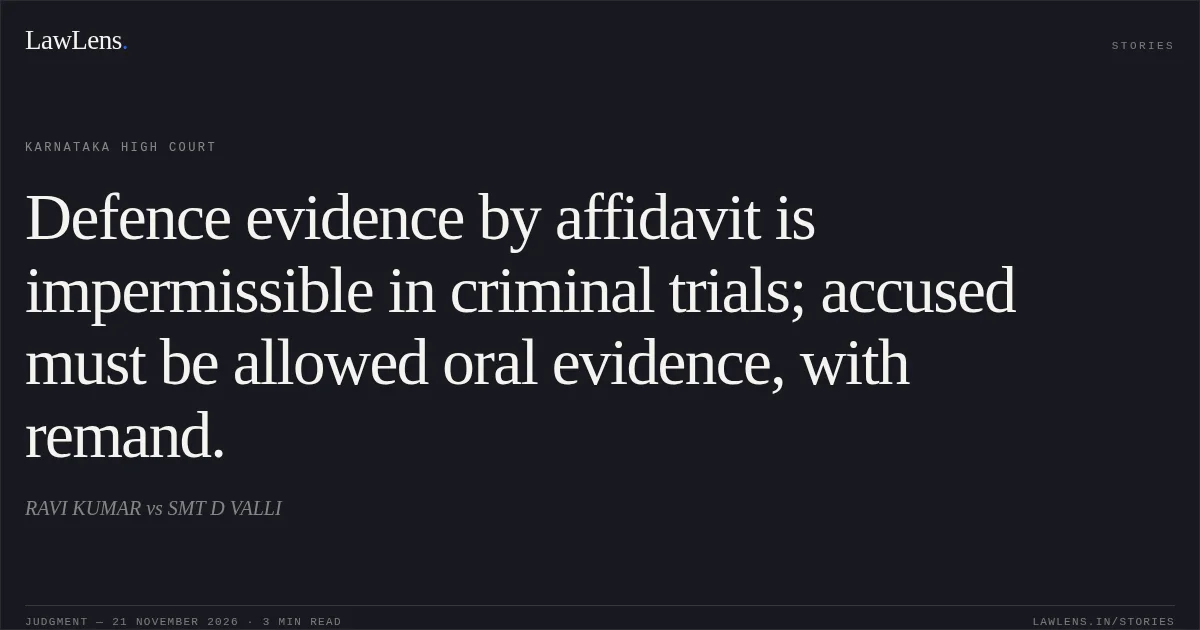
Affidavit evidence of defence witnesses is inadmissible, and a Section 313 CrPC statement recorded in a mechanically typed, unfilled format is a serious procedural defect.
¶ 6–7 · pp. 4–6The appeal is allowed. The judgment of conviction and sentence dated 26.05.2014 in C.C. No. 10193/2009 and the appellate acquittal dated 02.01.2016 in Crl.A. No. 705/2014 are set aside. The matter is remitted to the XV Addl. CMM, Bengaluru, with directions to: (a) allow the accused to adduce oral evidence instead of affidavit evidence; (b) permit the complainant to adduce additional evidence, if any; (c) record the appellant's Section 313 CrPC statement in accordance with law; (d) secure the respondent's presence and proceed in accordance with law. The appellant is to appear before the trial court on 17.12.2026 without notice. The Court expressed no opinion on the merits.
¶ 8(i)–(viii) · pp. 6–8Original Court PDF
RAVI KUMARvsSMT D VALLI
Click to open original judgment
Original judgment, available to read, download and summarize on LawLens.in