Facts
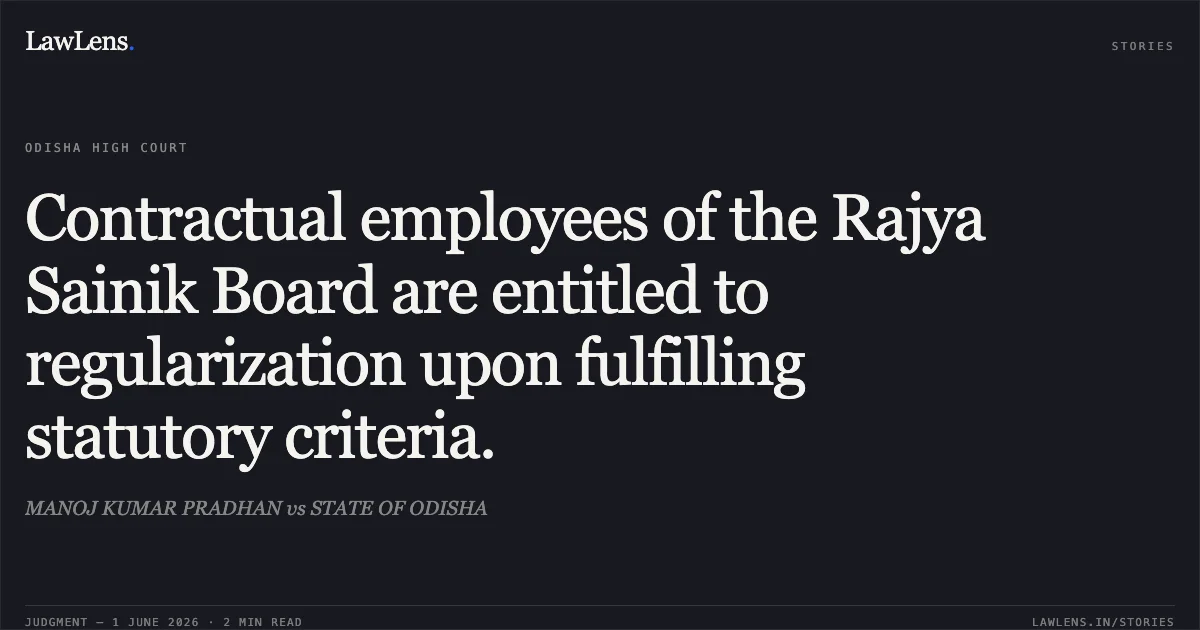
The petitioners, who are Ex-Servicemen, were appointed as Junior Clerks and Welfare Organizers in the Rajya Sainik Board (RSB) on a contractual basis in 2009 following a formal advertisement and selection process approved by the State Government
Source reference: p. 3, 6They sought regularization of their services under the G.A. Department Resolution No. 26108 dated 17th September 2013, which provides for the regularization of contractual employees after six years of continuous service
Source reference: p. 1-2Their claims were rejected by the State on 20th March 2020 on the grounds that RSB appointments were tenure-based under Ministry of Defence guidelines, lacked a formal recruitment procedure, and did not follow reservation principles
Source reference: p. 2, 4, 13The petitioners challenged this rejection, asserting that the RSB is a State Department and their appointments were made against sanctioned posts
Source reference: p. 6, 8Issues
1. Whether the petitioners, as employees of the Rajya Sainik Board, are entitled to regularization of their services in accordance with the G.A. Department Resolution dated 17th September 2013
Source reference: p. 9 / para. 11Law Applied
The court primarily relied on the G.A. Department Resolution No. 26108 dated 17th September 2013, which mandates the regularization of Group 'C' and 'D' contractual employees who have completed six years of continuous service against sanctioned posts
Source reference: p. 1-2, 11It applied the constitutional principles of equality under Articles 14 and 16
Source reference: p. 2The court further followed the precedents set in Secretary, State of Karnataka v. Uma Devi (3), State of Karnataka v. M.L. Kesari, and Amarkant Rai v. State of Bihar, which distinguish between "illegal" and "irregular" appointments, holding that irregular appointments against sanctioned posts by qualified candidates who have served for long periods should be regularized
Source reference: p. 2, 8, 9, 14Reasoning
The court found that the RSB had been recognized as a "normal Department of the State Government," meaning its employees are governed by State rules regarding recruitment and pay
Source reference: p. 9While the State argued the appointments were purely tenure-based under Central guidelines, the court noted that the Home Department had specifically granted permission to fill these sanctioned vacant posts in 2008
Source reference: p. 6, 13The court reasoned that since the petitioners were recruited through a public advertisement and selection process—not via "back-door entry"—their initial appointment was not illegal
Source reference: p. 14The court highlighted a violation of Article 14, noting that a similarly situated Group 'D' employee in the RSB had already been regularized
Source reference: p. 14Consequently, the court determined that the petitioners met the mandatory criteria of the 2013 Resolution: appointment against sanctioned posts, completion of six years of service, and a selection process that satisfied the foundational norms of public employment
Source reference: p. 13-14Holding
The court answered the issue in the affirmative, holding that the selection process was not illegal and the petitioners satisfied all criteria for regularization under the 2013 Resolution
The court set aside the impugned rejection orders dated 20th March 2020 and directed the State (Opposite Party No. 1) to regularize the services of the petitioners in terms of the Resolution dated 17th September 2013. This exercise is to be completed within eight weeks from the receipt of the judgment copy. Both writ petitions were allowed
Source reference: p. 15Acts & Sections Cited
1 provisions across 1 statute referred to in this judgment. Linked provisions open on LawLens.
the Act (alias, unresolved)1
Original Court PDF
MANOJ KUMAR PRADHANvsSTATE OF ODISHA
Click to open original judgment
Original judgment, available to read, download and summarize on LawLens.in