Facts
The petitioners were appointed as Itinerant Teachers/Resource Teachers, also described as Special Teachers, through district-level selection processes for implementing Centrally Sponsored educational schemes, including the Integrated Education for Disabled Children (IEDC) Scheme and Sarva Shiksha Abhiyan.
Source reference: paras. 8–11They possessed qualifications prescribed by the Rehabilitation Council of India and had continuously provided education, assessment, counselling, rehabilitation and monitoring services to children with special needs in Government schools for several years.
Source reference: paras. 8–11, 60Although their duties were continuing and perennial in nature, the petitioners were engaged on contractual terms and paid a consolidated honorarium rather than the regular pay scale and service benefits available to corresponding teachers.
Source reference: paras. 21–31, 60–61Relying principally on Clause 12.3 of the IEDC Scheme, which contemplated the same pay scales for Special Teachers as those available to teachers of the corresponding category in the State, they sought parity in pay and consequential service benefits.
Source reference: paras. 5, 62The respondents contended that the petitioners’ appointments were contractual, scheme-based, temporary, co-terminus with the scheme and not against sanctioned cadre posts; they also relied on the Supreme Court’s decision in Rajneesh Kumar Pandey v. Union of India and argued that subsequent appointments accepted by some petitioners rendered the writ petition infructuous.
Source reference: paras. 22–39, 41–56The Court rejected these objections and proceeded to examine whether the contractual description of the appointments could justify denial of parity.
Source reference: paras. 59–61Issues
1. Whether Special Teachers appointed under the IEDC/Centrally Sponsored Scheme were entitled to the same pay scales and consequential service benefits as teachers of the corresponding category under Clause 12.3 of the IEDC Scheme, notwithstanding the contractual description of their appointments?
Source reference: paras. 61–722. Whether continued contractual engagement, absence of a regular cadre or sanctioned posts, and acceptance of the contractual terms disentitled the petitioners from claiming parity under Articles 14 and 16 of the Constitution?
Source reference: paras. 21–39, 63–713. Whether the subsequent appointments accepted by some petitioners pursuant to the post-Rajneesh Kumar Pandey recruitment process extinguished their accrued claims or rendered the writ petition infructuous?
Source reference: paras. 41–58, 76–804. Whether the reasoning of the Gujarat High Court concerning parity for Special Teachers appointed under the same Central Scheme was applicable or persuasive in the present case?
Source reference: paras. 13–18, 73–78Law Applied
The Court applied Clause 12.3 of the IEDC Scheme, which provided that Special Teachers would receive the same pay scales as teachers of the corresponding category in the concerned State or Union Territory.
Source reference: paras. 62, 77It relied on Articles 14 and 16 of the Constitution, holding that State action must be fair, non-arbitrary and non-discriminatory, and that contractual nomenclature cannot defeat constitutional guarantees where employees perform substantially similar duties.
Source reference: paras. 64, 68–72, 81The Court also invoked the principle of “equal pay for equal work,” as embodied in Articles 14 and 39(d), while recognising that the principle depends on substantial similarity of qualifications, duties and responsibilities.
Source reference: para. 71The doctrines of legitimate expectation and promissory fairness were applied on the basis that the State adopted the Scheme, recruited the petitioners under it and continuously utilised their services while ignoring the Scheme’s pay-parity provision.
Source reference: paras. 63–67The Court treated the Gujarat High Court’s decision in Suo Motu & Others v. Chief Secretary & Others as persuasive authority because it interpreted the same Central Scheme.
Source reference: paras. 73–75It distinguished Rajneesh Kumar Pandey v. Union of India, (2021) 17 SCC 1, holding that the Supreme Court decision concerned inclusive education and appointment of qualified Special Educators and did not declare Clause 12.3 unenforceable.
Source reference: paras. 76–78The doctrines of approbate and reprobate, election and suppression of material facts, relied upon by the respondents, were not applied to defeat the petitioners’ accrued claims.
Source reference: paras. 45–49, 79–80Reasoning
The Court found that the petitioners were qualified Special Teachers selected by competent authorities and had continuously discharged specialised educational functions under the State’s administrative control.
Source reference: para. 60Since Clause 12.3 formed part of the Scheme under which they were recruited and their services were utilised, the State could not selectively accept the Scheme’s operational benefits while disregarding its pay-parity obligation.
Source reference: paras. 62–67The absence of a statutory cadre or sanctioned permanent posts did not justify discriminatory treatment in pay and service conditions, particularly because the work was continuous, indispensable and not casual or sporadic.
Source reference: paras. 68–72The Court held that the distinction between the petitioners and corresponding Special Teachers was based primarily on nomenclature and source of appointment, not on any substantial difference in qualifications, duties or responsibilities.
Source reference: paras. 70–72The Gujarat High Court’s interpretation of the same Scheme reinforced this conclusion, while Rajneesh Kumar Pandey was held not to be inconsistent because it did not decide that Clause 12.3 lacked enforceability.
Source reference: paras. 73–78Finally, later appointments accepted by some petitioners did not extinguish claims relating to parity and benefits accrued during their earlier service under the Scheme.
Source reference: paras. 79–80Holding
The writ petition was allowed.
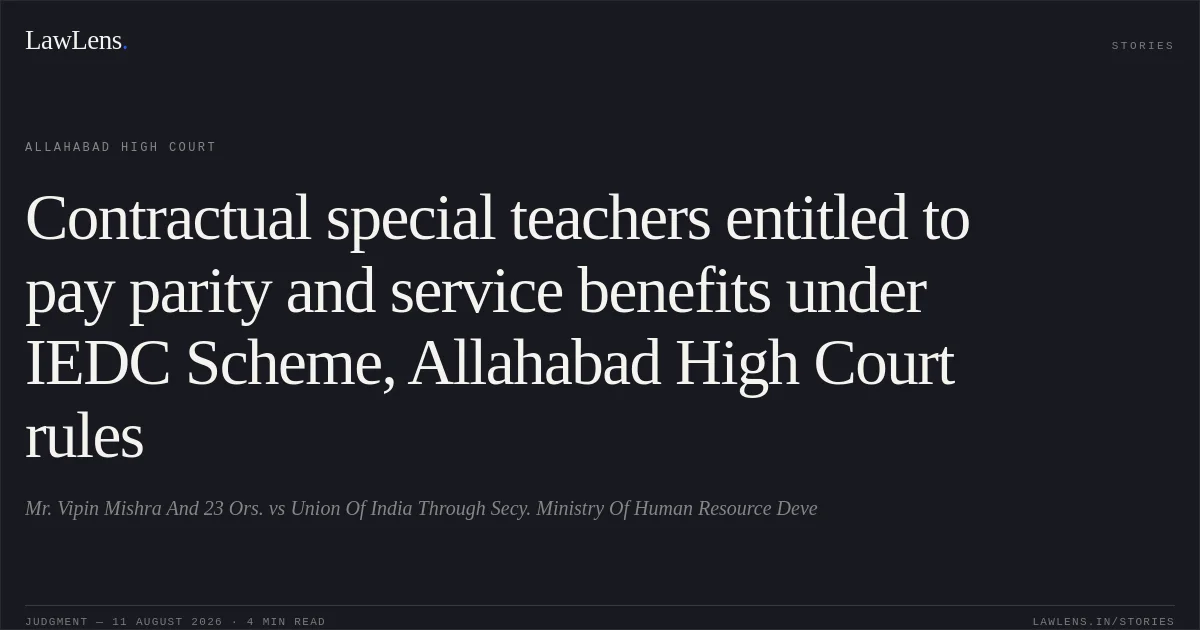
The Court held that denial of parity in pay scales and consequential service benefits to the petitioners solely because their appointments were described as contractual was arbitrary, unreasonable and violative of Articles 14 and 16 of the Constitution.
Source reference: para. 81The respondents were directed to extend to the petitioners parity in pay scales and service benefits with Special Teachers of the corresponding category under Clause 12.3 of the IEDC Scheme, including annual increments, admissible leave benefits, maternity benefits wherever applicable, continuity of service and other corresponding benefits, within four months from production of a certified copy of the judgment.
Source reference: para. 82No order as to costs was made.
Source reference: para. 83Original Court PDF
Mr. Vipin Mishra And 23 Ors.vsUnion Of India Through Secy. Ministry Of Human Resource Deve
Click to open original judgment
Original judgment, available to read, download and summarize on LawLens.in