Facts
Larsen & Toubro engaged Radhe Krishna Infrastructure under a sub-contract and work order dated 21.12.2019, followed by subsequent amendments, for infrastructure works in Rajkot.
Source reference: p. 2–7After L&T terminated the sub-contract in March 2024, the parties asserted substantial competing claims.
Source reference: p. 2–7Radhe Krishna invoked arbitration under Section 21 of the Arbitration and Conciliation Act, 1996, nominated an arbitrator, and sought appointment of L&T’s nominee under Section 11(6); L&T did not accept the proposed three-member procedure and later issued its own notice proposing a sole arbitrator under a different contractual clause.
Source reference: p. 2–7The parties agreed that arbitrable disputes existed but disagreed over the applicable arbitration clause and tribunal composition.
Source reference: p. 2–7Issues
1. Whether the Court should determine at the Section 11 stage which of the competing arbitration clauses governed the parties’ dispute
Source reference: p. 7–82. Whether a three-member tribunal should be constituted to adjudicate the parties’ claims and counterclaims
Source reference: p. 8–10Law Applied
Under Section 11 of the Arbitration and Conciliation Act, 1996, the Court’s inquiry is primarily directed to the prima facie existence and validity of an arbitration agreement.
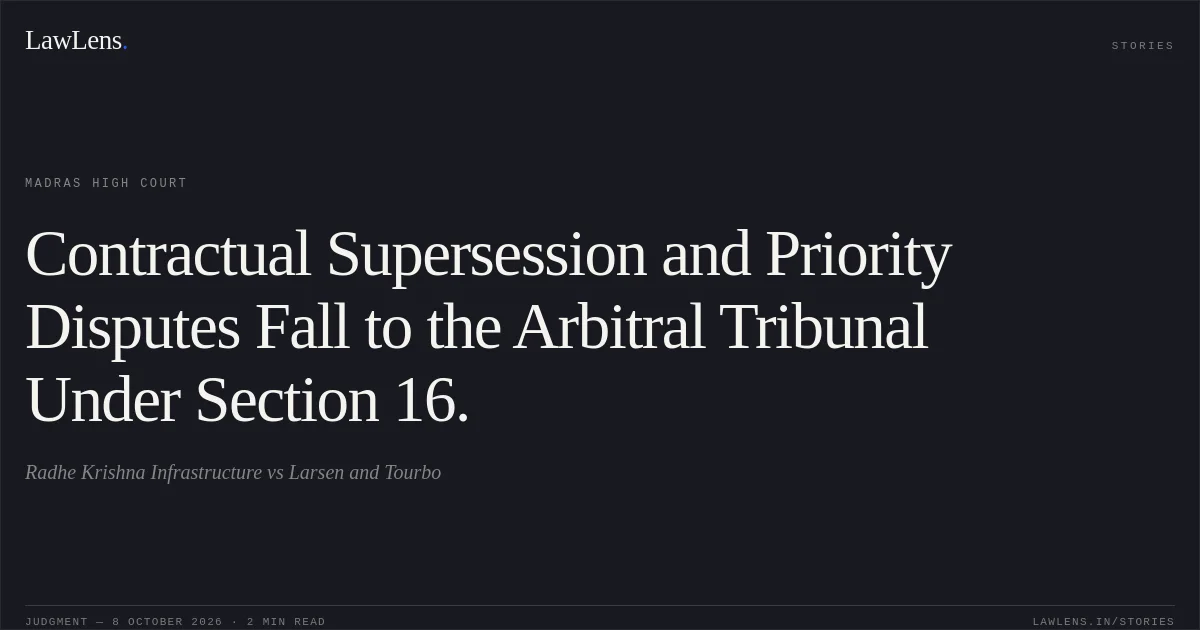
Source reference: p. 8Detailed questions about contractual supersession or the priority of interrelated contractual documents fall within the arbitral tribunal’s jurisdiction under Section 16.
Source reference: p. 8Section 12 requires arbitrators to provide disclosure declarations before entering upon the reference.
Source reference: p. 9–10No judicial precedents were cited
Source reference: p. 8; pp. 9–10Reasoning
The Court noted that the existence of arbitrable commercial disputes was undisputed, while the parties contested whether Clause 41 of the original agreement or Clause 17.3 of the amended work order governed the tribunal’s composition.
Source reference: p. 7–9Applying the limited Section 11 inquiry, it left the question of contractual priority to the tribunal under Section 16.
Source reference: p. 7–9Given the substantial claims and counterclaims, the Court constituted a three-member tribunal, comprising the arbitrators selected or proposed by the parties and a former Supreme Court Judge as Presiding Arbitrator.
Source reference: p. 7–9Holding
The Court allowed the petition and constituted a three-member arbitral tribunal to determine all arbitrable disputes, claims, and counterclaims arising from the agreement, work order, and amendments.
It appointed Justice R. Banumathi as Presiding Arbitrator, with Justice M.G. Gaikwad as the petitioner’s nominee and M. Aravind Subramaniam as the respondent’s nominee.
Source reference: p. 9–11The seat and venue were fixed at Chennai; the arbitration was directed to proceed under the aegis of the Madras High Court Arbitration Centre.
Source reference: p. 9–11The arbitrators were directed to file Section 12 disclosures, and all merits contentions were left open.
Source reference: p. 9–11Acts & Sections Cited
4 provisions across 1 statute referred to in this judgment. Each provision opens on LawLens.
Arbitration and Conciliation Act, 19964
Original Court PDF
Radhe Krishna InfrastructurevsLarsen and Tourbo
Click to open original judgment
Original judgment, available to read, download and summarize on LawLens.in