Facts
The respondent appointed the petitioner as a Piece Rate Worker for HVAC expansion works at the Taj-Bengaluru Airport Hotel Project under a Work Order dated 9 November 2021, subsequently amended on 25 April 2022.
Source reference: p.3, para. 2Disputes arose regarding unpaid bills, following which the respondent terminated the arrangement on 8 December 2022.
Source reference: p.3, para. 2The petitioner approached the Micro and Small Enterprises Facilitation Council, Konkan at Thane, under Section 18 of the Micro, Small and Medium Enterprises Development Act, 2006 (“MSME Act”).
Source reference: p.3–4, para. 3The MSEFC passed an award directing the respondent to pay Rs.1,83,24,524/- with statutory interest.
Source reference: p.3–4, para. 3After the respondent failed to satisfy the award, the petitioner initiated execution proceedings before the Commercial Court at Bengaluru.
Source reference: p.4, para. 4The respondent filed an application under Section 34 of the Arbitration and Conciliation Act, 1996 (“Arbitration Act”) before the same court to set aside the award.
Source reference: p.4, para. 4The petitioner objected that the Section 34 application was not maintainable at Bengaluru because the award had been passed by the MSEFC at Thane.
Source reference: p.4–5, para. 5The Commercial Court rejected the objection, leading to the present writ petition.
Source reference: p.4–5, para. 5Issues
Whether an application under Section 34 of the Arbitration Act challenging an award passed under Section 18 of the MSME Act was maintainable before the Commercial Court at Bengaluru, despite the award having been passed by the MSEFC at Thane
Source reference: p.9, para. 10Whether the exclusive jurisdiction clause in the Work Order designating the courts at Bengaluru governed the territorial jurisdiction and seat of arbitration for purposes of a Section 34 challenge
Source reference: p.9–12, paras. 10, 14–15Law Applied
Section 18(3) of the MSME Act provides that, when conciliation fails, the Facilitation Council may itself arbitrate or refer the dispute for arbitration, and the Arbitration Act applies as if the arbitration arose from an arbitration agreement under Section 7.
Source reference: p.9–10, para. 11Section 18(4) confers jurisdiction on the MSEFC where the supplier is located, but the Council’s statutory jurisdiction does not necessarily determine the juridical seat for post-award proceedings.
Source reference: p.10, para. 11A challenge to an MSEFC award is maintainable under Section 34 of the Arbitration Act, and the competent “Court” under Section 2(1)(e)(i) is ordinarily determined by the seat of arbitration.
Source reference: p.13, para. 13; p.15–16, paras. 17–18The court relied on J&K Economic Reconstruction Agency v. Rash Builders India (P) Ltd., 2026 SCC OnLine SC 596, for the principles that the seat is the legal centre of arbitration, courts at the seat have supervisory jurisdiction, and the venue of hearings or delivery of the award does not by itself determine the seat.
Source reference: p.12–14, para. 15An express exclusive jurisdiction clause, supported by a territorial nexus to the dispute, is binding and may establish the juridical forum for arbitration-related proceedings.
Source reference: p.14–15, para. 16Reasoning
The Court held that the MSEFC’s proceedings at Thane constituted the statutory forum or venue through which the dispute was processed under Section 18 of the MSME Act; they did not, by themselves, displace the parties’ contractual allocation of jurisdiction.
Source reference: p.10–12, paras. 12, 14Clause E of the Work Order expressly stipulated that the courts at Bengaluru alone would have exclusive jurisdiction over disputes arising from the contract.
Source reference: p.5–6, para. 7; p.10–12, para. 12The underlying work, project, and respondent’s location were also connected with Bengaluru.
Source reference: p.5–6, para. 7; p.10–12, para. 12Since Section 18(3) incorporates the Arbitration Act once the Council proceeds to arbitration, the post-award challenge was governed by Section 34 and the jurisdictional principles applicable to the agreed seat.
Source reference: p.15–16, paras. 17–18Accordingly, Bengaluru was treated as the juridical seat and the Commercial Court at Bengaluru was competent to entertain the respondent’s Section 34 application.
Source reference: p.15–16, paras. 17–18However, the Commercial Court’s observations that the MSEFC at Thane lacked jurisdiction and that the petitioner’s filing of execution proceedings at Bengaluru amounted to an admission of jurisdiction were held to be unwarranted.
Source reference: p.16, para. 20Holding
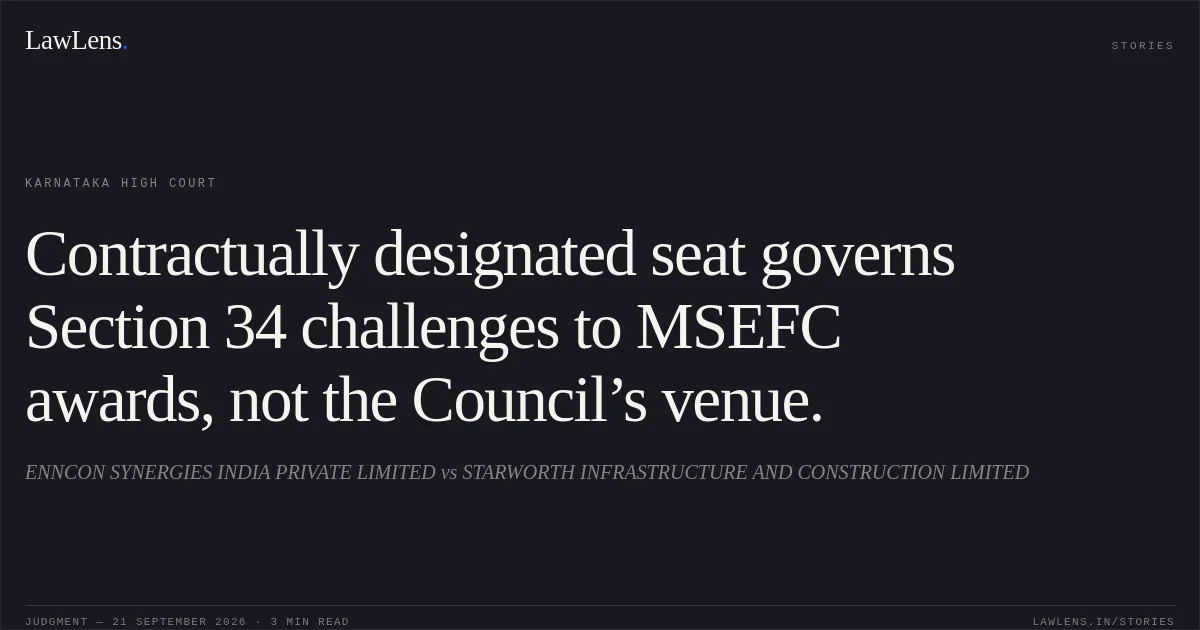
The High Court held that the Section 34 application filed by the respondent before the Commercial Court at Bengaluru was maintainable because the exclusive jurisdiction clause in the Work Order established Bengaluru as the seat and forum for arbitration-related proceedings.
The writ petition was therefore allowed in part.
Source reference: p.16–17, paras. 20–22The Court set aside only the observations contained in paragraph 8 of the Commercial Court’s order concerning the alleged lack of jurisdiction of the MSEFC at Thane and the effect of the petitioner’s execution proceedings at Bengaluru; the remainder of the Commercial Court’s order was left undisturbed.
Source reference: p.16–17, paras. 20–22Acts & Sections Cited
24 provisions across 3 statutes referred to in this judgment. Each provision opens on LawLens.
Arbitration and Conciliation Act, 1996
Micro, Small and Medium Enterprises Development Act, 20063
Commercial Courts Act, 20151
Original Court PDF
ENNCON SYNERGIES INDIA PRIVATE LIMITEDvsSTARWORTH INFRASTRUCTURE AND CONSTRUCTION LIMITED
Click to open original judgment
Original judgment, available to read, download and summarize on LawLens.in