01Facts
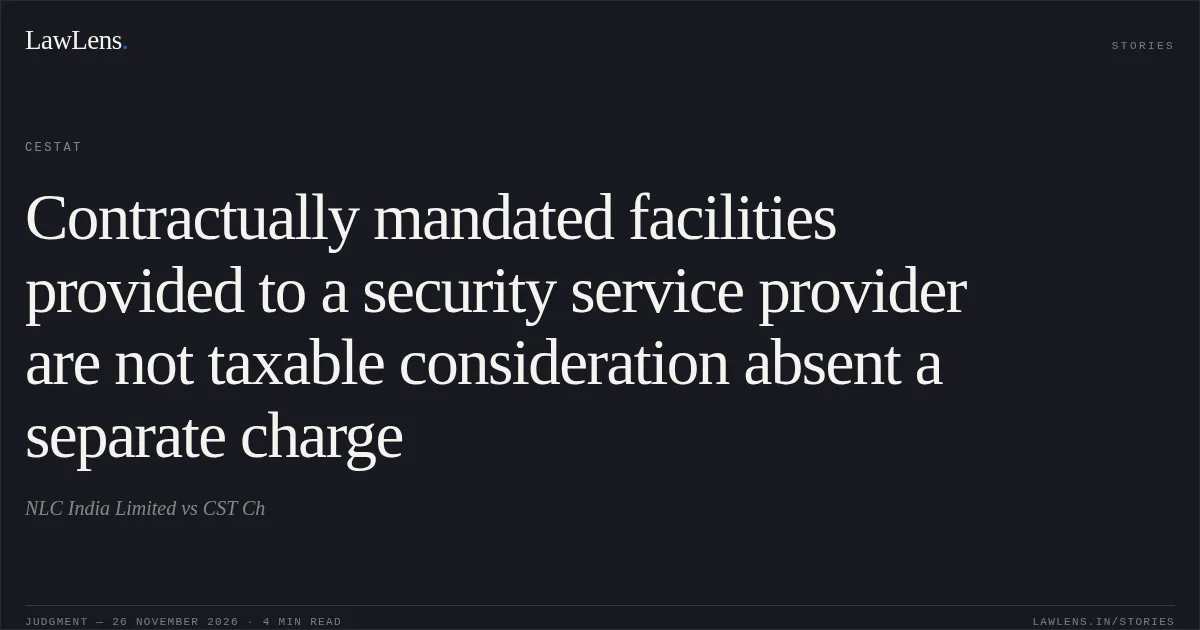
The Appellant, Neyveli Lignite Corporation (NLC), a Navratna Government of India Enterprise, engaged the Central Industrial Security Force (CISF), DIG Unit, for security services under a Memorandum of Understanding dated 27.10.2011.
p. 2 · ¶ 5Service tax on CISF's deployment invoices was paid up to August 2012. From 01.07.2012, the Negative List regime shifted liability to the Appellant as recipient under reverse charge.
p. 2During a CISF audit, the Department found that the Appellant had also provided rent-free accommodation and office premises, electricity, water, vehicles, fuel, medical facilities, forms and stationery, over and above invoiced amounts, and treated their value as taxable.
p. 2Show Cause Notices dated 04.09.2014 (Neyveli) and 01.10.2014 (Barsingsar) covered July 2012 to March 2014.
p. 3The Adjudicating Authority confirmed demands of ₹44,93,376 and ₹6,40,719 with interest and penalties under Sections 75 and 76.
p. 3The Commissioner (Appeals) upheld the demands except for vehicles, which was remanded for verification of documents.
p. 3The Appellant's synopsis states a demand of ₹31,53,820, which the Tribunal noted as inconsistent with the impugned order.
¶ 5The Appellant contended the facilities were contractual obligations, not consideration. The Revenue contended they were consideration in kind, includible under Section 67 read with Rule 3 of the Valuation Rules, 2006.
pp. 4–1002Issues
i.1. Whether the monetary value of facilities provided by the Appellant to CISF (rent-free accommodation, electricity, water, office facilities, medical facilities, vehicles, fuel, forms and stationery) is includible in the taxable value of security services under Section 67 of the Finance Act, 1994, read with Rule 3 of the Valuation Rules, 2006.
p. 11 · ¶ 4(i)ii.2. Whether the extended period of limitation under Section 73(1) of the Finance Act, 1994 has been correctly invoked.
p. 11 · ¶ 4(ii) · ¶ 23iii.3. Whether the Appellant is liable to pay interest and penalty under Sections 75 and 76 of the Finance Act, 1994.
p. 11 · ¶ 4(iii) · ¶ 2303Law Applied
The Tribunal relied on Section 67 of the Finance Act, 1994, which bases service tax on the gross amount charged for taxable services, with Explanation (a) giving "consideration" an inclusive meaning.
¶ 7Rule 3 of the Valuation Rules, 2006 governs the monetary valuation of non-monetary consideration, but presupposes that the item in question is consideration for the service.
¶ 7, 12Under CCE v. Bhayana Builders (P) Ltd. (SC, 2018), the taxable value must have a direct nexus with consideration; notional values of materials or facilities supplied free by the recipient cannot be added to the "gross amount charged".
¶ 9–10Under Union of India v. Intercontinental Consultants and Technocrats Pvt. Ltd. (SC, 2018), non-consideration amounts cannot be included in taxable value through valuation rules.
¶ 11The Tribunal also applied CST v. Repco Home Finance Ltd. (Tri. LB, 2020) and the line of Tribunal decisions holding that such facilities are contractual amenities, not consideration.
¶ 16–17These include Bharat Coking Coal Ltd. (2021), CCE Dehradun v. Commandant, CISF (2019), and Deputy Commissioner of GST, Salem v. The Commandant (2025).
¶ 16–17Under Section 73(1) and Section 75, the extended period, interest, and Section 76 penalties depend on a sustainable demand and on proof of suppression or intent to evade.
¶ 23Provisions in the judgment · 4 · Linked ones open on LawLens
Central Industrial Security Force Act, 1968 Section 14Section 3
General Clauses Act, 1897 Section 3
Indian Contract Act, 1872 Section 2
04Reasoning
The Tribunal first noted that the Appellant's liability under reverse charge and the taxability of the deployment charges were undisputed, so the sole question was the taxable value.
¶ 6The MoU separated two obligations: Clause 23 governed deployment costs, on which service tax was paid, while Clauses 3, 7 and 20 governed infrastructure and amenities needed for CISF to perform its functions.
¶ 13–14Applying Bhayana Builders and Intercontinental Consultants, the Tribunal held that a contractual obligation to provide facilities does not by itself make their monetary equivalent consideration for the service.
¶ 8, 18The Revenue did not show that CISF separately charged for these facilities or that they were an agreed additional payment, and the mere stipulation in the MoU was not determinative.
¶ 19Because the service tax on the Clause 23 amounts was not disputed, Rule 3 could not be used to add notional values to the taxable value.
¶ 20On vehicles, the Tribunal held that notional value alone could not sustain a demand.
¶ 22Since the demand failed on merits, the limitation issue, the interest under Section 75, and the penalty under Section 76 did not survive.
¶ 2305Holding
The Tribunal answered the first issue in the negative: the value of rent-free accommodation, electricity, water, office facilities, medical facilities, fuel, forms and stationery is not includible in the taxable value of security services, and the value of vehicles cannot be included on a notional basis.
¶ 21–22Because the demand fails on merits, the extended-period question (Issue 2), interest under Section 75, and penalties under Section 76 (Issue 3) were held not to survive.
¶ 23The impugned order is set aside, and the Appellant is entitled to consequential relief, if any, as per law.
¶ 24Original Court PDF
NLC India LimitedvsCST Ch
Click to open original judgment
Original judgment, available to read, download and summarize on LawLens.in