01Facts
The appellant, a religious and charitable institution constituted under the Andhra Pradesh Charitable and Hindu Religious Institutions and Endowments Act, 1987, manages the Sri Venkateswara temple and associated institutions.
¶ 3It provides accommodation to pilgrims at Tirumala and Tirupati for a charge.
¶ 3A show cause notice dated 11.02.2015 demanded service tax of Rs. 2,25,81,935 on gross receipts of Rs. 30,45,02,900 for April 2013 to March 2014.
¶ 4The Adjudicating Authority treated the activity as taxable short-term accommodation and confirmed the demand with interest under Section 75 and penalties under Sections 76 and 77 of the Finance Act, 1994.
¶ 1, 4The appellant contended that the accommodation falls under Serial No. 5(a) of Notification No. 25/2012-ST, relying on CBEC Circular No. 200/10/2016-ST and Supreme Court decisions, and alternatively claimed cum-tax benefit under Section 67(2).
¶ 5–8The Revenue relied on the Andhra Pradesh High Court's decision in the appellant's earlier case, reported at 2013 (30) STR 27 (AP), and on Commissioner of Customs (Import), Mumbai v. Dilip Kumar & Co. [2018 (361) ELT 577 (SC)] for strict construction of exemptions.
¶ 9–11The Supreme Court, by order dated 14.02.2014 in W.P.(C) No. 74/2014, directed that no coercive recovery steps be taken.
¶ 2302Issues
i.1. Whether the accommodation provided by the appellant in its guest houses, choultries and rest houses constitutes "renting of precincts of a religious place meant for general public" eligible for exemption under Serial No. 5(a) of Notification No. 25/2012-ST.
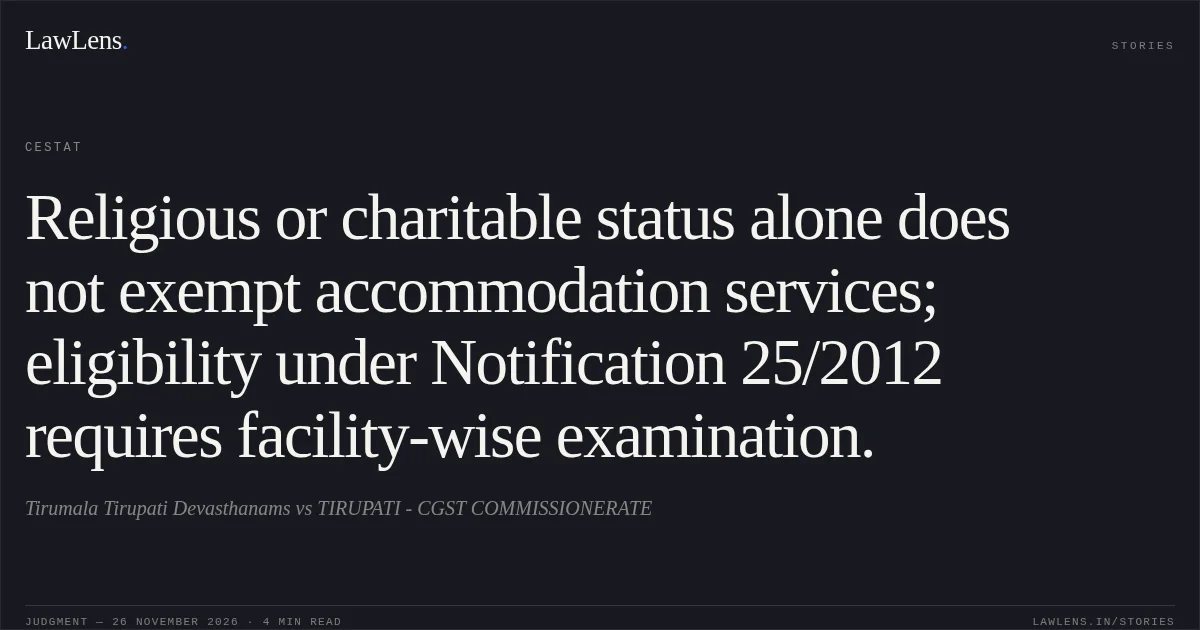
¶ 2, 13, 15ii.2. Whether the appellant's religious and charitable status exempts all its services from service tax, including under Section 93 of the Finance Act, 1994.
¶ 24iii.3. Whether accommodation with a declared tariff below Rs. 1,000 per day is independently exempt, and whether the cum-tax benefit under Section 67(2) applies.
¶ 20, 21iv.4. Whether the demand of service tax, interest and penalties is legally sustainable, including the applicability of Section 80 of the Finance Act, 1994.
¶ 13, 2203Law Applied
Serial No. 5(a) of Notification No. 25/2012-ST exempts renting of precincts of a religious place meant for the general public.
¶ 15CBEC Circular No. 200/10/2016-ST directs that "precincts" not be read restrictively and may include immovable property within the religious complex and property in its immediate vicinity owned by or under the same management as the religious place.
¶ 16The Notification contains a separate entry for accommodation with declared tariff below Rs. 1,000 per day.
¶ 20Under Dilip Kumar (Constitution Bench), exemption notifications are strictly construed and the burden of proving eligibility lies on the assessee, though strict construction does not justify ignoring ordinary meaning or Board clarifications.
¶ 11, 17Section 93(1) and (2) of the Finance Act, 1994 empower the Government to grant exemptions generally or by special order; a religious or charitable character alone does not confer exemption.
¶ 24Section 67(2) governs valuation where service tax is not separately charged, and Section 80 governs the reasonable-cause defence to penalties.
¶ 21, 22Municipal Council, Tirupati v. Tirumala Tirupati Devastanams, AIR 1974 SC 521, establishes the charitable character of choultry activities but does not decide exemption eligibility under the Notification.
¶ 18The High Court's 2013 decision concerned a registration direction issued in May 2011 and does not dispose of eligibility for April 2013–March 2014.
¶ 18Provisions in the judgment · 6
Finance Act, 1994 Section 75Section 76Section 77Section 67Section 80Section 93
04Reasoning
The Tribunal accepted that the appellant's religious and charitable character is not seriously disputed, but held that this status does not by itself exempt every service.
¶ 14It rejected the argument that the State Act confers blanket exemption, because the appellant produced no special order under Section 93(2).
¶ 24It found the High Court's earlier ruling not determinative of the disputed period, since the Notification was then in force and required independent examination.
¶ 18The demand was computed on aggregate receipts from several guest houses (Madhavam, Srinivasam, Shri Padmavathi and Vishnu Nivasam) without any record showing that each unit's location and eligibility under Serial No. 5(a) was examined.
¶ 19Blanket exemption on the basis of status and outright denial without examining location and nature were both found legally inappropriate.
¶ 19Units independently eligible under the Rs. 1,000 tariff entry cannot be taxed merely because the appellant also runs higher-tariff units.
¶ 20The cum-tax claim and penalty liability, including the Section 80 defence and the appellant's bona fide contest in constitutional courts, also required fresh examination.
¶ 21–22Because verification of property location, relation to religious precincts, tariffs and receipts is factual, the Tribunal held that remand, rather than adjudication on the record, was appropriate.
¶ 2505Holding
The impugned order, which confirmed the entire demand without examining eligibility of individual accommodation units, cannot be sustained in its present form.
¶ 25The religious status of the appellant does not confer blanket exemption, and the Section 93(2) argument was rejected.
¶ 24The appeal is allowed by way of remand. The Adjudicating Authority is directed to: (i) examine each accommodation unit's eligibility under Serial No. 5(a) of Notification No. 25/2012-ST in light of CBEC Circular No. 200/10/2016-ST; (ii) examine the Rs. 1,000-per-day tariff exemption; (iii) determine taxable value after considering the cum-tax claim under Section 67(2); (iv) reconsider interest and penalties, including Section 80; and (v) afford a personal hearing and pass a reasoned order, subject to any subsisting Supreme Court directions.
¶ 26, 27, 28Original Court PDF
Tirumala Tirupati DevasthanamsvsTIRUPATI - CGST COMMISSIONERATE
Click to open original judgment
Original judgment, available to read, download and summarize on LawLens.in