Facts
The deceased, Rupalben, married Accused No. 1 (Arvindbhai) in a second marriage that lasted twelve years
Source reference: p. 7On March 6, 2010, Rupalben committed suicide by self-immolation after pouring kerosene on herself and her two minor children, all of whom succumbed to their injuries
Source reference: p. 7The prosecution alleged that the respondents (husband, in-laws) subjected the deceased to mental harassment and dowry demands, specifically regarding a residential house
Source reference: p. 2The trial Court acquitted the respondents on May 19, 2012
Source reference: p. 1The state appealed, primarily contesting the trial Court's dismissal of the dying declarations
Source reference: p. 3Issues
1. Whether the trial Court was justified in passing a judgment of acquittal based on the appreciation of evidence
Source reference: p. 6, para. 112. Whether the dying declarations were reliable and trustworthy given the inconsistencies and external influence
Source reference: p. 9-11, para. 12.2-12.33. Whether the ingredients of abetment of suicide under Section 306 and cruelty under Section 498A IPC were proved beyond reasonable doubt
Source reference: p. 15, para. 18-19Law Applied
The Court applied Sections 498A, 306, and 114 of the Indian Penal Code (IPC)
Source reference: p. 1Regarding evidentiary value, the Court relied on Sections 113A and 113B of the Indian Evidence Act, 1872, concerning presumptions of abetment of suicide and dowry death
Source reference: p. 5-6, para. 10The Court applied the principle from Laxman v. State of Maharashtra (2002) regarding the authenticity of dying declarations
Source reference: p. 8, para. 12.1The Court applied the principle from Chandrappa v. State of Karnataka (2007) regarding the "double presumption of innocence" in appeals against acquittal
Source reference: p. 13, para. 16Reasoning
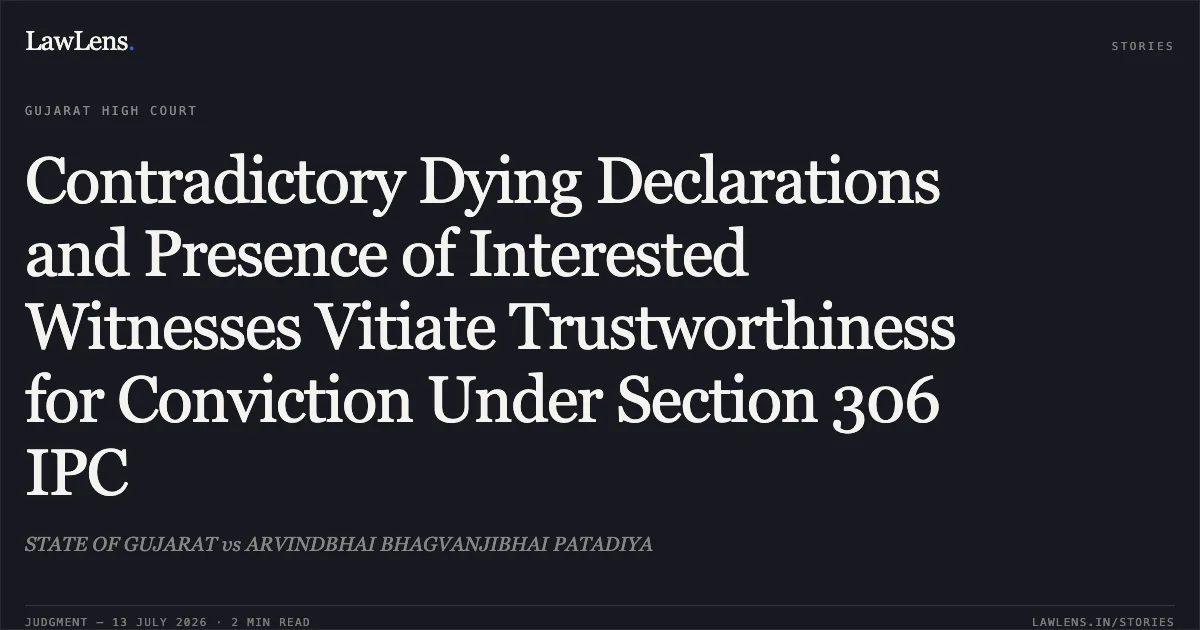
The Court found the prosecution's case weakened by contradictory dying declarations. While the FIR alleged the in-laws attempted to burn the deceased, her statement to the medical officer (PW-18) indicated self-immolation without naming any assailants
Source reference: p. 8, para. 12; p. 11, para. 12.3The allegation of harassment for a residential house was invalidated by testimony that the couple had lived separately for years and the deceased’s parents had attended their housewarming ceremony
Source reference: p. 8-9, para. 12.1Furthermore, PW-12 admitted that the parents were present when the dying declaration was recorded by the Executive Magistrate, creating a "cloud of doubt" regarding potential coaching
Source reference: p. 10, para. 12.2The court noted that no independent witnesses supported the allegations, and earlier "letters" from the deceased surfaced only during the trial, lacking prior disclosure to investigating officers
Source reference: p. 10, para. 12.2Holding
The prosecution miserably failed to prove the charges beyond reasonable doubt
The High Court dismissed the appeal and confirmed the trial Court's acquittal. All bail bonds were cancelled
Source reference: p. 16, para. 20The Court ruled that where two reasonable conclusions are possible, the appellate court should not disturb an acquittal, especially when the trial court's findings are not perverse or manifests an illegality
Source reference: p. 12-14, paras. 15-17Acts & Sections Cited
4 provisions across 2 statutes referred to in this judgment. Each provision opens on LawLens.
Code of Criminal Procedure, 19732
Indian Penal Code, 18602
Original Court PDF
STATE OF GUJARATvsARVINDBHAI BHAGVANJIBHAI PATADIYA
Click to open original judgment
Original judgment, available to read, download and summarize on LawLens.in