Facts
On 1 March 2004, at approximately 7:30 p.m., the claimant was returning after selling groundnuts while riding motorcycle No. GJ-11-J-8782. Near Bamangadh Village Chowkdi on the Junagadh–Bhesan Road, an Ambassador car bearing No. GJ-G-8051 allegedly came from behind at a high speed and in a rash and negligent manner, colliding with the motorcycle. The claimant fell and sustained serious injuries. An FIR was registered against the car driver.
Source reference: p.1; para. 2The claimant, aged approximately 45 years and earning Rs.4,000 per month from labour work and selling groundnuts, filed a claim petition under Section 166 of the Motor Vehicles Act, 1988, seeking compensation of Rs.2,70,000.
Source reference: p.2; paras. 2.1–2.2The driver and owner did not file a written statement or contest the proceedings. The Insurance Company filed its written statement and denied liability.
Source reference: p.2; para. 2.3The Motor Accident Claims Tribunal assessed total compensation at Rs.99,960, attributed 30% contributory negligence to the claimant and 70% negligence to the car driver, and awarded Rs.69,972 with interest at 9% per annum.
Source reference: p.2; para. 2.4The claimant preferred the present appeal under Section 173 of the Motor Vehicles Act, limited to the finding of contributory negligence.
Source reference: p.1; para. 1; p.2, para. 2.5Issues
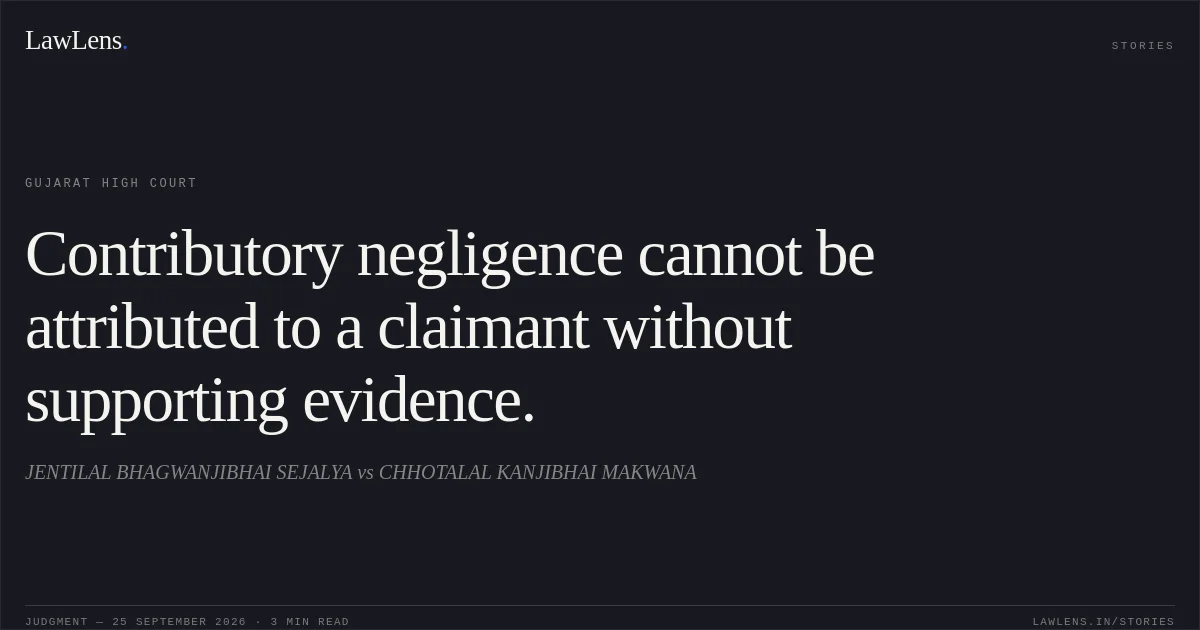
1. Whether the Tribunal was justified in attributing 30% contributory negligence to the claimant in the absence of evidence establishing negligence on his part?
Source reference: p.1, para. 1; p.3, paras. 4–52. Whether an adverse inference ought to have been drawn against the driver of the offending vehicle for failing to enter the witness box and substantiate the defence?
Source reference: p.3, paras. 4–5Law Applied
The Court applied Section 173 of the Motor Vehicles Act, 1988, governing appeals against awards of the Motor Accident Claims Tribunal, and the principles relating to contributory negligence, under which a deduction can be made only when the claimant’s negligent conduct is supported by evidence.
Source reference: p.3, para. 6The Court further relied on the evidentiary principle permitting an adverse inference against a party who, despite being in a position to provide material evidence, fails to enter the witness box.
Source reference: p.3, para. 6In support, it relied on Oriental Insurance Company Limited v. Kalu Ram, 2026 INSC 653, where the Supreme Court held that failure of the driver and owner to testify in support of their defence justified an adverse inference against them.
Source reference: p.3, para. 6Reasoning
The claimant was an eyewitness to the accident and his deposition did not disclose any conduct amounting to contributory negligence. The FIR and police papers were registered against the driver of the Ambassador car, while the driver and owner, though served, neither contested the claim nor entered the witness box.
Source reference: p.3, paras. 4–5Although the Insurance Company had obtained permission under Section 170 of the Motor Vehicles Act to contest the claim on all available grounds, it led no evidence to rebut the claimant’s version or establish negligence on his part.
Source reference: p.3–4, paras. 5–7Applying the principle in Kalu Ram, the Court held that an adverse inference ought to have been drawn against the offending vehicle’s driver.
Source reference: p.3–4, paras. 5–7Accordingly, the Tribunal’s attribution of 30% negligence to the claimant was unsupported by evidence and legally erroneous.
Source reference: p.3–4, paras. 5–7Holding
The Court answered the issues in favour of the claimant and set aside the Tribunal’s finding attributing 30% contributory negligence to him.
The appeal was allowed to that extent.
Source reference: p.4, paras. 8.1–8.6The Insurance Company was directed to deposit the enhanced amount, representing the amount deducted towards contributory negligence, with interest at 9% per annum from the date of the claim petition until realization, within eight weeks.
Source reference: p.4, paras. 8.1–8.6The remaining directions of the Tribunal were confirmed, and the Tribunal was directed to disburse the entire amount lying with it, including accrued interest, to the claimant after due verification and deduction of unpaid court fees, if any.
Source reference: p.4, paras. 8.1–8.6Acts & Sections Cited
3 provisions across 1 statute referred to in this judgment. Each provision opens on LawLens.
Motor Vehicles Act, 19883
Original Court PDF
JENTILAL BHAGWANJIBHAI SEJALYAvsCHHOTALAL KANJIBHAI MAKWANA
Click to open original judgment
Original judgment, available to read, download and summarize on LawLens.in