Facts
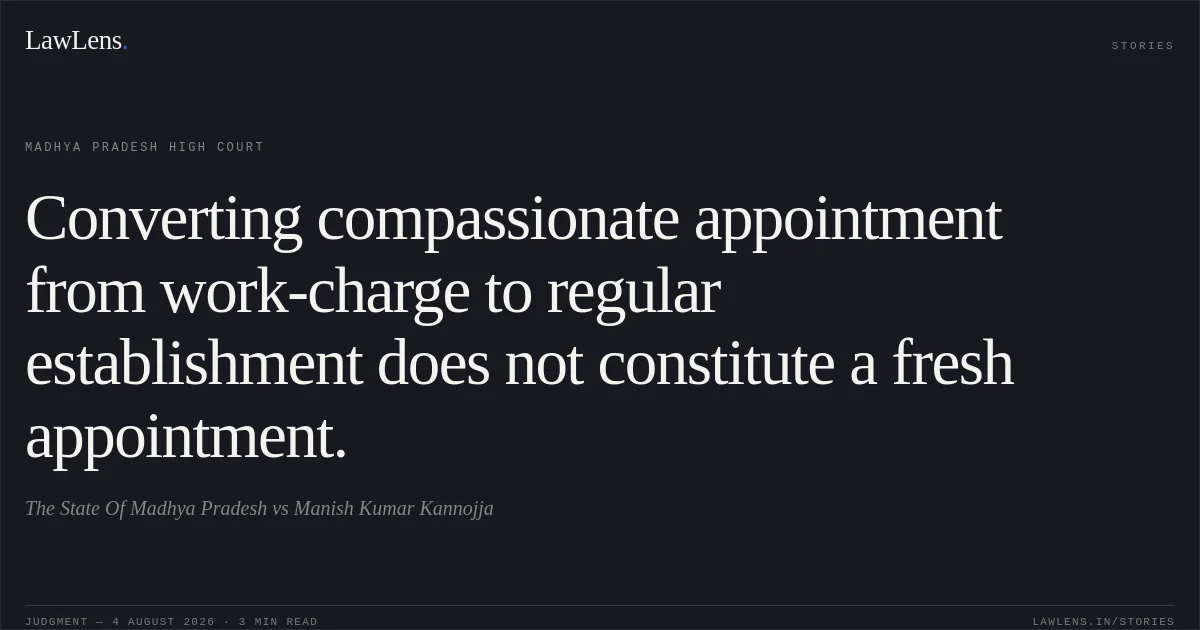
The State of Madhya Pradesh filed a review petition seeking recall, review, or modification of the order dated 12 September 2025 passed in W.P. No. 5767/2014, by which the respondent’s writ petition had been allowed.
Source reference: para. 3The respondent had been appointed in 2007 as a work-charge, contingency-paid employee on compassionate grounds.
Source reference: para. 4The State contended that, having accepted such appointment, he could not subsequently seek appointment on the regular establishment and that Clause 13.1 of the GAD Policy dated 18 August 2008 prohibited a fresh compassionate appointment.
Source reference: para. 4The respondent maintained that regular sanctioned vacant posts were available when his case was considered, and that Clause 9.5 entitled him to compassionate appointment on a regular basis. He argued that his claim was not for a fresh appointment but for appointment on the regular establishment against the same post.
Source reference: para. 5The delay in filing the review petition was condoned under Section 5 of the Limitation Act.
Source reference: paras. 1–2Issues
Whether the direction to appoint the respondent on the regular establishment, after his appointment on the work-charge contingency establishment, amounted to a fresh compassionate appointment prohibited by Clause 13.1 of the GAD Policy.
Source reference: paras. 4–8Whether the State had established a permissible ground for review under Section 114 read with Order XLVII Rule 1 of the Code of Civil Procedure, namely discovery of new material, an error apparent on the face of the record, or any other sufficient reason.
Source reference: paras. 9–16Law Applied
Section 5 of the Limitation Act permits the Court to condone delay for sufficient cause.
Source reference: paras. 1–2Clause 13.1 of the GAD Policy dated 18 August 2008 provides that, after compassionate appointment has once been granted, a person shall not be given compassionate appointment again on another post.
Source reference: para. 7Section 114 CPC and Order XLVII Rule 1 CPC restrict review to discovery of new and important matter or evidence, mistake or error apparent on the face of the record, or any other sufficient reason.
Source reference: paras. 11–13In Kamlesh Verma v. Mayawati, (2013) 8 SCC 320, the Supreme Court held that review cannot be used to repeat rejected arguments, reappreciate evidence, or function as an appeal in disguise.
Source reference: para. 9State of West Bengal v. Kamal Sengupta, (2008) 8 SCC 612, states that an error apparent must be prima facie visible and not require detailed examination.
Source reference: para. 10Col. Avatar Singh Sekhon v. Union of India, 1980 Supp SCC 562, and Parsion Devi v. Sumitri Devi, (1997) 8 SCC 715, establish that review lies only for a patent or self-evident error, not for an erroneous decision requiring reasoning to detect the alleged error.
Source reference: paras. 14–15Reasoning
The Court construed Clause 13.1 as prohibiting a fresh compassionate appointment on another post, not a change in the nature of the respondent’s existing appointment. The direction under review required appointment on the regular establishment instead of the work-charge contingency establishment; the post remained the same, while only the nature of service and applicable conditions would change. Accordingly, Clause 13.1 was prima facie inapplicable.
Source reference: para. 8The State’s arguments essentially sought reconsideration of the interpretation of the policy and the merits of the original decision. Such reconsideration would amount to rehearing the writ petition and could not be undertaken in review absent a manifest error apparent on the record. Applying the limited scope of review under Section 114 and Order XLVII Rule 1 CPC, the Court found no patent error, new material, or other sufficient reason warranting interference.
Source reference: paras. 16–17Holding
The Court held that the order directing the respondent’s appointment on the regular establishment did not grant a fresh appointment on a different post and was not barred by Clause 13.1 of the GAD Policy.
No error apparent on the face of the record or other permissible ground for review was established. The review petition was therefore dismissed as devoid of merit, after condoning the filing delay.
Source reference: paras. 1–2, 16–18Acts & Sections Cited
2 provisions across 2 statutes referred to in this judgment. Each provision opens on LawLens.
Limitation Act, 19631
Code of Civil Procedure, 19081
Original Court PDF
The State Of Madhya PradeshvsManish Kumar Kannojja
Click to open original judgment
Original judgment, available to read, download and summarize on LawLens.in