Facts
The petitioner, wife of Sandula Veeranna, challenged the memorandum dated 10 September 2024 issued by the prison authorities, which forfeited her husband’s earned remission of approximately 27 days and denied him parole and furlough for three years.
Source reference: pp. 3–4Her husband had been convicted under Sections 148 and 302 read with Section 149 IPC in S.C. No. 115 of 1982 and sentenced to life imprisonment by the Additional District Judge, Warangal, on 9 June 1983.
Source reference: pp. 3–4He was released on parole on 17 December 1983, with the period extended until 17 March 1984, but failed to surrender on 18 March 1984.
Source reference: p. 4He was apprehended approximately 40 years, one month and 28 days later, on 16 May 2024, and transferred to Central Prison, Cherlapalli.
Source reference: pp. 4, 8–9A show-cause notice was issued on 21 May 2024, the husband submitted an explanation, and the authorities thereafter imposed the impugned punishment.
Source reference: p. 4Issues
1. Whether the memorandum dated 10 September 2024 imposing forfeiture of remission and denial of parole and furlough for three years was illegal, arbitrary, or violative of the principles of natural justice, particularly when the alleged breach occurred approximately 40 years earlier?
Source reference: pp. 3–4, 12–13 / para. 92. Whether the petitioner’s husband was entitled to parole on account of his age and alleged medical ailments, notwithstanding his prolonged overstay and failure to surrender after release on parole?
Source reference: pp. 5–8, 10–13 / para. 93. Whether directions should be issued to the prison authorities to establish mechanisms for monitoring prisoners released on parole and ensuring their return to prison?
Source reference: p. 14 / para. 10Law Applied
The Court applied Rule 973 of the Telangana Prison Rules, 1979, which permits disciplinary action for breach of the conditions of temporary release, parole, or furlough after providing the prisoner an opportunity to show cause and be heard.
Source reference: pp. 6, 9It also considered Rule 974(2) of the Andhra Pradesh Prison Rules, 1979, as applicable in Telangana, and Rule 12 of the Telangana Prisoners Release on Parole Rules, 1981, concerning parole on grounds such as serious illness, death, or marriage of a family member or close relative.
Source reference: p. 7Rule 15 of G.O.Ms. No. 647, Home (Prisons-C) Department, dated 23 October 1981, was relied upon by the State as authorising punishment for breach of parole or furlough conditions.
Source reference: p. 9The Court further recognised that parole is not an absolute or enforceable right and that a prisoner’s eligibility must be assessed in light of the facts of the case, including the nature of the breach and conduct while on release.
Source reference: pp. 10–11The Court distinguished Kailash Wati v. State of Delhi, W.P.(Crl.) No. 1976 of 2025, decided on 12 November 2025, where parole had been considered on compassionate and medical grounds in the case of an 81-year-old bedridden prisoner who had already served half of a seven-year sentence.
Source reference: p. 13Reasoning
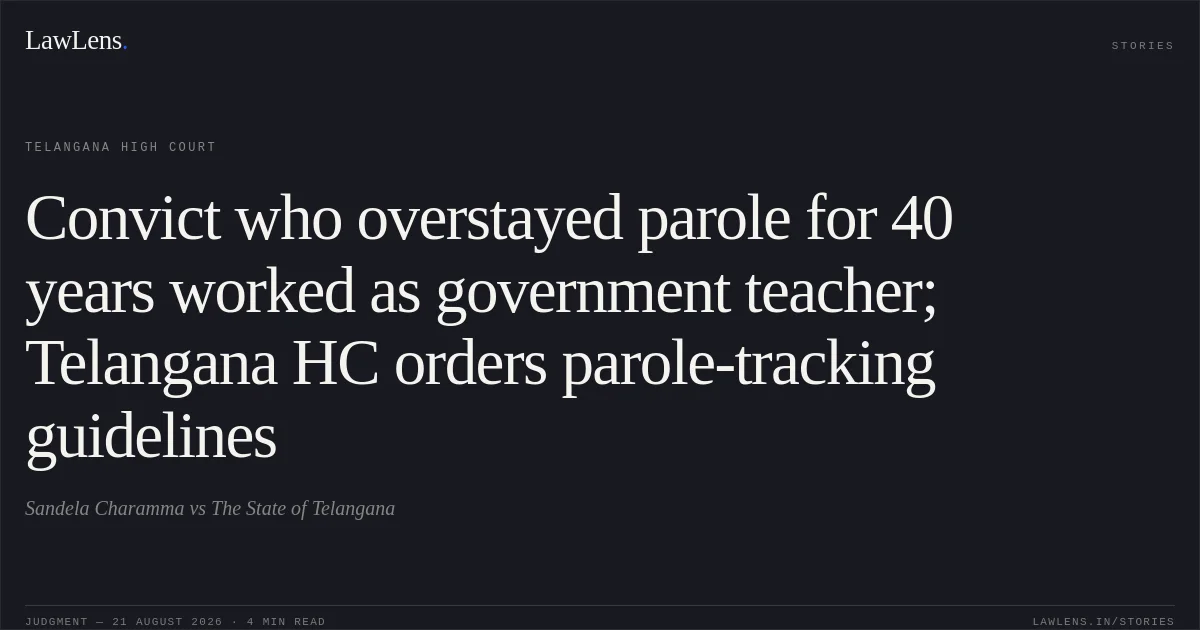
The Court held that the husband had not merely committed a technical violation but had intentionally failed to surrender after the expiry of parole and remained at large for over 40 years.
Source reference: pp. 12–13 / para. 9His subsequent employment as a Government teacher and retirement from service were treated by the Court as indicating that he had concealed his conviction and deliberately evaded custody.
Source reference: pp. 12–13 / para. 9Since the authorities issued a show-cause notice, considered his explanation, and thereafter imposed the punishment, the Court found no violation of Rule 973 or the principles of natural justice.
Source reference: p. 13 / para. 9The Court also rejected the medical-ground claim because the prison at Cherlapalli had a hospital, medical and paramedical staff, ambulance services, and access to specialist hospitals where required.
Source reference: pp. 10–11, 13 / para. 9The decision in Kailash Wati was considered distinguishable because the factual circumstances there involved a substantially older, bedridden prisoner who had already served half of a determinate sentence.
Source reference: p. 13At the same time, the Court found that the authorities’ inability to trace the prisoner for four decades exposed deficiencies in parole-monitoring procedures and warranted institutional directions to prevent recurrence.
Source reference: p. 14 / para. 10Holding
The Court dismissed the writ petition and upheld the memorandum dated 10 September 2024 imposing forfeiture of the husband’s earned remission and denial of parole and furlough for three years, finding no illegality, arbitrariness, or breach of natural justice.
The Court also declined to direct release on parole on medical or humanitarian grounds.
Source reference: p. 13 / para. 9However, it directed Respondent Nos. 1 and 2 to frame appropriate guidelines and establish machinery to monitor prisoners released on parole, including by constituting Special Task Forces to ensure vigilance and their timely return to prison.
Source reference: p. 14 / para. 10There was no order as to costs, and pending miscellaneous petitions were closed.
Source reference: p. 14 / para. 11Original Court PDF
Sandela CharammavsThe State of Telangana
Click to open original judgment
Original judgment, available to read, download and summarize on LawLens.in