01Facts
The appellant was convicted by the Trial Court under Section 377 of the IPC and Section 6 of the POCSO Act for the sexual assault of an 11-year-old boy on 05.06.2019
¶ 2–3While the victim initially supported the prosecution in his Section 164 CrPC statement, he turned hostile during the trial, asserting he named the appellant out of nervousness and had not seen the perpetrator’s face
¶ 4b, 6, 15The Trial Court based the conviction primarily on an FSL report confirming the presence of the appellant’s DNA (semen) on the victim's pants
¶ 4c, 17On appeal, the appellant challenged the reliability of the FSL report, citing a 12-day delay in sending samples to the laboratory (from 05.06.2019 to 17.06.2019) and the absence of Malkhana register entries to prove a continuous chain of custody
¶ 11, 21–2202Issues
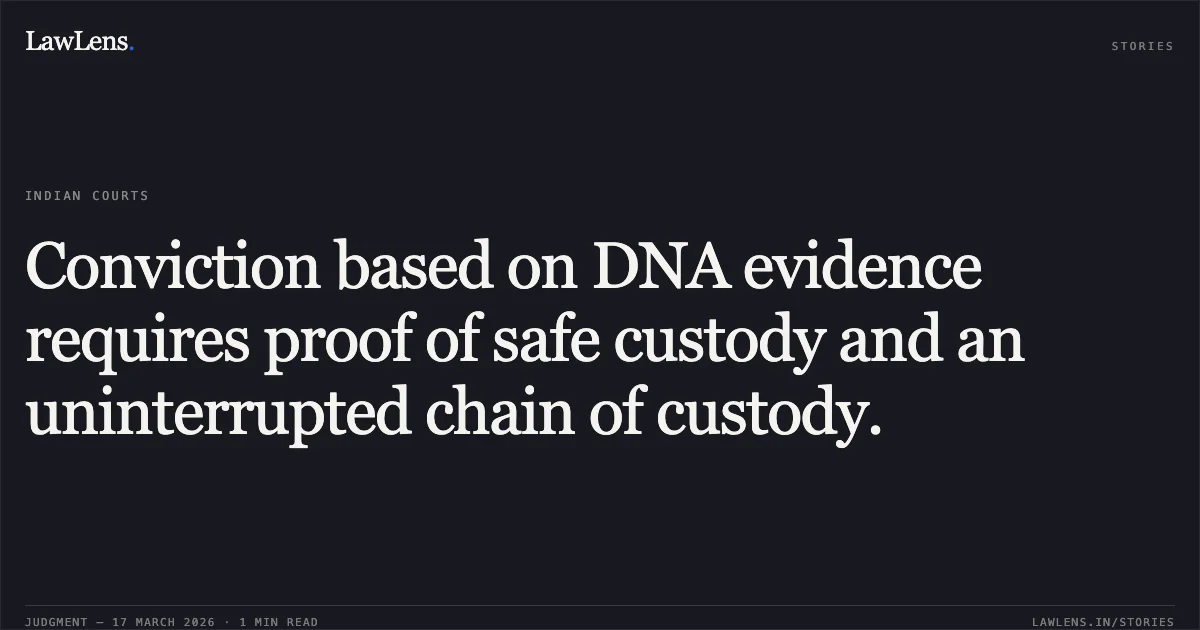
i.1. Whether the FSL report can be deemed reliable evidence for conviction in the absence of proof regarding the safe custody and untampered transit of seized samples
¶ 18, 23ii.2. Whether the Appellate Court should exercise its power to direct the recording of additional evidence to bridge gaps in the prosecution's case regarding the chain of custody
¶ 25–26iii.3. Whether the appellant is entitled to the suspension of sentence pending the final disposal of the appeal
¶ 33–3403Law Applied
The Court applied Sections 377 of the IPC and Section 6 of the POCSO Act regarding the substantive offences
¶ 2–3It relied on Sections 29 and 30 of the POCSO Act concerning statutory presumptions
¶ 4c, 13Regarding procedural powers, the Court invoked Section 348 of the Bharatiya Nagarik Suraksha Sanhita, 2023 (formerly Section 311 CrPC) and Section 168 of the Bharatiya Sakshya Adhiniyam, 2023 (formerly Section 165 Evidence Act) to take additional evidence
¶ 26It further applied the principle from Kattavellai v. State of T.N. (2025), which mandates that DNA evidence must be discarded if the chain of custody is not handled with the highest quality control and procedures
¶ 19Provisions in the judgment · 7 · Linked ones open on LawLens
Indian Penal Code, 1860 Section 377
Code of Criminal Procedure, 1973 Section 164Section 294Section 311
Bharatiya Sakshya Adhiniyam, 2023 Section 168
Bharatiya Nagarik Suraksha Sanhita, 2023 Section 348
Protection of Children from Sexual Offences Act, 2012 Section 6
04Reasoning
The Court observed that while the medical evidence (MLC) confirmed recent sexual insertion, the identity of the culprit rested solely on the FSL report due to the victim's hostility
¶ 16–17However, the prosecution failed to provide clarity on where the samples were stored between seizure and dispatch to the FSL
¶ 21The Court noted that the mere assertion that samples were "sealed" is insufficient; the prosecution must prove safe custody via Malkhana records to rule out tampering
¶ 20, 23Citing Kattavellai, the Court emphasized that lapses by investigators in handling sensitive DNA evidence often lead to the rejection of vital proof
¶ 19, 24Nevertheless, the Court held that such lapses should not result in an "automatic acquittal" if justice can be served by calling for additional evidence
¶ 24Consequently, the Court determined that the Investigating Officer and the Malkhana-in-charge must be examined to establish the integrity of the sample transit
¶ 2605Holding
The High Court deferred the final hearing of the appeal and directed the Special Court to record additional evidence regarding the chain of custody within six months
¶ 27, 30Regarding the application for suspension of sentence, the Court held that since the appellant had already served seven years in custody and the FSL report—the primary link to the crime—remained under a cloud of doubt, the appellant was entitled to bail
¶ 34, 36The Court ordered the release of the appellant on a personal bond of ₹20,000 with two sureties, subject to specific conditions
¶ 36The appeal is listed for further hearing on 28.10.2026
¶ 31Original Court PDF
Mohd. MujahidvsThe State (Govt. Of Nct) Delhi & Anr.
Click to open original judgment
Original judgment, available to read, download and summarize on LawLens.in