Facts
On July 10, 2014, the appellant allegedly took the victim (PW12), a 4½-year-old girl, into his grocery shop, removed her underwear, climbed onto her back, and "poured water" (semen) on her
Source reference: p. 2, 8Based on the mother’s (PW11) statement, an FIR was registered
Source reference: p. 2The Trial Court framed charges under Section 9(m) read with Sections 10 and 18 of the POCSO Act (attempt to commit aggravated sexual assault)
Source reference: p. 4, 14Following the prosecution's evidence, the Trial Court convicted the appellant for the substantive offence of aggravated sexual assault under Section 9(m) punishable under Section 10, sentencing him to five years of rigorous imprisonment
Source reference: p. 4-5The appellant challenged the conviction on grounds of lack of physical injuries, potential tutoring of the child witness, an alleged financial dispute with the victim's family, and the legal error of convicting for a completed offence despite being charged only with an "attempt"
Source reference: p. 5-6Issues
1. Whether non-compliance with the mandatory hearing under Section 232 of the CrPC vitiates the trial proceedings
Source reference: p. 42. Whether the sole testimony of a minor victim is sufficient to sustain a conviction under the POCSO Act
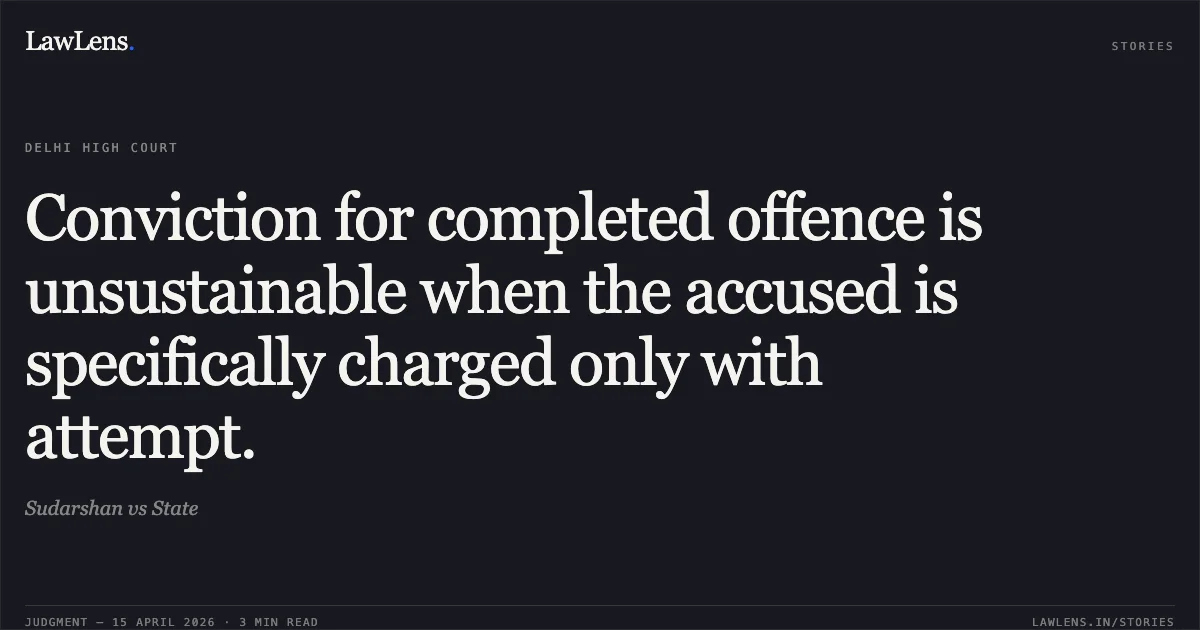
Source reference: p. 133. Whether the Trial Court can legally convict an accused for a completed offence when the charge framed was only for an "attempt" under Section 18 of the POCSO Act
Source reference: p. 15-164. Whether the sentence of five years was legally sustainable for an "attempt" under Section 18
Source reference: p. 17Law Applied
The court applied Section 374(2) of the CrPC regarding criminal appeals
Source reference: p. 1Regarding procedural lapses, it relied on Moidu K. vs. State of Kerala, holding that non-compliance with Section 232 CrPC only vitiates proceedings if substantial prejudice is shown
Source reference: p. 4For witness credibility, it applied Ganesan v. State, establishing that the credible testimony of a sexual assault victim requires no corroboration
Source reference: p. 13Substantively, the court interpreted Sections 7 (Sexual Assault), 9(m) (Aggravated Sexual Assault on children under 12), 10 (Punishment), and 18 (Attempt) of the POCSO Act, noting that Section 18 limits punishment for an attempt to one-half of the longest term provided for the substantive offence
Source reference: p. 14-17Reasoning
The High Court found the victim's testimony (PW12) credible, noting it remained consistent with her Section 164 statement and was corroborated by her mother's prompt FIS/FIR
Source reference: p. 9-10The court dismissed the defense regarding the absence of injuries, noting the charge did not involve penetration
Source reference: p. 12It further rejected the "financial dispute" theory due to inconsistent versions provided by the defense during cross-examinations and the Section 313 statement
Source reference: p. 12-13However, the court found a significant legal error in the Trial Court's judgment: while the accused was charged with "attempt" under Section 18, he was convicted for the completed offence under Section 9(m) without an amendment to the charge
Source reference: p. 15-16Since the appellant was never charged with the completed act, the conviction was restricted to "attempt"
Source reference: p. 16Consequently, applying Section 18, the court determined that the maximum sentence permissible is half of the longest term for the offence (7 years under Section 10), which is 3.5 years
Source reference: p. 17Holding
The High Court partly allowed the appeal, modifying the conviction from the completed offence of aggravated sexual assault to the "attempt to commit aggravated sexual assault" under Section 18 read with Section 9(m) of the POCSO Act
The court held that the Trial Court's sentence of five years exceeded the legal limit for an attempt
Source reference: p. 17Accordingly, the substantive sentence was reduced to rigorous imprisonment for a period of three and a half years
Source reference: p. 18Acts & Sections Cited
11 provisions across 3 statutes referred to in this judgment. Each provision opens on LawLens.
Code of Criminal Procedure, 19734
Protection of Children from Sexual Offences Act, 20124
Indian Penal Code, 18603
Original Court PDF
SudarshanvsState
Click to open original judgment
Original judgment, available to read, download and summarize on LawLens.in