Facts
The prosecution alleged that Accused No. 1 (A1) harbored a grudge against the deceased, Dhirubhai Satani, for arranging a marriage for A1’s sister based on a misrepresentation (claiming it was the groom's second marriage when it was actually his fourth)
Source reference: para 3.1On 20.12.2011, A1 allegedly stabbed the deceased at the Botad Swaminarayan Gurukul City Bus Stop, while Accused No. 2 (A2) assisted A1 in escaping the scene on a motorcycle
Source reference: para 3.1The Sessions Court, Bhavnagar, convicted both appellants under Section 302 read with Section 34 of the IPC and sentenced them to life imprisonment
Source reference: para 2The appellants challenged the conviction on the grounds that the eye-witnesses turned hostile and the circumstantial evidence was insufficient to sustain the conviction
Source reference: para 5.1, 6.1Issues
1. Whether the circumstantial evidence presented by the prosecution was sufficient to form a complete chain unerringly pointing to the guilt of the accused
Source reference: para 302. Whether the recovery of the weapon (knife) could be deemed proved under Section 27 of the Evidence Act when the independent panch witnesses turned hostile
Source reference: para 213. Whether the 12-day delay in sending muddamal (evidence) to the FSL and inconsistencies in dharamshala stay records vitiated the prosecution’s case
Source reference: para 19, 23Law Applied
The court primarily applied Section 302 (Murder) and Section 34 (Common Intention) of the IPC
Source reference: para 2It scrutinized the admissibility of discovery evidence under Section 27 of the Indian Evidence Act
Source reference: para 20-21The court relied on the "Panchsheel" principles of circumstantial evidence established in Sharad Birdhichand Sarda v. State of Maharashtra, which require the chain of evidence to be so complete as to exclude any hypothesis of innocence
Source reference: para 31It further applied the "chain of custody" requirements for forensic evidence as highlighted in Prakash Nishad @ Kewat Zinak Nishad v. State of Maharashtra
Source reference: para 32Reasoning
The High Court found that the prosecution's case collapsed because the three alleged eye-witnesses (PW-14, 15, and 16) turned hostile and denied seeing the incident
Source reference: para 11The court rejected the Trial Court's reliance on the scene-of-offence panchnama because the panch witness admitted he did not know the complainant and the document was not prepared at the complainant's instance
Source reference: para 10Regarding the recovery of the knife, the court held that the testimony of the Investigating Officer alone could not suffice when both independent panch witnesses (PW-8 and PW-9) turned hostile
Source reference: para 21The court further noted a serious lapse in the 12-day unexplained delay in sending the knife to the FSL, which raised concerns about tampering or contamination
Source reference: para 23, 32Additionally, the court found the dharamshala evidence (PW-21) inconsistent, as the witness's oral testimony regarding the timing of the stay (one-and-a-half years prior) contradicted the documentary records (dated the night of the incident), rendering the "absconding" theory unproven
Source reference: para 19Holding
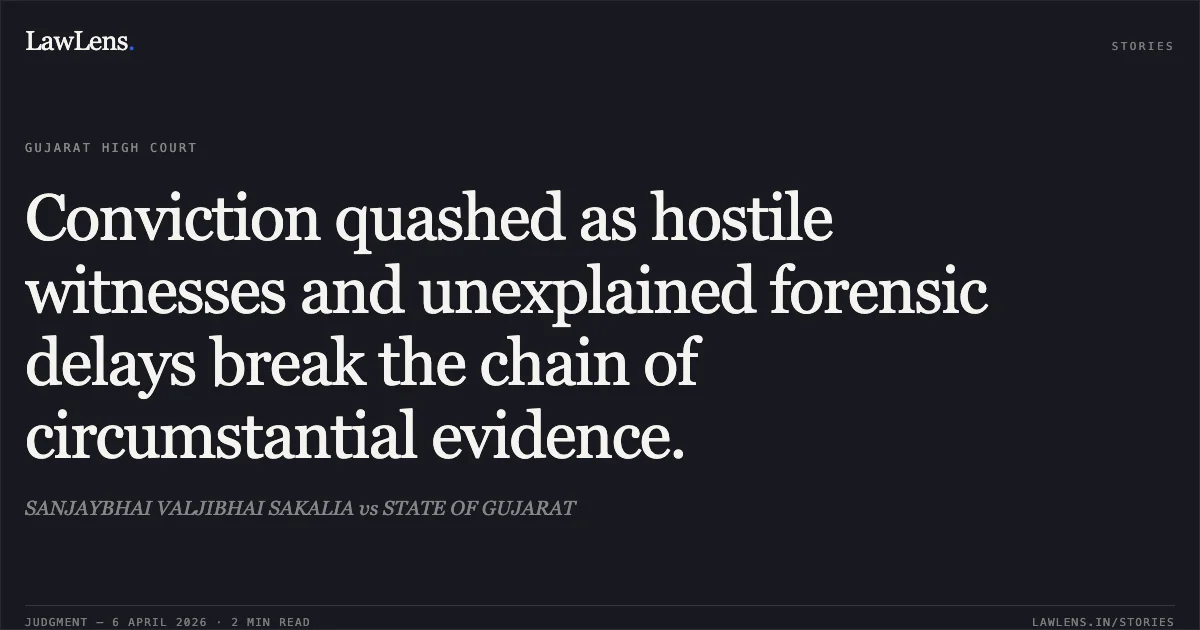
The High Court held that the prosecution failed to establish a continuous and unbroken chain of circumstantial evidence
It ruled that the circumstances relied upon were either neutral, inconclusive, or not proved beyond reasonable doubt
Source reference: para 27Consequently, the court allowed both appeals, quashed the judgment dated 07.08.2013, and acquitted both appellants of all charges
Source reference: para 34The bail bonds were ordered to be discharged forthwith
Source reference: para 34Acts & Sections Cited
2 provisions across 1 statute referred to in this judgment. Each provision opens on LawLens.
Indian Penal Code, 18602
Original Court PDF
SANJAYBHAI VALJIBHAI SAKALIAvsSTATE OF GUJARAT
Click to open original judgment
Original judgment, available to read, download and summarize on LawLens.in