Facts
On 16 April 1996, a quarrel occurred between Kamal/Kamlesh Yadav and appellant Rajendra Yadav. Following the quarrel, Rajendra allegedly returned with the other accused, who assaulted Santu Yadav and his uncle Jhari Yadav with lathis. Jhari sustained serious head injuries and Santu also suffered injuries. Jhari was initially treated at Sadar Hospital, Daltonganj, and was thereafter referred to Ranchi, where he died approximately ten days after the assault
Source reference: p.2–3, paras. 4–5, 13The post-mortem disclosed a skull fracture, brain contusion and subdural bleeding, and the medical opinion attributed death to head injury. Following investigation, the accused were charge-sheeted under Sections 147, 323, 341 and 304/34 of the IPC. The trial court convicted the appellants under Sections 304 Part II/34, 323 and 341 IPC and imposed concurrent sentences, including seven years’ rigorous imprisonment under Section 304 Part II IPC.
Source reference: p.3–4, para. 8; p.10–11, para. 13During the appeals, appellant Kamraj Yadav died and his appeal abated.
Source reference: p.1–2, para. 2Issues
Whether the conviction of the appellants under Sections 304 Part II/34, 323 and 341 IPC was sustainable on the prosecution evidence.
Source reference: p.6–7, paras. 12–13Whether the delay of approximately ten days between the assault and Jhari Yadav’s death, together with the alleged contradictions and absence of detailed treatment evidence, created reasonable doubt regarding causation and entitled the appellants to acquittal.
Source reference: p.4–6, paras. 9, 14Whether the trial court’s judgment disclosed any serious error of law warranting appellate interference.
Source reference: p.6, para. 12Law Applied
The Court applied Sections 304 Part II and 34 IPC, which respectively concern culpable homicide not amounting to murder where the accused has knowledge that the act is likely to cause death, and liability for acts done in furtherance of common intention. Sections 323 and 341 IPC govern voluntarily causing hurt and wrongful restraint, respectively.
Source reference: no citationThe Court relied on the principle that credible testimony of an injured witness may be acted upon, particularly when corroborated by other eyewitnesses and medical evidence.
Source reference: p.11–12, paras. 14–15It further applied the causation principle that a subsequent death does not break the chain of liability where the evidence establishes that death resulted from injuries inflicted during the occurrence and no intervening cause is proved.
Source reference: p.11–12, paras. 14–15Reasoning
The Court found P.W.-8, Santu Yadav, to be an injured eyewitness whose account consistently attributed the assault to the appellants. His testimony was corroborated by P.Ws.-2, 7, 10 and 11, and by the medical evidence showing multiple scalp injuries on Jhari and injuries on Santu.
Source reference: p.6–11, para. 13The post-mortem evidence established a parietal-bone fracture, brain contusion and subdural bleeding, with death expressly attributed to head injury.
Source reference: p.10–11, paras. 13–14The Court held that the ten-day interval before death did not create reasonable doubt because no intervening cause was shown and the medical evidence connected the death to the assault-related head injury.
Source reference: p.11, para. 14It further held that the use of lathis and repeated blows on the vital part of the body established the requisite knowledge for Section 304 Part II IPC, while the injuries to Santu and the evidence of interception and assault supported the convictions under Sections 323 and 341 IPC.
Source reference: p.12, para. 15The appellants’ arguments concerning interested witnesses, contradictions and incomplete treatment evidence were therefore rejected.
Source reference: no citationHolding
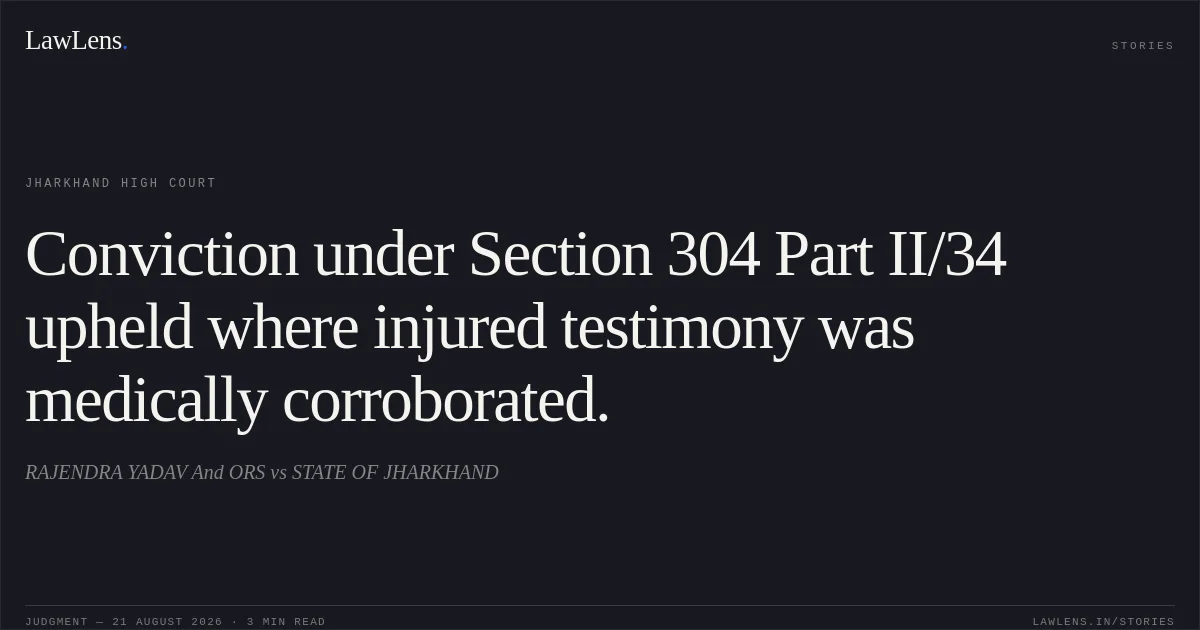
The High Court answered the issues against the appellants and held that the conviction under Sections 304 Part II/34, 323 and 341 IPC did not suffer from any legal or factual infirmity.
The appeals were dismissed and the trial court’s convictions and concurrent sentences were affirmed.
Source reference: p.12, para. 18Since the appellants were on bail, their bail bonds were cancelled, and they were directed to surrender before the trial court within two months to undergo the remaining sentence; failing surrender, coercive steps were directed to be taken for their arrest and detention.
Source reference: p.12, para. 18Acts & Sections Cited
5 provisions across 1 statute referred to in this judgment. Each provision opens on LawLens.
Indian Penal Code, 18605
Original Court PDF
RAJENDRA YADAV And ORSvsSTATE OF JHARKHAND
Click to open original judgment
Original judgment, available to read, download and summarize on LawLens.in