Facts
The appellant was prosecuted on the allegation that he had maintained a sexual relationship with the victim on the promise of marriage, impregnated her, and thereafter administered pills causing miscarriage of a pregnancy of approximately three months.
Source reference: para. 2The FIR alleged offences under Sections 376, 493 and 313 of the IPC and Section 3(2)(v) of the SC/ST Act.
Source reference: para. 2The medical examination established that the victim was approximately 10–12 weeks pregnant and undergoing an abortion process, but no external injuries were found.
Source reference: paras. 2, 13The trial court acquitted the appellant of the offences under Sections 376 and 493 IPC and Section 3(2)(v) of the SC/ST Act, but convicted him under Section 313 IPC and sentenced him to three years’ rigorous imprisonment, with a fine of ₹5,000 and one year’s further imprisonment in default.
Source reference: paras. 5, 1The appeal was confined to the conviction under Section 313 IPC.
Source reference: para. 9Issues
Whether the prosecution proved beyond reasonable doubt that the miscarriage was caused by an act of the appellant.
Source reference: paras. 15–16Whether the prosecution established that the miscarriage was caused without the victim’s consent, as required for conviction under Section 313 IPC.
Source reference: paras. 16–17Whether the evidence of pregnancy, abortion and the victim’s allegation that the appellant administered pills was sufficient to sustain the conviction under Section 313 IPC.
Source reference: paras. 10, 13–17Law Applied
Section 313 IPC criminalises causing a woman to miscarry without her consent and incorporates the essential requirements of the offence under Section 312 IPC.
Source reference: para. 16The prosecution must therefore prove beyond reasonable doubt that the woman was pregnant, that a miscarriage occurred, that the accused’s act caused the miscarriage, and that the act was done without the woman’s consent.
Source reference: para. 16Mere proof of pregnancy and miscarriage, or medical evidence establishing an abortion, is insufficient without proof of causal connection between the accused’s conduct and the miscarriage, together with absence of consent.
Source reference: para. 16The Court relied on Prabhu @ Kulandaivelu v. State of Tamil Nadu, Criminal Appeal No. 1178 of 2011, decided on 18 September 2018, where conviction under Section 313 IPC was held unsustainable when the woman’s consent and the connection between the accused’s act and the miscarriage were not disproved or established respectively.
Source reference: para. 15Reasoning
Although the medical evidence established that the victim was pregnant and undergoing an abortion, it did not conclusively establish that the appellant’s alleged administration of pills caused the miscarriage.
Source reference: paras. 13–16The victim stated that the appellant administered pills, but she did not state that the miscarriage occurred without her consent.
Source reference: paras. 10, 17The evidence also disclosed that the victim and appellant had been in a consensual relationship, and no pills, prescription, medical record identifying the substance, or other corroborative evidence was produced to connect the appellant with the miscarriage.
Source reference: para. 10; p. 4The medical witness acknowledged that miscarriage could occur naturally or due to an external cause.
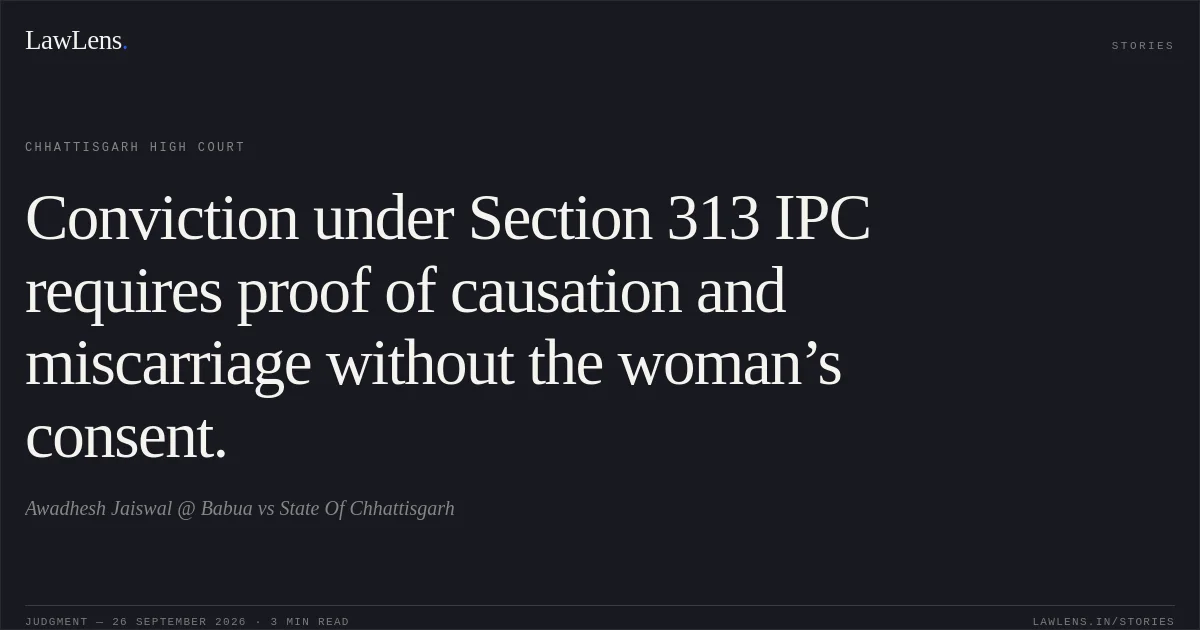
Source reference: para. 13In the absence of proof of both causation and want of consent, the statutory ingredients of Section 313 IPC were not established beyond reasonable doubt.
Source reference: paras. 16–17The Court consequently extended the benefit of doubt to the appellant.
Source reference: paras. 16–17Holding
The Court held that the prosecution failed to prove that the miscarriage was caused by the appellant without the victim’s consent.
The appeal was allowed, the conviction and sentence under Section 313 IPC were set aside, and the appellant was acquitted by giving him the benefit of doubt.
Source reference: para. 18As the appellant was on bail, his bail bonds were directed to continue for six months under Section 481 of the Bharatiya Nagarik Suraksha Sanhita, 2023.
Source reference: para. 18Acts & Sections Cited
9 provisions across 4 statutes referred to in this judgment. Each provision opens on LawLens.
Code of Criminal Procedure, 19733
Indian Penal Code, 18604
Scheduled Castes and the Scheduled Tribes (Prevention of Atrocities) Act, 19891
Bharatiya Nagarik Suraksha Sanhita, 20231
Original Court PDF
Awadhesh Jaiswal @ BabuavsState Of Chhattisgarh
Click to open original judgment
Original judgment, available to read, download and summarize on LawLens.in