Facts
The petitioner sought a direction under Articles 226/227 of the Constitution to the Tahsildar, Kunkuri, and the Collector, Jashpur, for correction and mutation of the revenue records in her name pursuant to the judgment and decree dated 7 January 2026 passed by a coordinate Bench of the High Court in First Appeal No. 139 of 2004, which had set aside the trial court’s judgment and decree dated 6 May 2004 in Civil Suit No. 54-A/2003.
Source reference: para. 2The petitioner applied for correction and mutation before the Tahsildar on 19 February 2026. The proceedings were not concluded; the Collector subsequently called for the record from the Tahsildar, and the matter remained pending before the Collector.
Source reference: paras. 2, 4The petitioner contended that she had been litigating since 2004 and had not obtained the benefit of the decree.
Source reference: para. 2Issues
Whether the High Court, while exercising jurisdiction under Articles 226/227 of the Constitution, should direct the revenue authorities to correct and mutate the petitioner’s name pursuant to the judgment and decree in First Appeal No. 139 of 2004.
Source reference: paras. 5–6Whether the petitioner had an alternative and efficacious remedy under the Chhattisgarh Land Revenue Code, 1959, in relation to correction or mutation of the revenue records.
Source reference: para. 5Law Applied
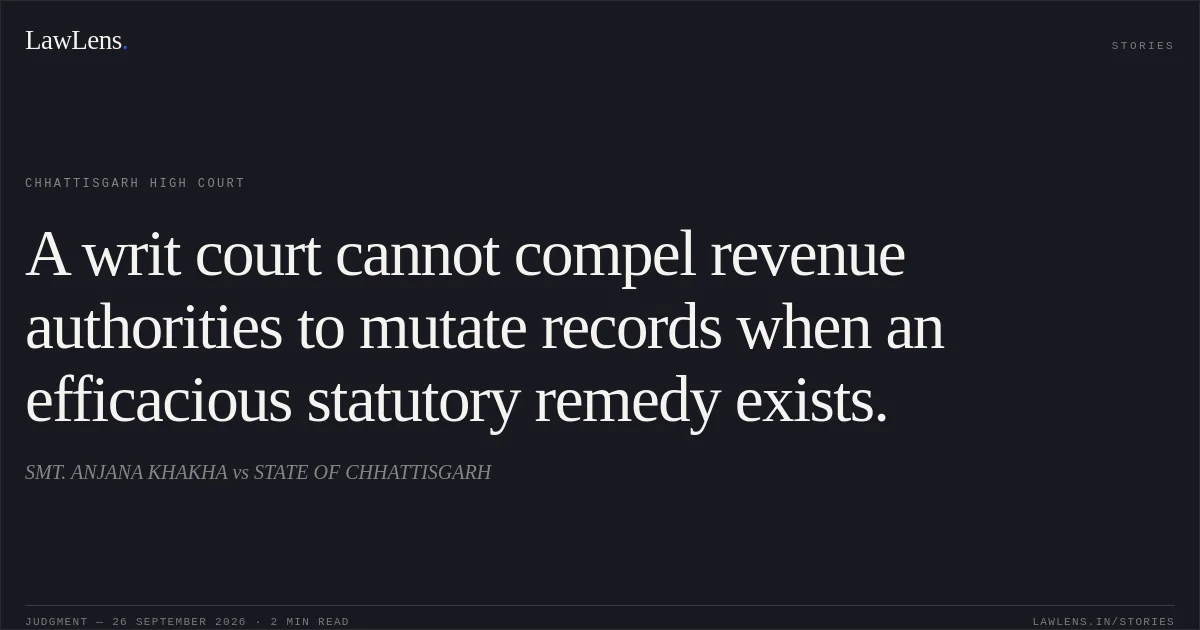
The Court applied Articles 226/227 of the Constitution, observing that writ jurisdiction is discretionary and ordinarily should not be exercised where an alternative efficacious statutory remedy is available.
Source reference: paras. 5–6It relied on the scheme of the Chhattisgarh Land Revenue Code, 1959, under which the petitioner could pursue appropriate proceedings before the competent revenue authorities for correction and mutation of the revenue records.
Source reference: para. 5The Court further held that revenue proceedings are to be independently conducted by the competent authorities, and the High Court should not compel the Collector or Tahsildar to mutate a person’s name merely on the basis of a judgment and decree while exercising writ jurisdiction.
Source reference: para. 6Reasoning
The Court accepted that the petitioner had already initiated proceedings before the Tahsildar and that the matter had subsequently been called for by the Collector.
Source reference: paras. 2, 4Since the statutory revenue proceedings were pending and the petitioner had a remedy under the Chhattisgarh Land Revenue Code, 1959, the Court declined to substitute its decision for that of the competent revenue authorities.
Source reference: para. 5It held that the existence of the High Court decree did not justify issuing a mandatory writ directing mutation, because the revenue authorities were required to consider and decide the petitioner’s application independently in accordance with law.
Source reference: para. 6Holding
The Court held that no direction could be issued to the Collector or Tahsildar to mutate the petitioner’s name pursuant to the decree in First Appeal No. 139 of 2004.
The petitioner was left to pursue her statutory remedy before the competent revenue authorities.
Source reference: paras. 6–7The writ petition was accordingly dismissed for lack of merit.
Source reference: paras. 6–7Original Court PDF
SMT. ANJANA KHAKHAvsSTATE OF CHHATTISGARH
Click to open original judgment
Original judgment, available to read, download and summarize on LawLens.in