Facts
The prosecution alleged that on 8 June 2021 the minor victim went missing from her home and was subsequently found near her house at approximately 2:30 a.m.
Source reference: paras. 1–2It was alleged that the respondent took or caused her to be taken towards Lanketar Talab/field and sexually harassed her.
Source reference: paras. 1–2The victim’s father lodged a report, following which an FIR was registered under Sections 363 and 366 of the Indian Penal Code, Section 12 of the Protection of Children from Sexual Offences Act, 2012, and Section 3(2)(v-a) of the Scheduled Castes and Scheduled Tribes (Prevention of Atrocities) Act, 1989.
Source reference: paras. 1–2The Special Judge, Janjgir, acquitted the respondent of all charges on 12 May 2022, holding that the prosecution had failed to prove the offences beyond reasonable doubt.
Source reference: paras. 1, 12The State preferred the present acquittal appeal under Section 14-A(1) of the SC/ST Act.
Source reference: para. 1Issues
Whether the prosecution proved beyond reasonable doubt that the respondent kidnapped the minor victim from the lawful guardianship of her parents or otherwise compelled/took her away so as to attract Sections 363 and 366 of the IPC.
Source reference: paras. 8–12Whether the evidence established sexual harassment or the charged offence under Section 12 of the POCSO Act and the offence under Section 3(2)(v-a) of the SC/ST Act.
Source reference: paras. 9–12Whether the trial court’s acquittal was perverse or legally impossible so as to warrant interference in an appeal against acquittal.
Source reference: paras. 13–15Law Applied
The Court applied Sections 363 and 366 of the IPC concerning kidnapping and taking a minor woman for an unlawful purpose, Section 12 of the POCSO Act concerning sexual harassment of a child, Section 3(2)(v-a) of the SC/ST Act, and Section 14-A(1) of the SC/ST Act governing the appeal.
Source reference: no citationThe victim’s age could be established through documentary evidence, including a statutory birth certificate admissible under Section 35 of the Indian Evidence Act, 1872, corroborated by school records.
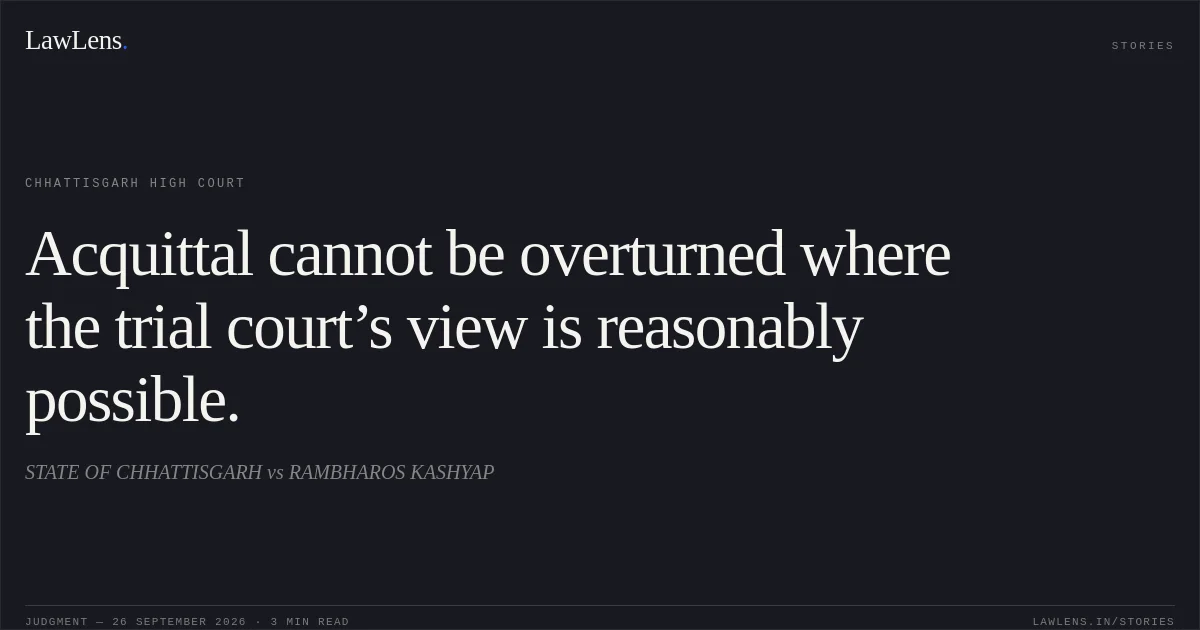
Source reference: para. 8In an appeal against acquittal, the appellate court may interfere only where the trial court’s view is impossible, perverse, or legally unsustainable; where two reasonable views are possible, the view favouring the accused must be preserved.
Source reference: paras. 13–14The Court relied on State of Rajasthan v. Kistoora Ram, 2022 SCC OnLine SC 984, and Jafarudheen v. State of Kerala, (2022) 8 SCC 440, for the principles of limited appellate interference and the strengthened presumption of innocence following acquittal.
Source reference: paras. 13–14Reasoning
The Court accepted that the victim was below eighteen years of age, relying on her birth certificate recording her date of birth as 24 November 2005 and the corroborating school register.
Source reference: para. 8However, age alone did not establish kidnapping, sexual harassment, or the other charged offences.
Source reference: no citationThe victim’s account contained material inconsistencies: in examination-in-chief she attributed the dragging to the respondent and his sister-in-law, but in cross-examination she stated that the sister-in-law dragged her and specifically denied that the respondent had caught hold of her hand.
Source reference: para. 9Her version also contained omissions regarding the alleged place of occurrence, and she referred only generally to prior harassment without specifying its date, nature, or circumstances.
Source reference: para. 9The evidence of the parents was largely based on what the victim allegedly told them and contained omissions and contradictions; it did not independently establish that the respondent had kidnapped or sexually harassed her.
Source reference: paras. 10–11In light of these deficiencies, the trial court’s conclusion that the prosecution evidence created reasonable doubt was a possible view of the evidence and was neither perverse nor legally unsustainable.
Source reference: paras. 12, 15Holding
The Court answered the issues against the State.
It held that the prosecution failed to prove beyond reasonable doubt that the respondent committed the offences under Sections 363 and 366 of the IPC, Section 12 of the POCSO Act, or Section 3(2)(v-a) of the SC/ST Act.
Source reference: paras. 9–12Since the trial court’s acquittal represented a possible and reasonable view of the evidence, no interference was warranted under the settled principles governing appeals against acquittal.
Source reference: paras. 13–15The acquittal appeal was accordingly dismissed, and the respondent’s acquittal was affirmed.
Source reference: para. 16Acts & Sections Cited
8 provisions across 4 statutes referred to in this judgment. Each provision opens on LawLens.
Scheduled Castes and the Scheduled Tribes (Prevention of Atrocities) Act, 19891
Indian Penal Code, 18602
Protection of Children from Sexual Offences Act, 20121
Code of Criminal Procedure, 19734
Original Court PDF
STATE OF CHHATTISGARHvsRAMBHAROS KASHYAP
Click to open original judgment
Original judgment, available to read, download and summarize on LawLens.in