Facts
The appellant, Bijay Goswami, and co-accused Krishna Bahadur Giri allegedly approached the informant, Sushila Tigga, with a proposal for her daughter’s marriage with Krishna Bahadur.
Source reference: para. 3; p. 1–2On 9 July 2001, while the victim was proceeding to school, the accused allegedly took her away.
Source reference: para. 3; p. 1–2The appellant allegedly took her to his house, where she remained for two days, after which Krishna Bahadur and his parents took her to Nepal.
Source reference: para. 3; p. 1–2The appellant subsequently gave the informant a Nepal telephone number to speak with the victim.
Source reference: para. 3; p. 1–2A case was registered under Section 366A of the Indian Penal Code, and after investigation the appellant was committed to trial in S.T. No. 57 of 2002.
Source reference: para. 4; p. 2The Sessions Court convicted him under Section 366A IPC and sentenced him to five years’ rigorous imprisonment and a fine of Rs. 5,000.
Source reference: para. 2; p. 1During the appeal, it was submitted that Krishna Bahadur, who was a juvenile, had been separately dealt with and acquitted following a compromise.
Source reference: para. 7; p. 2–3Issues
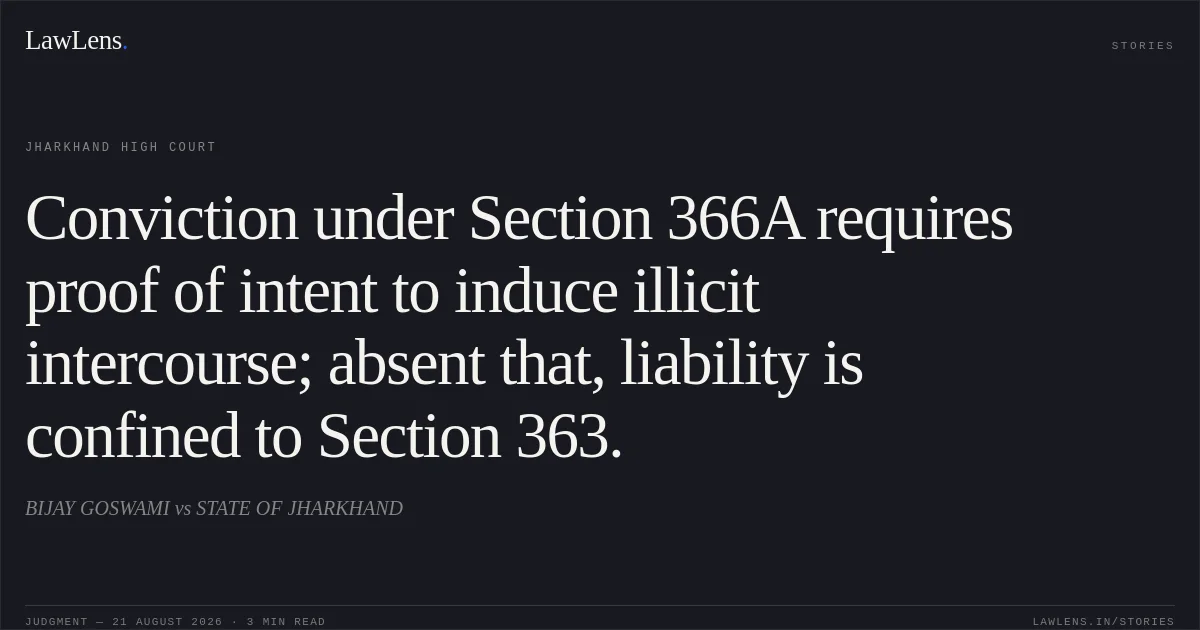
Whether the appellant’s conduct established the ingredients of an offence under Section 366A IPC, particularly the requisite intention or knowledge that the victim would be forced or seduced to illicit intercourse.
Source reference: para. 10; p. 4Whether, on the evidence, the appellant was instead guilty of kidnapping from lawful guardianship under Section 363 IPC.
Source reference: para. 7; p. 2–3; para. 10; p. 4Whether the appellant was entitled to the benefit of Section 4 of the Probation of Offenders Act, 1958, in lieu of imprisonment.
Source reference: para. 7–8; p. 3; para. 11; p. 4–5Law Applied
Section 366A IPC requires proof that a minor girl was induced to go from a place or do an act with the requisite intention or knowledge that she was likely to be forced or seduced to illicit intercourse with another person.
Source reference: paras. 10–12; p. 4–5In the absence of that specific intention or knowledge, the conduct may constitute kidnapping from lawful guardianship under Section 363 IPC.
Source reference: paras. 10–12; p. 4–5The Court applied Section 4 of the Probation of Offenders Act, 1958, which permits release of an offender on probation of good conduct where, having regard to the circumstances of the case, the nature of the offence, and the offender’s character, it is expedient to do so.
Source reference: paras. 10–12; p. 4–5No judicial precedent was cited in the judgment.
Source reference: no citationReasoning
The victim’s testimony established that the appellant and Krishna Bahadur took her from the route to school and that the appellant facilitated her initial removal by keeping her at his house for two days.
Source reference: para. 10; p. 4The evidence also showed that the appellant had participated in the marriage proposal and assisted in taking the victim away.
Source reference: para. 10; p. 4However, the Court found no sufficient evidence that the appellant possessed the specific intention or knowledge required under Section 366A IPC that the victim would be forced or seduced to illicit intercourse with another person.
Source reference: para. 10; p. 4Accordingly, the proved conduct amounted, at most, to kidnapping from lawful guardianship under Section 363 IPC.
Source reference: para. 10; p. 4Regarding sentence, the Court considered the appellant’s age, character, antecedents, the nature and circumstances of the offence, the lapse of time, and the fact that it was his first offence, and held that probation would serve the ends of justice.
Source reference: paras. 8, 11; p. 3–5Holding
The appeal was partly allowed.
The conviction under Section 366A IPC was altered to one under Section 363 IPC.
Source reference: para. 10; p. 4Instead of imposing imprisonment, the appellant was granted the benefit of Section 4 of the Probation of Offenders Act, 1958, and directed to furnish a bond of Rs. 5,000 with one surety of like amount for maintaining peace and good behaviour for one year.
Source reference: para. 12; p. 5If the bond was not furnished within two months, the trial court was directed to secure his attendance; violation of the bond conditions could result in his being called upon to undergo the sentence under Section 363 IPC.
Source reference: paras. 13–14; p. 5Acts & Sections Cited
2 provisions across 2 statutes referred to in this judgment. Each provision opens on LawLens.
Indian Penal Code, 18601
Probation of Offenders Act, 19581
Original Court PDF
BIJAY GOSWAMIvsSTATE OF JHARKHAND
Click to open original judgment
Original judgment, available to read, download and summarize on LawLens.in