Facts
The petitioner was accused of inducing complainants Gurmukh Singh and Gurnet Singh to pay him ₹90,000 each on the assurance that he would send them to Malaysia and arrange permanent work permits for three years. The complainants paid the amounts on 22.03.2002 and 23.03.2002, respectively, and travelled to Malaysia on 30.03.2002. They were unable to obtain the promised work permits and returned to India on 30.07.2002. The petitioner allegedly refused to refund their money and threatened them when they sought repayment.
Source reference: pp. 2–3Following a preliminary police inquiry, FIR No. 88 dated 07.06.2003 was registered under Sections 420 and 406 IPC. The petitioner was ultimately charged under Section 420 IPC, convicted by the Sub-Divisional Judicial Magistrate, Baba Bakala, and sentenced to three years’ rigorous imprisonment with a fine of ₹2,000. His appeal was dismissed by the Additional Sessions Judge, Amritsar on 11.08.2010.
Source reference: pp. 3–5In revision, the petitioner challenged the conviction on the grounds that a subsequent police inquiry had found him innocent, that an FIR had been registered concerning the alleged disappearance of that inquiry report, that the prosecution arose from family enmity, and that payment of ₹1,80,000 had not been satisfactorily proved.
Source reference: pp. 5–6During the revision proceedings, the State produced a custody certificate showing that the petitioner had undergone four months and eight days, including remission, and had no other pending criminal case.
Source reference: p. 6Issues
Whether the concurrent findings of conviction under Section 420 IPC suffered from any patent illegality, perversity, jurisdictional error, or material irregularity warranting interference in criminal revision?
Source reference: pp. 7–12Whether the alleged subsequent police inquiry exonerating the petitioner and the FIR concerning the disappearance of that inquiry report undermined the prosecution case?
Source reference: pp. 8–10Whether the alleged family hostility and the challenge to proof of payment rendered the complainants’ evidence unreliable?
Source reference: pp. 5–8, 10Whether, in view of the petitioner’s advanced age, first-offender status, prolonged trial, conduct on bail, and period already undergone, the sentence should be reduced while maintaining the conviction and fine?
Source reference: pp. 12–14Law Applied
The Court applied Section 420 IPC, which criminalises cheating and dishonest inducement to deliver property.
Source reference: no citationIn exercising revisional jurisdiction under Section 397 CrPC, the Court relied on Malkeet Singh Gill v. State of Chhattisgarh, holding that revisional interference is narrow and is justified only for a patent defect, error of jurisdiction, illegality, or perversity; the revisional court is not to function as a second appellate court.
Source reference: pp. 10–11It also relied on Amit Kapoor v. Ramesh Chander, which recognises interference where there is palpable error, non-compliance with law, a wholly erroneous decision, or arbitrary exercise of judicial discretion.
Source reference: pp. 11–12The Court further relied on Jaswinder Singh v. State of Punjab, holding that multiple police inquiries should not ordinarily be conducted after an inquiry has already been held, except with appropriate authority or judicial/statutory direction.
Source reference: pp. 8–9For sentencing, the Court applied the reformative principle recognised in Satish v. State of U.P., particularly that first-time offenders should, where circumstances justify, be afforded an opportunity for reformation.
Source reference: p. 13Reasoning
The Court found that the complainants’ central grievance was not that they had failed to travel to Malaysia, but that the petitioner had promised work permits which were never arranged.
Source reference: p. 7The petitioner did not dispute that the complainants had travelled to Malaysia and returned after approximately four months; the absence of the promised work permits therefore supported the prosecution version.
Source reference: p. 7The complainants gave direct evidence regarding payment of ₹90,000 each, supported by witnesses present at the time of payment and by the evidence of the police officer who conducted the original inquiry.
Source reference: pp. 7–8The alleged later inquiry was not proved through the examination of DSP(D) Lakhbir Singh, and there was no material showing that it had been authorised by the competent authority. Moreover, the subsequent FIR concerning the alleged disappearance of the report did not establish the petitioner’s innocence, and its ultimate fate remained unexplained.
Source reference: pp. 8–10The alleged enmity was not shown to be direct between the petitioner and the complainants, and the judgment relied upon by the petitioner had neither been produced during trial nor properly placed on the revision record.
Source reference: p. 10Since both courts below had concurrently appreciated the evidence and no patent illegality or perversity was demonstrated, the conviction did not warrant revisional interference.
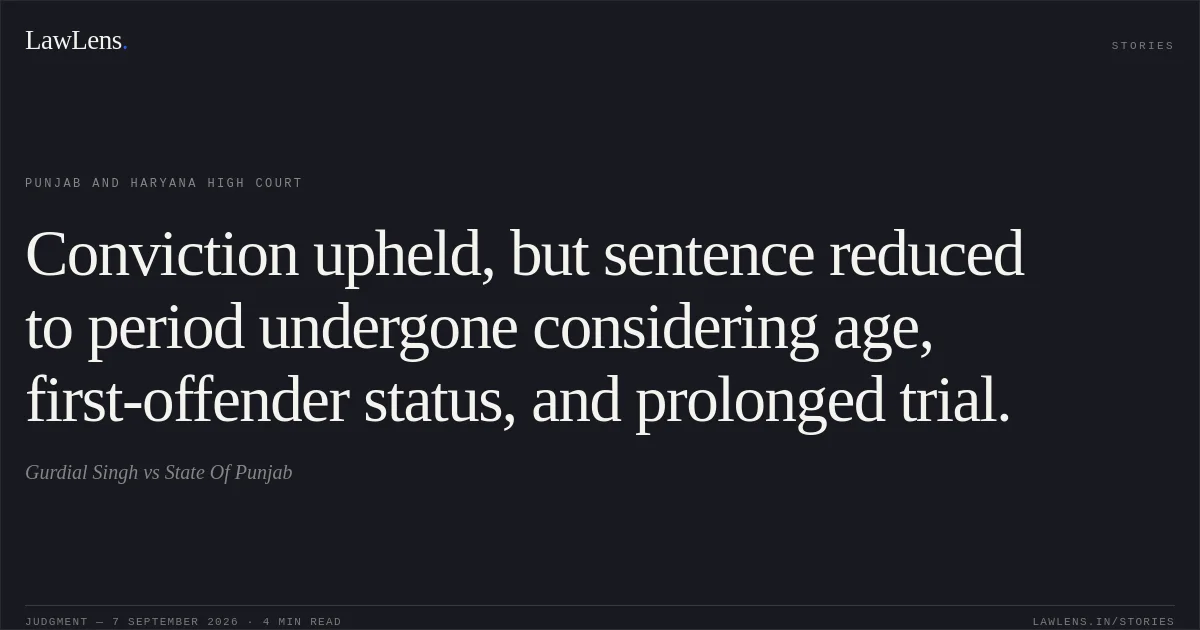
Source reference: pp. 10–12However, considering the petitioner’s age of approximately 80 years, first-offender status, prolonged pendency since 2003, absence of bail misuse, and custody already undergone, the Court considered reduction of sentence appropriate.
Source reference: pp. 12–14Holding
The revision petition was dismissed insofar as the conviction under Section 420 IPC was concerned, and the concurrent findings of guilt were upheld.
However, the sentence of three years’ rigorous imprisonment was reduced to the period already undergone, namely approximately four months and eight days including remission.
Source reference: pp. 12–14The fine of ₹2,000 was maintained, and the petitioner’s deposit of the fine was noted.
Source reference: pp. 6, 12–14The revision petition was accordingly disposed of, along with any pending applications.
Source reference: p. 14Acts & Sections Cited
11 provisions across 2 statutes referred to in this judgment. Each provision opens on LawLens.
Indian Penal Code, 18608
Code of Criminal Procedure, 19733
Original Court PDF
Gurdial SinghvsState Of Punjab
Click to open original judgment
Original judgment, available to read, download and summarize on LawLens.in