Facts
Two minor girls, aged approximately 14 and 16 years, were found hanging from a tree in Singimari jungle on 11 June 2021.
Source reference: p.4–10The prosecution alleged that they had been sexually assaulted, manually strangulated, and thereafter hanged to make the deaths appear suicidal.
Source reference: p.4–10The post-mortem examination indicated homicidal death by ante-mortem manual strangulation and forcible vaginal and anal intercourse.
Source reference: p.23–25The Special Judge (POCSO), Kokrajhar convicted all three accused under Sections 376D, 376DA, 376A, 120B and 302 IPC, read with Section 6 of the POCSO Act and Sections 3(1)(w)(i) and 3(2)(v) of the SC/ST (Prevention of Atrocities) Act, and imposed the death penalty.
Source reference: p.9–10The accused appealed, and the matter was placed before the High Court for confirmation of the death sentence.
Source reference: p.10–17Issues
1. Whether the prosecution proved beyond reasonable doubt, through circumstantial, medical and DNA evidence, that the three accused sexually assaulted and caused the homicidal deaths of the two minor victims.
Source reference: p.40–42, 68–782. Whether the evidence relating to DNA collection, preservation, transmission and examination was sufficiently reliable despite alleged risks of contamination, degradation and procedural irregularity.
Source reference: p.30–36, 51–603. Whether the call-detail records, tower-location evidence, alleged confessions and recoveries legally connected the accused with the offence.
Source reference: p.36–38, 61–674. Whether the case warranted confirmation of the death sentence or whether a lesser sentence was appropriate.
Source reference: p.42–45, 79–86Law Applied
The Court applied Sections 302, 376A, 376D, 376DA and 120B of the IPC, Section 6 of the POCSO Act, and the relevant provisions of the SC/ST (Prevention of Atrocities) Act as the substantive penal provisions governing murder, aggravated gang rape, rape of minors, conspiracy and aggravated offences.
Source reference: p.9–10It applied the settled rule governing circumstantial evidence that each circumstance must be firmly established and that the cumulative chain must be complete and inconsistent with the accused’s innocence.
Source reference: para.73DNA evidence was assessed as expert scientific evidence capable of establishing a biological connection when the collection, identification, forwarding and examination of samples were sufficiently proved.
Source reference: para.46–60Evidence obtained from police custody was treated subject to the bar against using custodial confessions as confessions of guilt, with only the legally admissible discovery portion available under Section 27 of the Evidence Act.
Source reference: para.66For sentencing, the Court applied the principle that life imprisonment is the normal rule and death penalty is exceptional, requiring consideration of both aggravating and mitigating circumstances and proof that the possibility of reformation or rehabilitation is foreclosed.
Source reference: para.79–82Relying on Union of India v. Sriharan @ Murugan, (2016) 7 SCC 1, the Court recognised the power to impose imprisonment for life for the remainder of the convict’s natural life, subject to the constitutional powers under Articles 72 and 161.
Source reference: para.84–86Reasoning
The Court found that the medical evidence conclusively established that the victims were sexually assaulted and died from ante-mortem manual strangulation; the later hanging was not the cause of death.
Source reference: para.36–39Although the witnesses who saw the accused in the jungle did not establish a complete last-seen circumstance, their evidence placed all three accused together near the place of occurrence and operated as corroboration.
Source reference: para.42–44The Court treated the DNA evidence as the decisive link: the specific matches between the victims’ vaginal and anal swabs and the respective accused persons’ reference samples directly connected each accused with the sexual assault.
Source reference: para.46–50, 68–78General possibilities of contamination, degradation or substitution were insufficient because no evidence showed that the particular samples producing positive results were actually contaminated, substituted or tampered with.
Source reference: para.51–60The CDR and tower evidence was not treated as proof of precise physical presence, but only as corroborative material.
Source reference: para.61–65The alleged custodial confessions were not relied upon as substantive confessions, and the recoveries were considered only to the extent legally admissible under Section 27.
Source reference: para.66Collectively, the medical, oral and DNA evidence formed a complete chain proving the appellants’ involvement beyond reasonable doubt.
Source reference: para.68–78However, despite the extreme gravity of the offences, the prosecution failed to produce material establishing that the appellants were incapable of reformation or rehabilitation; accordingly, the death penalty was not considered legally justified.
Source reference: para.79–83Holding
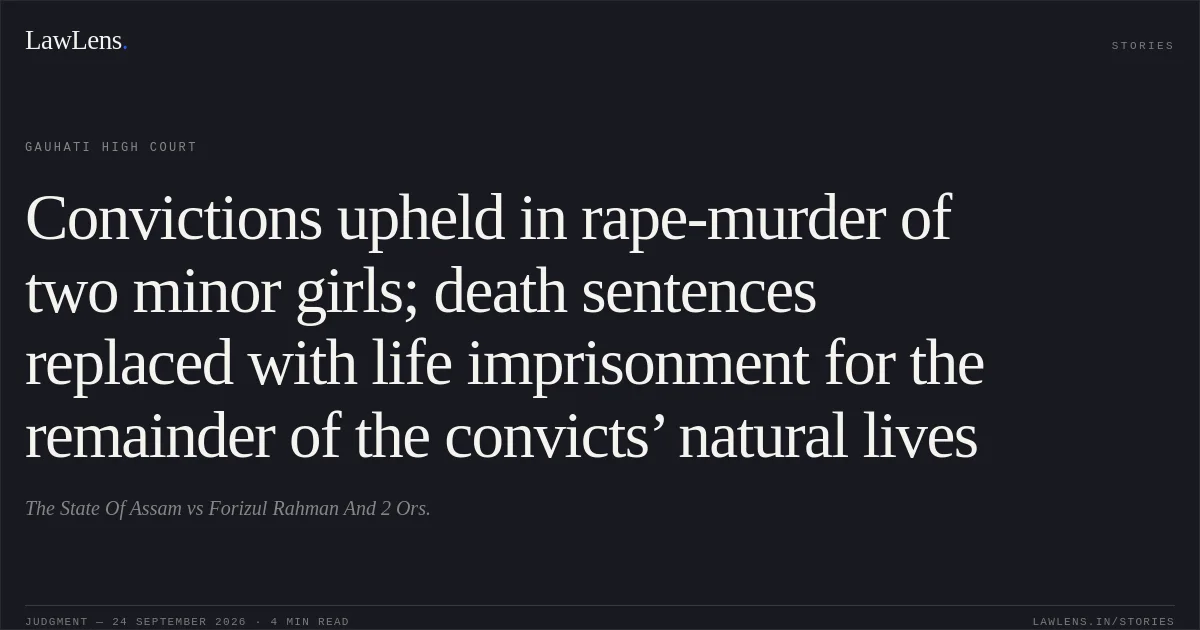
The High Court affirmed the convictions of all three appellants for the offences recorded by the trial court.
It answered the Death Sentence Reference in the negative and declined to confirm the death sentences.
Source reference: para.87(II)The death sentences were set aside and substituted with imprisonment for life for the remainder of each appellant’s natural life, without ordinary remission or commutation, subject to the constitutional powers of remission, suspension or commutation under Articles 72 and 161 of the Constitution.
Source reference: para.86–87(III)The criminal appeal was accordingly allowed in part, and the trial court record was directed to be returned.
Source reference: para.87(IV)–(V)Acts & Sections Cited
5 provisions across 4 statutes referred to in this judgment. Each provision opens on LawLens.
Indian Penal Code, 18601
Protection of Children from Sexual Offences Act, 20121
Scheduled Castes and the Scheduled Tribes (Prevention of Atrocities) Act, 19891
Code of Criminal Procedure, 19732
Original Court PDF
The State Of AssamvsForizul Rahman And 2 Ors.
Click to open original judgment
Original judgment, available to read, download and summarize on LawLens.in