Facts
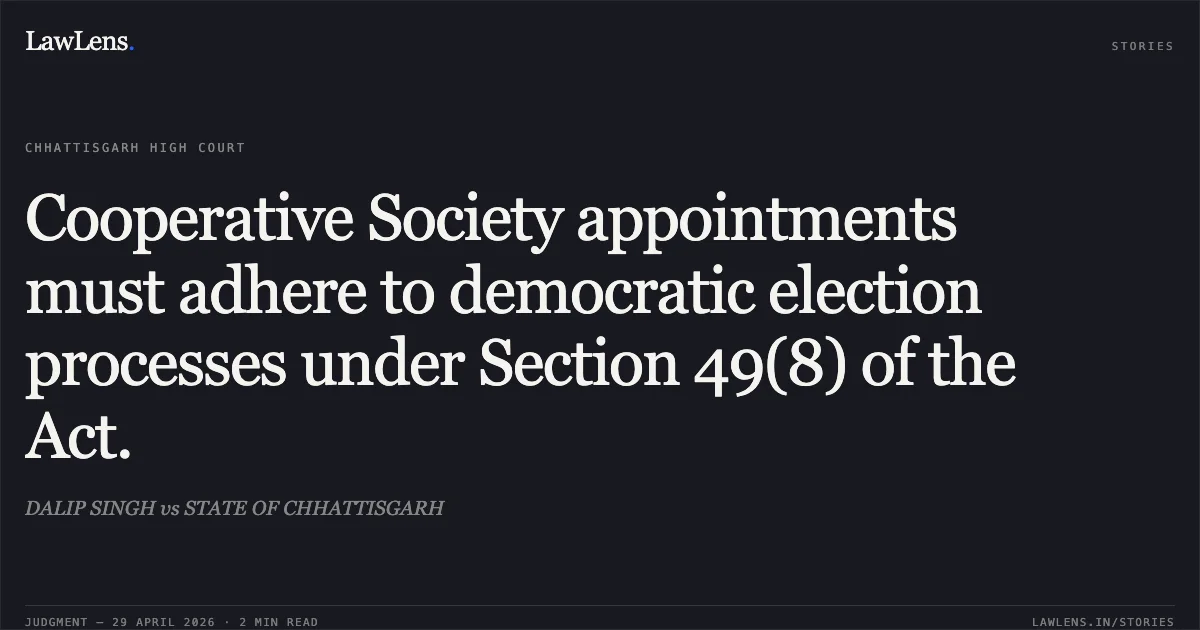
The petitioner, a member of the Sarva Adivasi Samaj and an eligible candidate for the post of President of the Adim Jati Seva Sahkari Samiti Maryadit, Jharnapara, challenged the action of the Respondent authorities in nominating Respondent No. 7 as President instead of conducting a democratic election.
Source reference: para. 1 & 2The petitioner contended that Respondent No. 4 initiated an appointment process via an order dated 14.11.2024, bypassing the mandatory election procedures.
Source reference: para. 2Despite an internal enquiry report by the Senior Cooperative Inspector recommending the removal of Respondent No. 7 due to ineligibility, no election was conducted.
Source reference: para. 2The petitioner sought the quashing of the appointment and a direction for the State Cooperative Election Commission to hold elections.
Source reference: para. 1, 3Issues
1. Whether the appointment of the President of a Cooperative Society through nomination/appointment rather than democratic election is legally sustainable under the governing Act.
Source reference: para. 1 & 22. Whether the court should direct the Joint Registrar to resolve the grievance regarding the irregular filling of the post within a specific timeline.
Source reference: para. 4 & 7Law Applied
Section 49(8) of the Chhattisgarh Co-operative Societies Act, 1960, which governs the management and the conduct of elections within cooperative societies.
Source reference: para. 4 & 7Procedural precedent set in W.P.(C) No. 5513 of 2025, which established that grievances regarding cooperative elections and appointments should first be adjudicated by the departmental authority (Joint Registrar) in an expedited, quasi-judicial manner.
Source reference: para. 4Reasoning
The Court did not delve into the merits of the appointment or the findings of the enquiry report.
Source reference: para. 9The Court observed that the legal issue regarding the vacancy and the necessity of an election was identical to a previous matter decided by the Court in October 2025.
Source reference: para. 4The Court applied the principle of exhaustion of alternative remedies by directing the petitioner to submit a formal representation to the Joint Registrar (Respondent No. 6).
Source reference: para. 6The Court reasoned that since Section 49(8) of the Act provides a statutory framework for such disputes, the competent authority must first pass a reasoned order after affording a hearing to all affected parties, including the incumbent President (Respondent No. 7).
Source reference: para. 7 & 8Holding
The High Court disposed of the writ petition without expressing an opinion on the merits.
The Court granted the petitioner liberty to file a fresh representation before Respondent No. 6 within two weeks and directed Respondent No. 6 to decide the representation in accordance with Section 49(8) of the Chhattisgarh Co-operative Societies Act through a reasoned and speaking order within 90 days of receipt, providing a due opportunity of hearing to all affected parties.
Source reference: para. 6, 7 & 8Acts & Sections Cited
1 provisions across 1 statute referred to in this judgment. Each provision opens on LawLens.
Chhattisgarh Co-operative Societies Act, 19601
Original Court PDF
DALIP SINGHvsSTATE OF CHHATTISGARH
Click to open original judgment
Original judgment, available to read, download and summarize on LawLens.in