Facts
Muniyammal B, a former Temple employee, obtained an order from the Deputy Commissioner of Labour directing payment of gratuity interest at 10%.
Source reference: paras. 2–5, 7She filed a writ petition seeking implementation of that order.
Source reference: paras. 2–5, 7The Single Judge directed payment of gratuity in accordance with the competent authority’s order and imposed costs of ₹5,000 on the Temple’s Joint Commissioner/Executive Officer.
Source reference: paras. 2–5, 7The Temple appealed only against the costs.
Source reference: paras. 2–5, 7During the appeal, it paid the gratuity amount with statutory interest, and attributed the delay to financial constraints.
Source reference: paras. 2–5, 7Issues
Whether the ₹5,000 costs imposed on the appellant by the Single Judge should be set aside, given the Temple’s stated financial constraints and subsequent payment of gratuity with statutory interest.
Source reference: paras. 8–11Law Applied
The Court applied the principle that gratuity is a statutory benefit payable to an employee in accordance with law and that an employer must ensure its timely payment.
Source reference: para. 10It also considered whether the delay amounted to deliberate or wilful disobedience when deciding whether costs were warranted.
Source reference: paras. 9–11The judgment cites no specific statutory provision or precedent.
Source reference: no citationReasoning
The Court noted that the employee’s entitlement to gratuity was undisputed and that the full amount, together with statutory interest, had been paid.
Source reference: para. 7Although timely payment remained the employer’s obligation, the Court found no material showing that the appellant had deliberately withheld the amount or intentionally disregarded the competent authority’s order.
Source reference: paras. 9–11In light of the Temple’s asserted financial constraints and its eventual compliance, the Court held that imposing costs personally on the appellant was unwarranted.
Source reference: paras. 9–11Holding
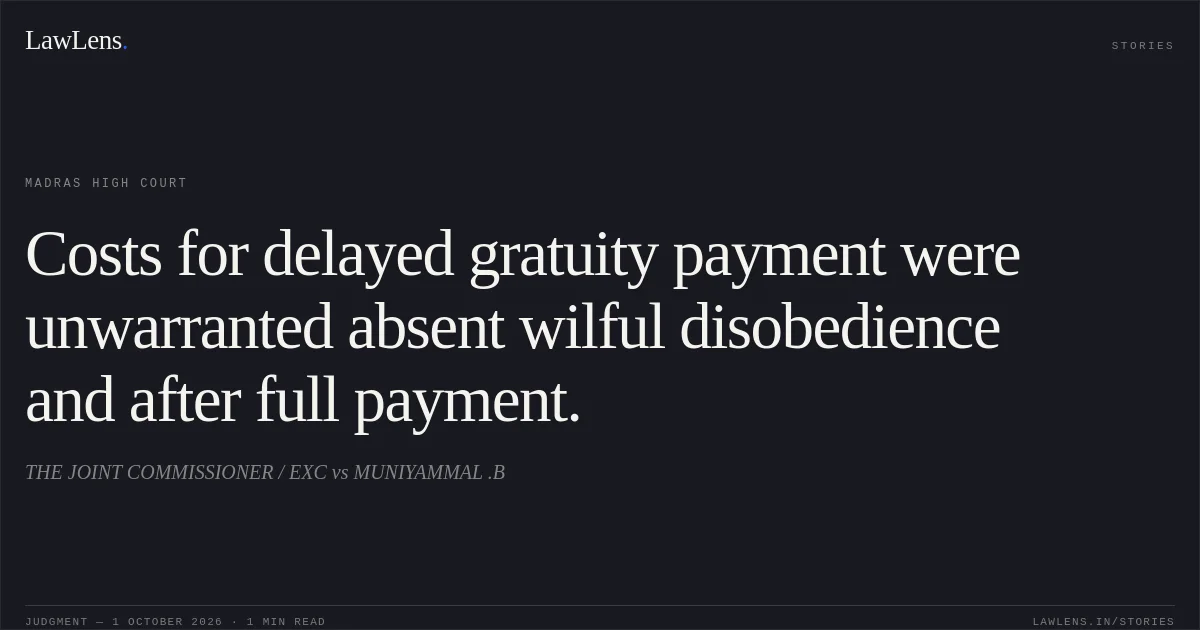
The Court partly allowed the appeal, set aside the ₹5,000 costs imposed on the appellant, and left undisturbed the direction to pay gratuity in accordance with the competent authority’s order, which had already been complied with.
There was no order as to costs in the appeal.
Source reference: paras. 12–13Original Court PDF
THE JOINT COMMISSIONER / EXCvsMUNIYAMMAL .B
Click to open original judgment
Original judgment, available to read, download and summarize on LawLens.in