Facts
The Applicant/Complainant filed a complaint under Sections 406, 504, and 506 IPC in 2013.
Source reference: para 3.1After recording statements under Sections 200 and 202 Cr.P.C., the accused were summoned in 2014.
Source reference: para 3.2In January 2021, the Complainant’s counsel made a formal written endorsement closing evidence under Section 244 Cr.P.C.
Source reference: para 3.3Charges were subsequently framed in March 2022 following a directive from the High Court for expedited trial.
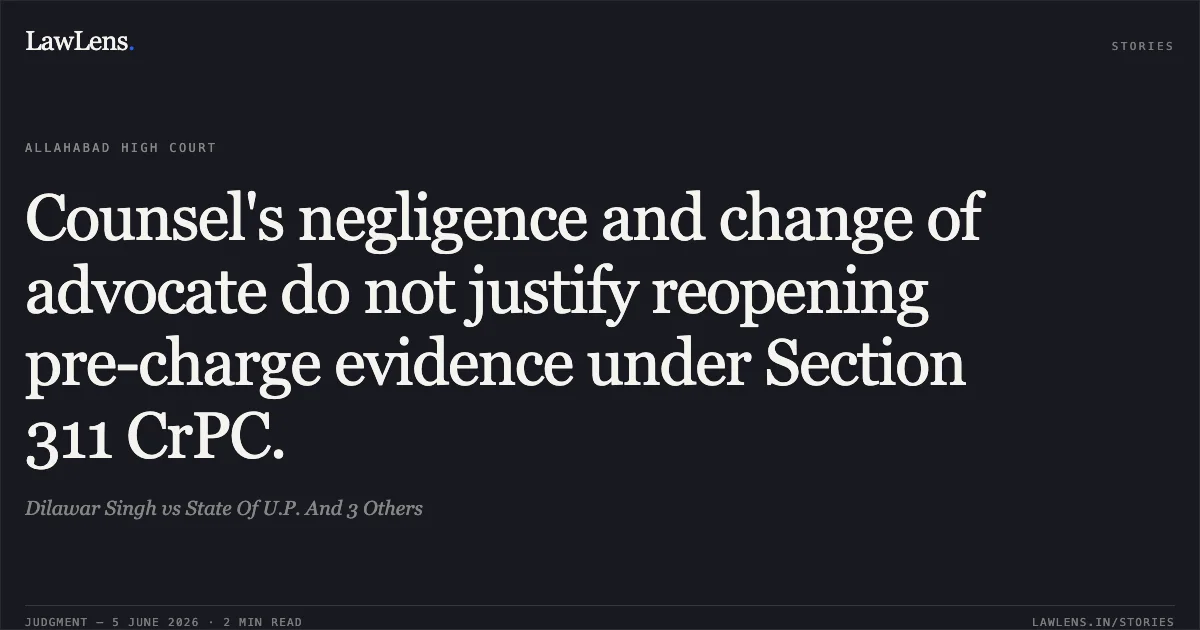
Source reference: para 3.3, 6In December 2025, the Applicant moved an application under Section 311 Cr.P.C. to examine two witnesses (Shivkumar and Ghanshyam) who were previously examined only at the pre-summoning stage, blaming the negligence of his former counsel for their omission during the pre-charge stage.
Source reference: para 3.4The Trial Court and Revisional Court rejected the application.
Source reference: para 3.5Issues
1. Whether a complainant can invoke Section 311 Cr.P.C. to record pre-charge evidence under Section 244 Cr.P.C. after charges have been framed and the trial has advanced to the Section 246 stage.
Source reference: para 8, 92. Whether the negligence or change of legal counsel constitutes a valid ground for recalling witnesses or reopening a closed stage of trial under Section 311 Cr.P.C.
Source reference: para 18, 20Law Applied
The court applied the statutory procedure for warrant cases instituted on complaints under Sections 244, 245, and 246 of the Cr.P.C., noting that only witnesses examined under Section 244 can be recalled for cross-examination under Section 246.
Source reference: para 8, 9Section 311 Cr.P.C. grants wide discretionary power to summon material witnesses at any stage if essential to a just decision.
Source reference: para 10, 11In State (NCT of Delhi) v. Shiv Kumar Yadav (2016), it was established that a change of counsel or claims of counsel incompetence are not grounds for retrial or recalling witnesses.
Source reference: para 13, 18In Swapan Kumar Chatterjee v. CBI (2019), the court cautioned against allowing Section 311 applications at a belated stage if they cause grave prejudice to the accused.
Source reference: para 14Reasoning
The Court reasoned that the Applicant’s previous counsel made a "conscious, deliberate written endorsement" to close pre-charge evidence.
Source reference: para 6, 19It found that allowing the motion four years after charges were framed would collapse the criminal justice structure into "endless delays".
Source reference: para 20The Court observed that statements under Section 202 Cr.P.C. do not automatically become substantive trial evidence; the complainant's failure to produce those witnesses under Section 244 meant they could not be introduced at the Section 246 stage without fundamentally disrupting the statutory trial process and prejudicing the accused.
Source reference: para 9, 21Following the precedent in Shiv Kumar Yadav, the Court rejected the plea of "counsel negligence," holding that an undertrial is expected to have a single line of defence that does not shift with a change of lawyer.
Source reference: para 18, 20Holding
The Court dismissed the application, holding that the power under Section 311 Cr.P.C., while wide, cannot be used to systematically undo an explicit waiver or fill gaps in a case at an advanced stage.
The Court affirmed the orders of the Trial Court and Sessions Court, finding no patent illegality or abuse of process.
Source reference: para 22, 23The Applicant’s request to reopen the Section 244 stage was denied as it lacked merit and would violate the mandate for an expedited trial.
Source reference: para 6, 23Acts & Sections Cited
10 provisions across 3 statutes referred to in this judgment. Each provision opens on LawLens.
Bharatiya Nagarik Suraksha Sanhita, 20231
Code of Criminal Procedure, 19736
Indian Penal Code, 18603
Original Court PDF
Dilawar SinghvsState Of U.P. And 3 Others
Click to open original judgment
Original judgment, available to read, download and summarize on LawLens.in