Facts
The petitioner, a General Nursing and Midwifery (G.N.M.) professional posted at Community Health Centre (C.H.C.), Sursand, alleged continuous mental and physical harassment by the In-charge Medical Officer (Respondent No. 7)
Source reference: p. 1-2She claimed her salary was deducted, increments stopped, and a false criminal case was lodged against her and her husband after she raised grievances
Source reference: p. 2-3Following a three-year deputation at a dispensary in 2022, she was returned to C.H.C. Sursand in February 2025, where harassment allegedly resumed, including a transfer to a facility without a sanctioned G.N.M. post
Source reference: p. 2-3The petitioner filed several representations to the Civil Surgeon and the Additional Secretary, Health Department, but received no response
Source reference: p. 3Consequently, she moved the High Court seeking disciplinary action against Respondent No. 7 or a transfer to a different jurisdiction
Source reference: p. 1-2Issues
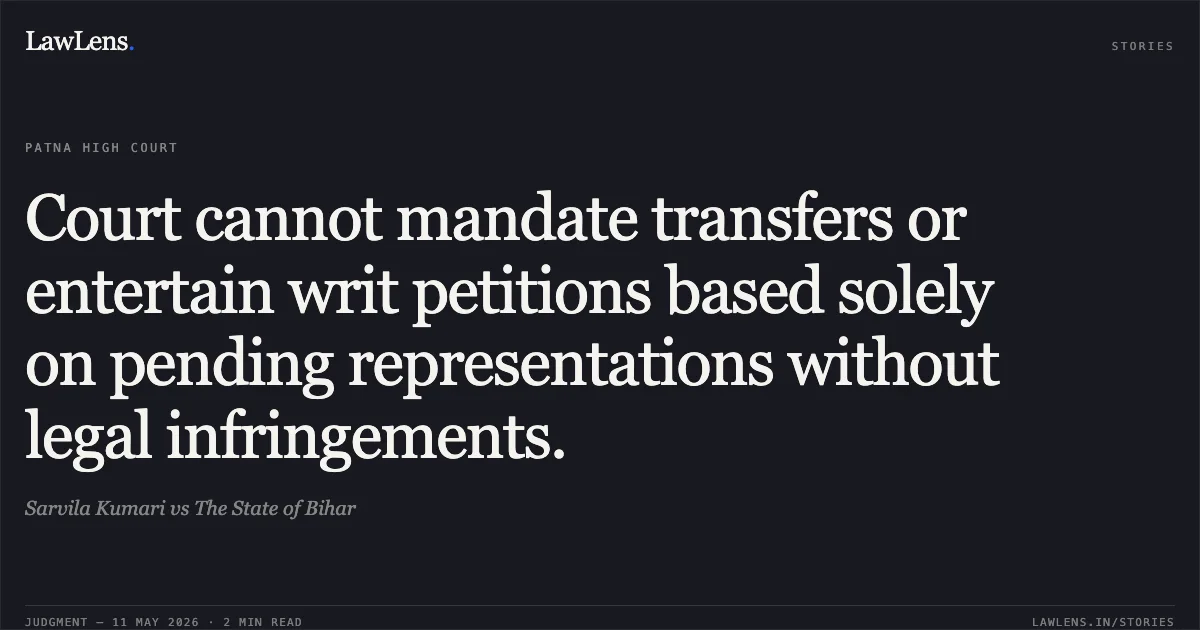
1. Whether the Court can exercise its writ jurisdiction under Article 226 to direct the transfer of an employee or disciplinary action based on representations alleging harassment
Source reference: p. 5, para. 62. Whether the mere filing of representations entitles a petitioner to seek judicial intervention under Article 226
Source reference: p. 5, para. 6Law Applied
The court applied the principle that the transfer of an employee is a prerogative of the employer, and decisions regarding such administrative matters must be taken at the departmental level rather than by the Court in a routine manner
Source reference: p. 5, para. 6The court relied on settled jurisprudence from the Hon’ble Supreme Court of India, which establishes that the mere filing of a representation does not create a vested right for a person to approach the High Court under Article 226 of the Constitution of India
Source reference: p. 5, para. 6Reasoning
The Court observed that while the petitioner alleged significant harassment and arbitrary actions (such as salary deduction and false litigation), she failed to bring "even a single chit of paper" or documentary evidence on record to substantiate these claims, such as appointment letters, transfer orders, or the First Information Report (FIR)
Source reference: p. 4, para. 5; p. 4, para. 6The Court reasoned that since the grievances remained at the level of unsupported representations, it could not intervene. It specifically noted that matters of transfer fall within the employer's administrative domain
Source reference: p. 5, para. 6Therefore, the petitioner had not established a legal or factual basis for the Court to issue a writ of mandamus for transfer or disciplinary action at this stage.
Source reference: no citationHolding
The Court disposed of the writ petition, declining to grant the specific prayers for transfer or immediate disciplinary action.
The Court held that the respondent authorities are "obliged to consider the representation" of the petitioner, provided the allegations against Respondent No. 7 are found to be true
Source reference: p. 5, para. 6Original Court PDF
Sarvila KumarivsThe State of Bihar
Click to open original judgment
Original judgment, available to read, download and summarize on LawLens.in