Facts
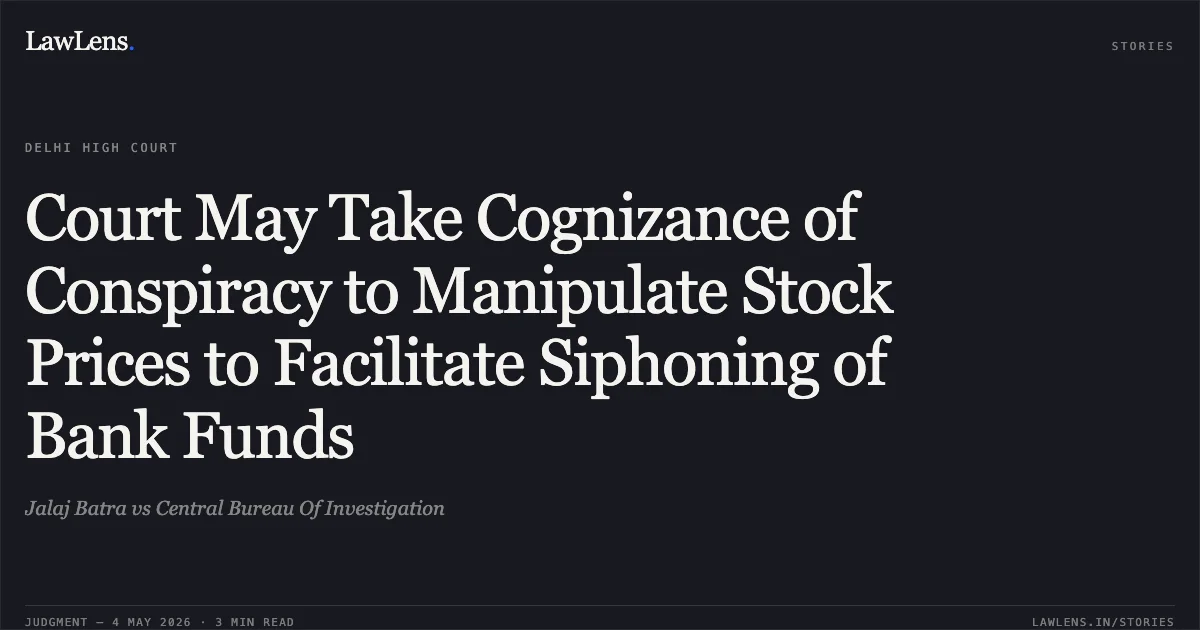
The Petitioner (A-2) challenged a Trial Court order dated 27.04.2024, which took cognizance of a supplementary charge-sheet and summoned him
Source reference: p. 1The case originated from a complaint by Union Bank of India alleging a criminal conspiracy by the promoters of DHFL to cheat a consortium of 17 banks of approximately Rs. 34,000 crores
Source reference: p. 2While the main charge-sheet focused on the siphoning of funds via shell companies, the supplementary charge-sheet alleged that the Petitioner, a stock advisor, conspired with Kapil Wadhawan to artificially "jack up" DHFL’s share prices and trade volume to attract institutional investors through a Qualified Institutional Placement (QIP)
Source reference: p. 3-4It was alleged that Rs. 689.32 crores were diverted to brokers for this manipulation
Source reference: p. 4The Petitioner contended he was merely a financial advisor, lived in Dubai, and had no involvement in the conspiracy
Source reference: p. 6Issues
1. Whether there was sufficient material on record to justify the Trial Court taking cognizance and summoning the Petitioner
Source reference: p. 10-112. Whether the Petitioner’s alleged role in share price manipulation formed part of the "single conspiracy" to siphon off funds as detailed in the original FIR
Source reference: p. 11-12Law Applied
The Court applied the principles governing criminal conspiracy under Section 120B of the IPC, noting that conspiracy is often hatched in secrecy and can be inferred from the conduct of the parties and circumstantial evidence
Source reference: p. 11It relied on State of Gujarat v. Afroz Mohammed Hasanfatta, holding that at the stage of taking cognizance, the court is not required to critically evaluate evidence but only to determine if there are sufficient grounds to proceed
Source reference: p. 7, 10Furthermore, the court applied the "unity of object" principle from S. Swamirathnam v. State of Madras, establishing that all participants in a single continuous conspiracy are liable for the acts of others, even if they joined at different stages or performed different roles
Source reference: p. 9, 11Reasoning
The Court observed that at the threshold stage of cognizance, it cannot weigh the evidentiary value of material meticulously but must ensure the application of mind
Source reference: p. 10Upon reviewing the hard disc containing the voluminous records, the Court found that multiple witnesses (e.g., LW 273, LW 656) and an approver (Abhay Adukia) specifically identified the Petitioner as the middleman who managed clandestine trading to project a false financial health of DHFL
Source reference: p. 12-14The Court rejected the Petitioner's argument that the jacking up of prices was a separate event, finding it was a "common feature and bedrock" of the overarching conspiracy to divert and mask siphoned funds
Source reference: p. 13The Court also dismissed the "pick-and-choose" allegation, noting that investigators may strategically use some participants as witnesses to expose the core conspiracy
Source reference: p. 15Holding
The Court dismissed the petition, holding that there was sufficient material to proceed against the Petitioner
The Court answered that the Trial Court had properly applied its mind and that the Petitioner's actions were part of a synchronized effort to facilitate the siphoning of funds
Source reference: p. 16The Petitioner was directed to participate in the Trial Court proceedings, with the Court noting his past conduct of remaining abroad as a factor
Source reference: p. 17All observations were made without prejudice to the merits at the stage of framing of charges
Source reference: p. 16Acts & Sections Cited
10 provisions across 3 statutes referred to in this judgment. Each provision opens on LawLens.
Indian Penal Code, 18607
Prevention of Corruption Act, 19882
Securities and Exchange Board of India Act, 19921
Original Court PDF
Jalaj BatravsCentral Bureau Of Investigation
Click to open original judgment
Original judgment, available to read, download and summarize on LawLens.in