Facts
Petitioner No. 1, a Senior Scale Stenographer, and Petitioner No. 2, a Senior Assistant (later promoted to Superintendent Grade-II), sought a writ of mandamus to compel the Forest Department to create Law Officer posts and frame Recruitment and Promotion (R) Rules for the same
Source reference: para. 1-3, 9The petitioners relied on a 1987 proposal and a 2005 government directive that suggested departments insert promotion avenues for clerical staff with LLB degrees into Legal Assistant roles
Source reference: para. 4Although the Forest Department sent several communications recommending the creation of these posts due to increasing litigation, the State Government ultimately rejected the proposal via communication dated 24.08.2009 (Annexure P-17).
Source reference: para. 6-7The rejection was based on the fact that a District Attorney had already been appointed to manage the department's legal work
Source reference: para. 7, 10Issues
1. Whether the High Court can exercise judicial review to direct the State to create specific posts or frame Recruitment and Promotion Rules in a particular manner
Source reference: para. 13, 142. Whether internal departmental recommendations and file notings constitute a binding government decision to create posts
Source reference: para. 16, 17Law Applied
The court followed the settled principle that the constitution of cadres, creation/abolition of posts, and framing of promotion criteria are matters of State policy within the exclusive discretion of the executive, as held in P.U. Joshi v. Accountant General, Ahmedabad (2003) 2 SCC 632
Source reference: para. 14It applied the rule from Union of India v. Indian Navy Civilian Design Officers Association (2023) 19 SCC 482, which stipulates that file notings are merely opinions and do not constitute a decision of the Government
Source reference: para. 17Furthermore, it relied on V.K. Naswa v. Home Secretary, Union of India (2012) 2 SCC 542, asserting that courts cannot legislate or direct the legislature to enact laws in a specific manner
Source reference: para. 18Reasoning
The court reasoned that the scope of judicial review in administrative policy matters is extremely narrow
Source reference: para. 13It held that prescribing qualifications and avenues of promotion is a complex task for expert bodies, and courts should not substitute their views for those of the State
Source reference: para. 13, 14The court noted that departmental recommendations (Annexure P-13) do not bind the competent authority until a final decision is taken
Source reference: para. 16It found the State’s rejection of the post-creation proposal to be valid and non-arbitrary because legal requirements were already being met by an appointed District Attorney
Source reference: para. 10, 19Additionally, since the petitioners already had established channels of promotion within their own respective cadres—evidenced by Petitioner No. 2’s promotion to Superintendent—they could not claim a right to be included in a different, non-existent feeder category
Source reference: para. 19Holding
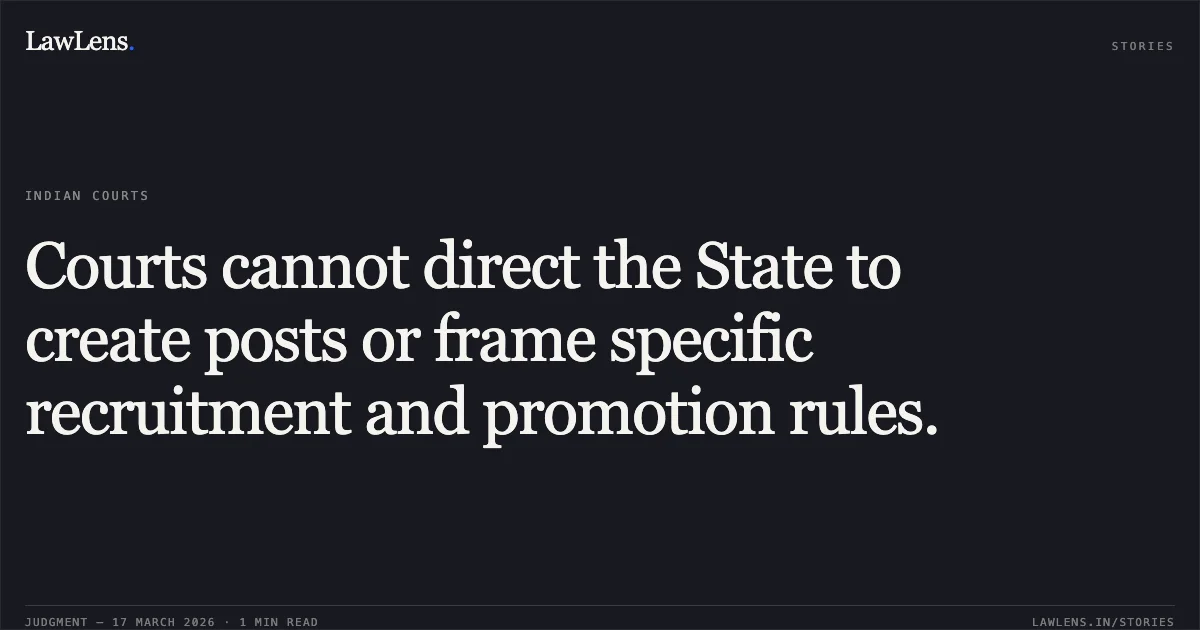
The High Court dismissed the writ petition, holding that it lacks the competence to direct the State to create posts or frame RP Rules in a specific way
The court affirmed that the State’s decision to reject the creation of Law Officer posts was a legitimate exercise of administrative discretion and did not violate Articles 14 or 16 of the Constitution
Source reference: para. 8, 19No costs were awarded
Source reference: para. 20Original Court PDF
Ashwani KumarvsSTATE OF HP
Click to open original judgment
Original judgment, available to read, download and summarize on LawLens.in