Facts
The petitioners invoked Article 226 of the Constitution challenging the model answer sheets issued for the Madhya Pradesh State Services Examination, 2012.
Source reference: p.1; para. 1They alleged that several questions contained two or more correct options, contrary to Rule 2008 and Appendix I, which contemplated only one correct answer for each objective question.
Source reference: p.1; para. 1They sought rectification of the model answers, revision of the result and selection list, stay of further examination proceedings, or permission to appear in the Main Examination.
Source reference: p.1; para. 1The respondents relied on the Full Bench decision in Nitin Pathak v. State of M.P. & Others, WA No. 581 of 2017, decided on 4 September 2017, and contended that the issue had already been settled against judicial re-evaluation of expert-determined answer keys.
Source reference: p.2; para. 2The Court also noted that the 2012 examination had concluded, final selections had been made, and appointment orders had already been issued.
Source reference: p.5; para. 6Similar challenges concerning the same examination had previously been rejected in Indra Kumar Dwivedi v. M.P. State Public Service Commission and Ku. Ananta Soni v. M.P. Public Service Commission.
Source reference: pp.5–9; paras. 6–7Issues
Whether the Court, in exercise of judicial review under Article 226, could re-examine or direct re-evaluation of the expert-approved model answer keys on the ground that multiple options were allegedly correct.
Source reference: pp.2–5; paras. 2–5Whether the alleged ambiguity or presence of more than one correct option violated the Madhya Pradesh State Services Examination Rules, 2008 and warranted revision of the result and selection list or permission to participate in the Main Examination.
Source reference: p.2; para. 3; p.5; para. 6Whether any relief could be granted after completion of the examination process, finalisation of selections, and issuance of appointment orders.
Source reference: p.5; para. 6Law Applied
The Court applied Article 226 of the Constitution subject to the principle that judicial review examines the decision-making process, not the correctness of an academic decision as an appellate forum.
Source reference: p.3; para. 2Appendix I, paragraph 4(1) of the Madhya Pradesh State Services Examination Rules, 2008 provides that each objective question must have four probable answers, of which only one is the correct answer.
Source reference: p.2; para. 3Relying on the Full Bench decision in Nitin Pathak v. State of M.P., the Court held that courts should ordinarily defer to academic experts and should not appoint court-controlled experts or substitute their own views for those of the examination authority absent mala fides or a demonstrable failure in the decision-making process.
Source reference: pp.2–3; para. 2Under Ran Vijay Singh v. State of Uttar Pradesh, (2018) 2 SCC 357, re-evaluation or scrutiny is permissible as of right only where the governing rules so provide; otherwise, interference is justified only in rare and exceptional cases where the incorrectness of the answer key is established clearly, without inferential reasoning or rationalisation.
Source reference: pp.3–5; para. 5The Court also relied on the prior decisions concerning the same examination, which upheld the Commission’s expert-based correction of answer keys and award of marks for multiple correct options where appropriate.
Source reference: pp.5–9; paras. 6–7Reasoning
The petitioners’ contention that the Rules contemplated only one correct answer did not, by itself, justify judicial interference.
Source reference: pp.5–7; para. 6The Commission had considered objections through an expert committee and had modified the model answers or awarded marks for more than one option where the experts found multiple answers correct.
Source reference: pp.5–7; para. 6Such corrective action was viewed as fair because denying marks to candidates selecting another objectively correct option would itself cause prejudice.
Source reference: pp.5–7; para. 6Applying Nitin Pathak and Ran Vijay Singh, the Court declined to act as a court of appeal over the academic assessment or independently determine the correctness of disputed answers.
Source reference: p.2; para. 4; pp.3–5; para. 5The petitioners were unable to distinguish their case from the earlier decisions or demonstrate mala fides, a clear material error, or an impermissible decision-making process.
Source reference: p.2; para. 4; pp.3–5; para. 5Further, the completed examination and appointments made the requested revision and consequential participation in the Main Examination impracticable and legally unwarranted.
Source reference: p.5; para. 6Holding
The Court held that no ground was made out for judicial re-evaluation or rectification of the model answer keys.
The Commission’s reliance on its expert committee and its treatment of questions having multiple correct options did not warrant interference under Article 226.
Source reference: p.10; para. 8In view of the binding principles in Nitin Pathak and Ran Vijay Singh, the prior decisions concerning the same examination, and the fact that selections and appointments had already been completed, the petition was dismissed.
Source reference: p.10; para. 8No relief was granted for revision of the result or selection list, stay of the examination process, or permission to appear in the Main Examination.
Source reference: p.1; para. 1Original Court PDF
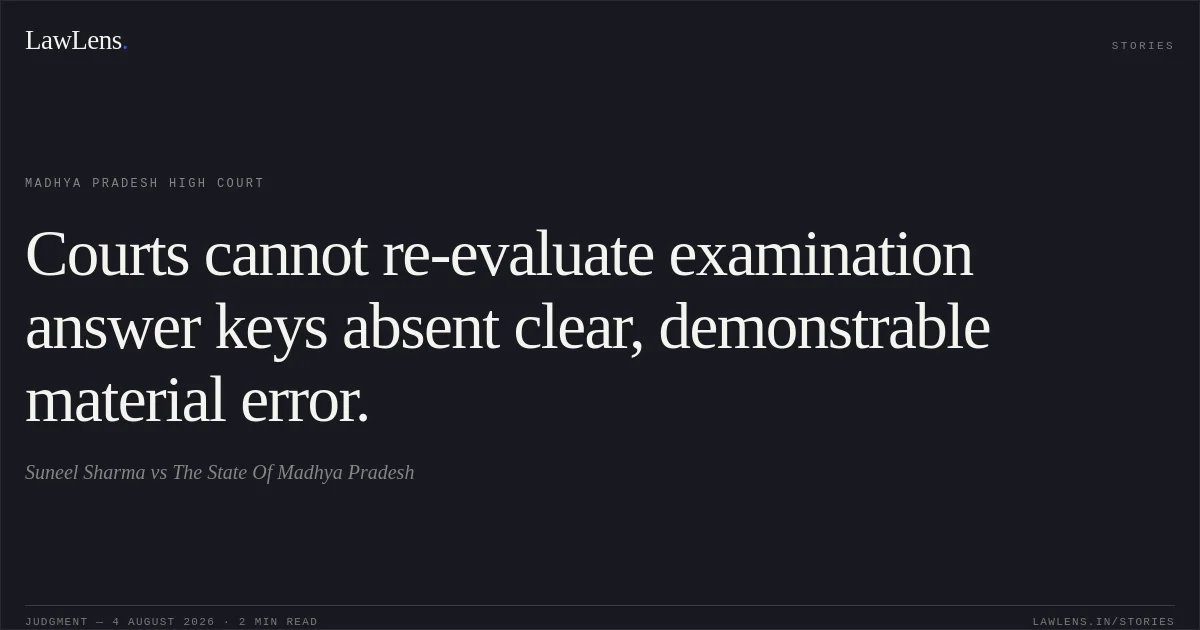
Suneel SharmavsThe State Of Madhya Pradesh
Click to open original judgment
Original judgment, available to read, download and summarize on LawLens.in