Facts
The petitioner invoked Article 226 of the Constitution seeking directions to the Madhya Pradesh Public Service Commission (“MPPSC”) to exclude Questions 8 and 32 from evaluation, include Question 9 in the answer key, and thereafter declare his result in the preliminary examination.
Source reference: p.1He also sought a declaration that he had qualified in the examination.
Source reference: p.1The MPPSC opposed the petition and submitted that the issue was covered by the Full Bench decision in Nitin Pathak v. State of M.P. & Others, W.A. No. 581 of 2017, decided on 4 September 2017.
Source reference: p.2Issues
1. Whether the High Court, in exercise of judicial review under Article 226, could direct alteration or exclusion of disputed examination questions and answers, and require the MPPSC to re-determine the petitioner’s result.
Source reference: pp.1–22. Whether the petitioner was entitled to judicial scrutiny or re-evaluation of the answer key despite the limited scope of interference in academic and examination matters.
Source reference: pp.2–4Law Applied
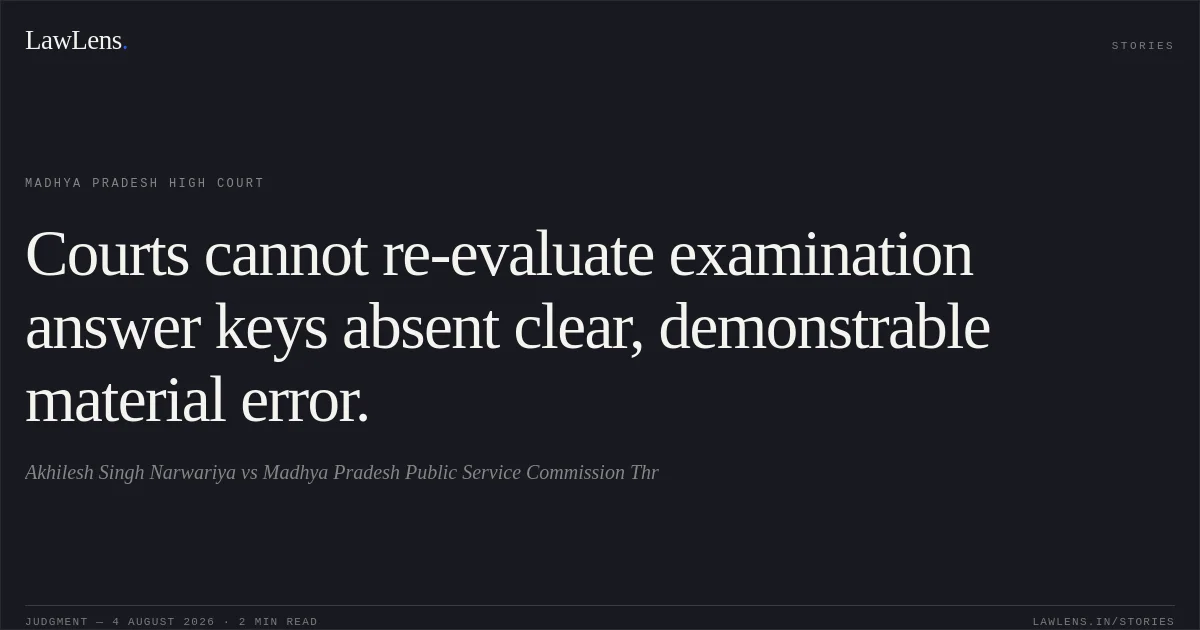
The Court applied Article 226 principles governing judicial review of examination processes and relied on Nitin Pathak v. State of M.P. & Others, which held that courts should ordinarily defer to academicians and expert bodies finalising answer keys, should not act as appellate authorities over expert academic opinions, and should review the decision-making process rather than substitute their own views.
Source reference: p.2It further relied on Ran Vijay Singh v. State of Uttar Pradesh, (2018) 2 SCC 357, which holds that re-evaluation or scrutiny is permissible as of right only where the governing statute, rule, or regulation so provides; otherwise, intervention is justified only in rare or exceptional cases where a material error is demonstrated clearly, without inferential reasoning or rationalisation.
Source reference: pp.2–4Courts must avoid re-evaluating answer sheets or disrupting the examination process merely on grounds of dissatisfaction, sympathy, or perceived injustice.
Source reference: pp.2–4Reasoning
The petitioner’s relief required the Court to determine the correctness of particular questions and answers and to modify the examination evaluation accordingly.
Source reference: p.2The Court held that such an exercise fell within the domain of academic experts and that judicial review could not be converted into an appellate examination of the answer key.
Source reference: p.2Applying Nitin Pathak and Ran Vijay Singh, the Court found no basis to undertake re-evaluation or substitute its own assessment for that of the MPPSC’s expert mechanism.
Source reference: pp.2–4It also emphasised that interference in examination results could create uncertainty and prejudice the entire body of candidates, and that courts should intervene only upon a clear and exceptional demonstration of material error.
Source reference: pp.2–4Holding
The Court answered the issues against the petitioner.
It declined to direct exclusion of Questions 8 and 32, inclusion of Question 9, re-evaluation of the answer key, or declaration of the petitioner as successful in the preliminary examination.
Source reference: p.5The writ petition was accordingly dismissed.
Source reference: p.5Original Court PDF
Akhilesh Singh NarwariyavsMadhya Pradesh Public Service Commission Thr
Click to open original judgment
Original judgment, available to read, download and summarize on LawLens.in