Facts
The appellant was convicted under Section 135 of the Electricity Act, 2003.
Source reference: para. 2The trial court released him on probation for two years upon his furnishing a surety bond of ₹25,000, but also directed him to pay a fine equal to three times the electricity-theft bill, with one year’s simple imprisonment in default.
Source reference: paras. 1–3The appellant did not challenge the conviction on merits; he challenged the fine and default-imprisonment order, arguing that it was inconsistent with the benefit of probation.
Source reference: paras. 4–7Issues
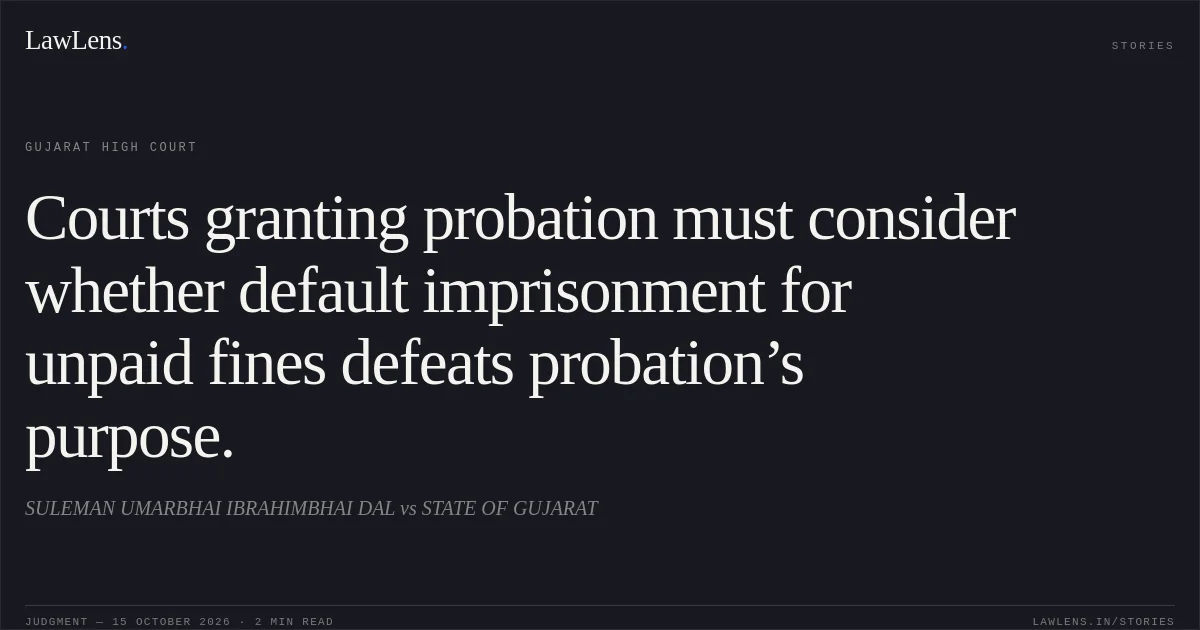
Whether the order imposing a fine with imprisonment in default, despite releasing the appellant on probation, required reconsideration in light of Ishar Das.
Source reference: paras. 5–8Whether the appeal should be remanded for the trial court to reconsider the sentencing order after hearing both sides.
Source reference: paras. 8–9Law Applied
Section 135 of the Electricity Act, 2003, was the basis of the appellant’s conviction.
Source reference: para. 2The appeal was brought under Section 415 of the Bharatiya Nagarik Suraksha Sanhita, 2023.
Source reference: para. 1The Court relied on Ishar Das v. State of Punjab, AIR 1972 SC 1295, where the Supreme Court explained that imposing a fine that entails imprisonment upon default may defeat the Probation of Offenders Act, 1958’s objective of avoiding imprisonment for persons granted probation; the decision also considered the benefit under Section 4 of that Act.
Source reference: para. 6The High Court directed the trial court to reconsider the matter in light of that precedent, without deciding the merits itself.
Source reference: paras. 8, 11Reasoning
The appellant’s challenge concerned the consequence of default in paying the fine, not the merits of his conviction.
Source reference: paras. 4–5Because the trial court had granted probation but also imposed a fine carrying a term of imprisonment in default, the High Court considered the principle in Ishar Das relevant to the sentencing issue.
Source reference: paras. 5–8As the trial court had not been directed to that decision at the sentencing stage, the High Court remitted the matter for fresh consideration and hearing of both sides rather than deciding the issue itself.
Source reference: paras. 7–9Holding
The High Court allowed the appeal to the extent of setting aside the trial court’s judgment and order dated 3 March 2026 and remanding the matter for fresh decision in accordance with law, after considering Ishar Das and hearing both sides.
It expressly stated that it had not considered the merits of the case.
Source reference: para. 11The application for suspension of sentence was disposed of as no longer surviving in light of the order in the appeal.
Source reference: p. 5Acts & Sections Cited
5 provisions across 3 statutes referred to in this judgment. Each provision opens on LawLens.
Bharatiya Nagarik Suraksha Sanhita, 20231
Electricity Act, 20031
Probation of Offenders Act, 19583
Original Court PDF
SULEMAN UMARBHAI IBRAHIMBHAI DALvsSTATE OF GUJARAT
Click to open original judgment
Original judgment, available to read, download and summarize on LawLens.in