01Facts
The petitioner, accused no. 2 in four complaints under the Negotiable Instruments Act, 1881, challenged the Trial Court’s order dated 31 August 2026 refusing his exemption application and directing issuance of non-bailable warrants (NBWs).
pp. 2–3The Trial Court cited his absence since 31 July 2024, earlier adjournments, unpaid costs, and its doubts about the medical certificate submitted in support of exemption.
pp. 2–3The High Court noted his persistent non-appearance despite directions for physical attendance, although he had reportedly appeared virtually on some dates.
p. 4 · ¶ 502Issues
i.Whether, in the circumstances recorded by the Trial Court, the petitioner’s attendance could be secured through NBWs.
p. 3 · ¶ 4ii.Whether the NBWs should be cancelled in light of the petitioner’s undertaking to attend future hearings and his agreement to pay costs.
p. 4 · ¶ 7–903Law Applied
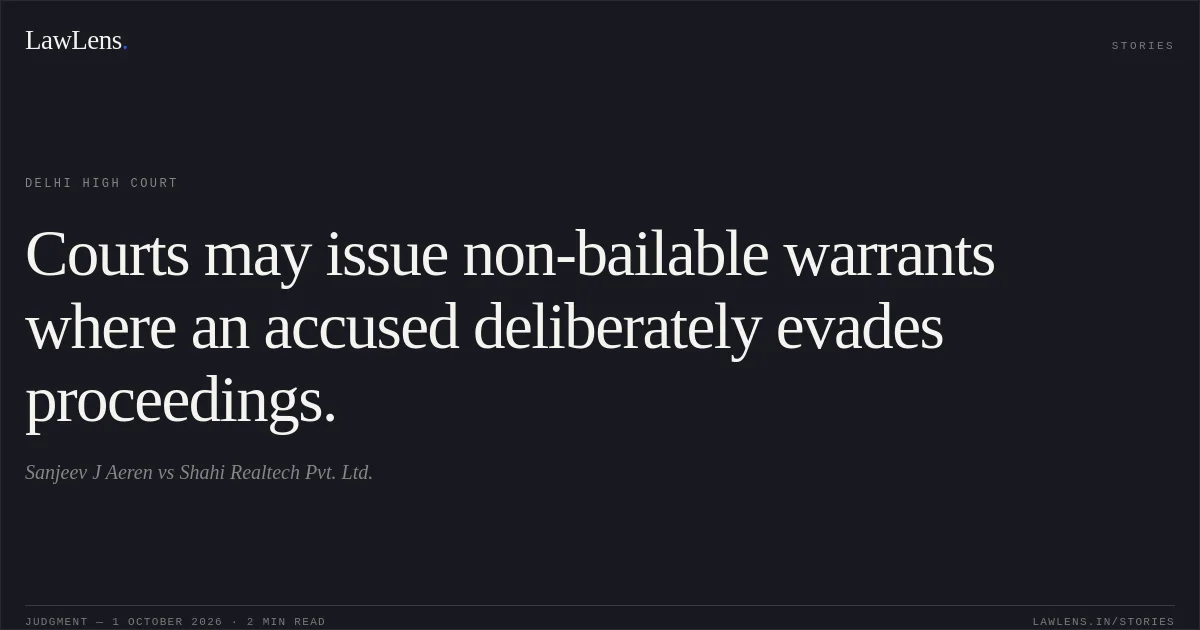
The Court stated that a Trial Court is not precluded from issuing NBWs where an accused deliberately evades proceedings, but must consider whether that measure is necessary on the particular facts.
p. 4 · ¶ 6The judgment cites no specific statutory provision or precedent governing issuance or cancellation of NBWs; it applies this case-specific necessity principle.
p. 4 · ¶ 604Reasoning
The petitioner’s repeated non-appearance and failure to comply with the direction for physical attendance supported the Trial Court’s decision to issue NBWs; virtual appearances on some dates did not excuse that failure.
p. 4 · ¶ 5The High Court therefore found no infirmity in the impugned order.
p. 4 · ¶ 7However, the petitioner appeared before the High Court and unequivocally undertook to attend future hearings unless exempted beforehand, and agreed to pay reasonable costs.
p. 4 · ¶ 7–8The Court cancelled the warrants subject to payment of cumulative costs of ₹1,00,000 and compliance with that undertaking.
p. 4 · ¶ 9–1005Holding
The Court held that the Trial Court’s issuance of NBWs was not infirm on the facts, but cancelled them subject to the petitioner paying ₹1,00,000 to the respondent and appearing on the next and subsequent hearing dates unless exempted beforehand.
p. 4 · ¶ 7–10It requested the Trial Court to endeavour to dispose of the four long-pending complaints preferably within one year, and disposed of the petitions on those terms.
pp. 4–5 · ¶ 11–12Original Court PDF
Sanjeev J AerenvsShahi Realtech Pvt. Ltd.
Click to open original judgment
Original judgment, available to read, download and summarize on LawLens.in