Facts
The petitioner was granted bail on 17 February 2020, subject to a condition that he would not leave the territorial jurisdiction of the NCT of Delhi without prior permission of the concerned court.
Source reference: p.1During the pendency of the proceedings, the Trial Court directed that he could not leave India without prior permission and his passport was sought to be seized.
Source reference: p.1The condition was subsequently relaxed by the High Court on 4 November 2024, permitting the petitioner to approach the Trial Court for permission to travel abroad for educational purposes.
Source reference: p.1On an earlier occasion, the petitioner had been permitted to travel to Canada to pursue studies at Sheridan College, Ontario, subject to conditions including furnishing an undertaking, depositing his passport upon return, furnishing an FDR of ₹2,00,000, providing his Canadian address and mobile number, and appearing through video conferencing when directed.
Source reference: pp.1–2The petitioner complied with those conditions and returned to India after completing the course.
Source reference: p.2The present proceedings were at the stage of prosecution evidence.
Source reference: p.2The petitioner sought permission to travel to Ottawa, Canada, to join employment as a “Junior System Administrator” with Connect Mandarin pursuant to an offer letter dated 17 April 2026.
Source reference: pp.1, 3He had obtained a work visa valid until 31 December 2027.
Source reference: pp.1, 3The Trial Court rejected his request on 13 May 2026.
Source reference: p.1Issues
Whether the petitioner should be permitted to travel abroad during the pendency of the criminal proceedings, notwithstanding the existing bail and passport-related restrictions?
Source reference: pp.1, 4Whether appropriate safeguards and conditions could adequately protect the prosecution and complainant’s interests and ensure the petitioner’s continued participation in the trial?
Source reference: pp.2–4Law Applied
The Court applied the principle that a condition restricting an accused’s travel during the pendency of criminal proceedings is subject to relaxation by the competent court upon consideration of the facts and circumstances, provided that the accused’s presence and the effective conduct of the trial are sufficiently secured.
Source reference: pp.1, 4The Court relied on the procedural safeguards earlier imposed in the petitioner’s case—undertaking, security deposit, disclosure of address and contact details, surrender of passport upon return, and video-conferencing participation—as appropriate mechanisms for balancing the petitioner’s personal and employment interests against the requirements of the pending trial.
Source reference: pp.1–2No specific statutory provision or precedent was cited in the judgment.
Source reference: no citationReasoning
The Court considered that the petitioner had previously been granted permission to travel abroad and had complied with all the conditions, including returning to India after completing his studies.
Source reference: p.2This prior compliance weighed in favour of permitting the proposed travel.
Source reference: p.2The petitioner had a genuine employment opportunity in Canada and a work visa valid until 31 December 2027.
Source reference: pp.1, 3At the same time, the Court addressed the complainant’s concern regarding possible delay by requiring the petitioner to undertake to participate through video conferencing, not dispute his identity, and appear physically whenever specifically directed.
Source reference: pp.2–3The requirement to furnish an affidavit, deposit original FDRs of ₹5,02,697, and provide his Canadian address and mobile number supplied additional assurance that he would remain amenable to the jurisdiction of the Trial Court.
Source reference: pp.3–4On this balance, the Court found it appropriate to relax the travel restriction.
Source reference: no citationHolding
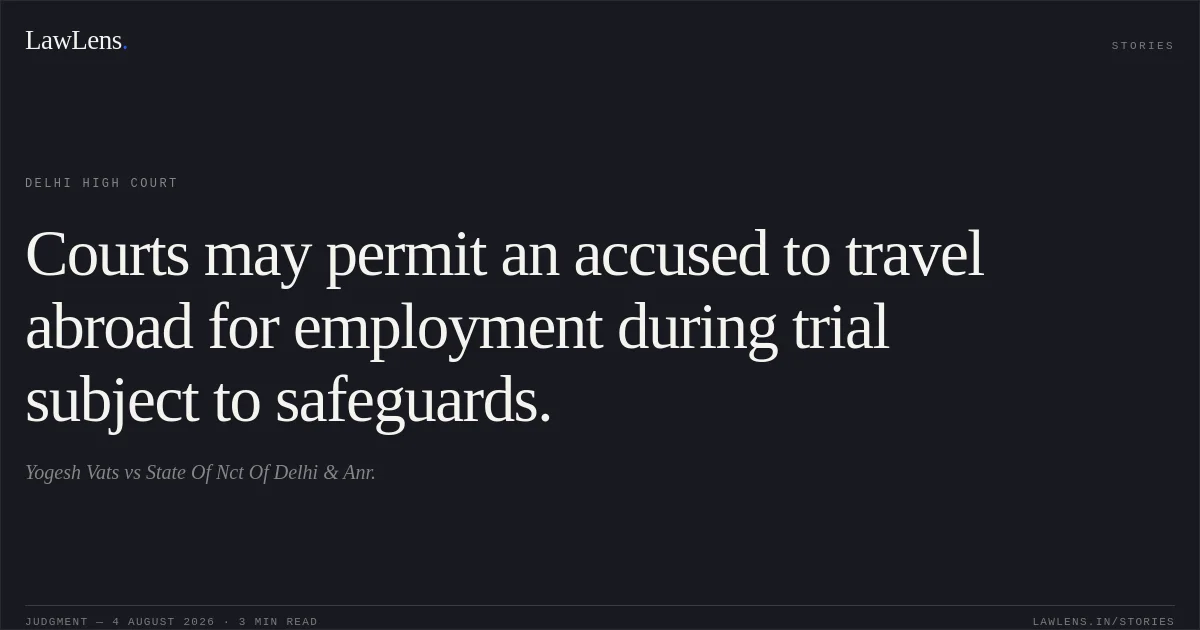
The High Court allowed the petition and permitted the petitioner to travel to Ottawa, Canada, to take up the offered employment.
He was directed to submit the original affidavit of undertaking and original FDRs before the Trial Court, and to provide his Canadian address and mobile number.
Source reference: p.4Upon compliance, the Trial Court was directed to release his passport.
Source reference: p.4The petitioner was required to abide by the terms of his undertaking, and the petition was disposed of accordingly.
Source reference: pp.4Original Court PDF
Yogesh VatsvsState Of Nct Of Delhi & Anr.
Click to open original judgment
Original judgment, available to read, download and summarize on LawLens.in