Facts
On 13 November 2012, the petitioners allegedly entered the informant’s house during dinner following a prior dispute, assaulted him, and threatened him.
Source reference: pp.4–6When the informant’s wife intervened, some of the accused allegedly assaulted her, pulled her hair and tore her clothes; the informant’s father was also allegedly assaulted.
Source reference: pp.4–6The injured persons were medically examined on 14 November 2012, and the FIR was lodged on 16 November 2012.
Source reference: pp.4–6After investigation, the petitioners were charge-sheeted under Sections 341, 452, 323, 294, 354, 506 and 34 IPC.
Source reference: pp.4–6The Trial Court convicted them under Sections 452/34, 506/34, 354/34 and 323/34 IPC and imposed custodial sentences and fines.
Source reference: pp.7–8On appeal, the conviction under Sections 452/34, 354/34 and 506/34 IPC was set aside, but the conviction under Section 323/34 IPC was maintained; the petitioners were sentenced to pay a fine of Rs.800 each, with Rs.200 each directed to be paid to the victims.
Source reference: p.8Their request for benefit under the Probation of Offenders Act, 1958 (“P.O. Act”) was rejected.
Source reference: p.8In revision, the petitioners did not challenge their conviction on merits and confined their prayer to release on probation.
Source reference: p.9Issues
Whether, after the conviction under Section 323 read with Section 34 IPC was maintained, the petitioners ought to have been considered for release on probation under the P.O. Act.
Source reference: pp.8–11Whether the appellate fine and the amount of compensation payable to the victims required modification in light of the applicable probationary provisions and the considerable lapse of time since the occurrence.
Source reference: pp.9–13Law Applied
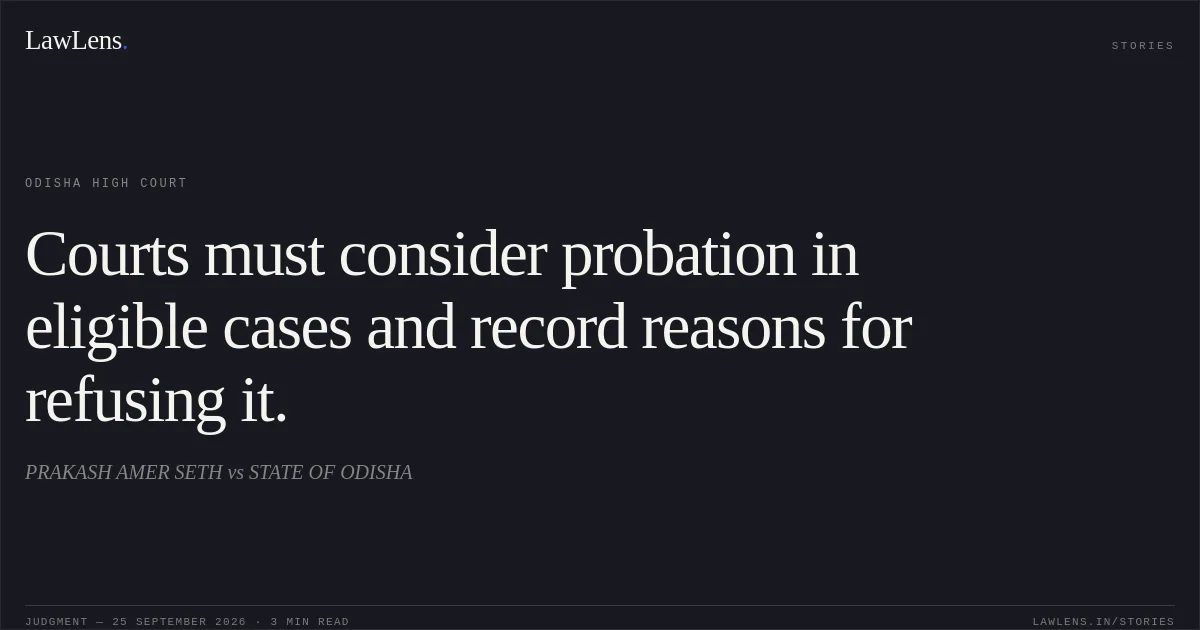
The Court applied Section 4 of the Probation of Offenders Act, 1958, under which, where its statutory conditions are attracted and applicability is not excluded, the court must consider releasing the offender on probation, although probation is not an offender’s absolute right.
Source reference: pp.9–12If probation is refused, reasons must be recorded.
Source reference: pp.9–12The Court relied on Chellammal v. State represented by the Inspector of Police , 2025 SCC OnLine SC 870, which held that consideration of probation is a mandatory judicial duty and that refusal must be supported by reasons.
Source reference: pp.9–12The Court also applied Section 5(1) of the P.O. Act, which permits the court, while directing release under Section 4, to order compensation for loss or injury caused by the offence, and Section 5(2), which permits recovery of unpaid compensation as a fine.
Source reference: pp.12–13The surviving conviction was under Section 323 read with Section 34 IPC.
Source reference: pp.4, 8Reasoning
The petitioners expressly limited the revision to the question of probation and relied on the nearly fourteen-year lapse since the occurrence.
Source reference: p.9In view of Chellammal , the Court held that the lower courts were required to meaningfully consider probation and could not reject it without adequate reasons.
Source reference: pp.9–12The appellate court had already acquitted the petitioners of the more serious allegations under Sections 452, 354 and 506/34 IPC, leaving only the conviction for voluntarily causing hurt under Section 323/34 IPC.
Source reference: p.8Considering the nature of the surviving offence, the appellate findings, and the substantial passage of time, the Court found it appropriate to set aside the appellate fine and impose compensation under Section 5 of the P.O. Act instead.
Source reference: p.12The compensation was enhanced from Rs.200 to Rs.500 for each victim, namely Dillip Amarseth and Manchini Amarseth.
Source reference: p.12Holding
The revision was disposed of without disturbing the petitioners’ conviction under Section 323 read with Section 34 IPC.
The fine imposed by the appellate court was set aside, and the compensation payable to each of the two victims was fixed at Rs.500 under Section 5 of the P.O. Act.
Source reference: p.12The amount was directed to be deposited within ten days for disbursement to the victims; in default, it would be recoverable in accordance with Section 5(2) of the P.O. Act and the applicable provisions governing recovery of fines.
Source reference: pp.12–14Acts & Sections Cited
18 provisions across 3 statutes referred to in this judgment. Each provision opens on LawLens.
Code of Criminal Procedure, 19737
Indian Penal Code, 18608
Original Court PDF
PRAKASH AMER SETHvsSTATE OF ODISHA
Click to open original judgment
Original judgment, available to read, download and summarize on LawLens.in