Facts
The petitioners participated in a recruitment examination for Assistant Engineer posts conducted by the Karnataka Examination Authority after an earlier examination had been set aside.
Source reference: p. 4–8They challenged the final answer key for Question 59 in the B3 version, contending that option 3—not the Authority’s chosen option 2—was correct.
Source reference: p. 4–8Their objections were considered and rejected by an expert committee, which selected option 2 after considering relevant textbooks.
Source reference: p. 4–8The petitioners sought one mark for the question and consequential revision of their rankings
Source reference: p. 4–8Issues
1. Whether the Court could interfere under Articles 226 and 227 with the expert committee’s selection of option 2 as the correct answer to Question 59, and direct the award of a mark to the petitioners.
Source reference: pp. 7–8, 242. Whether the petitioners demonstrated a patent or glaring error in the answer key sufficient to warrant judicial interference.
Source reference: pp. 20–24Law Applied
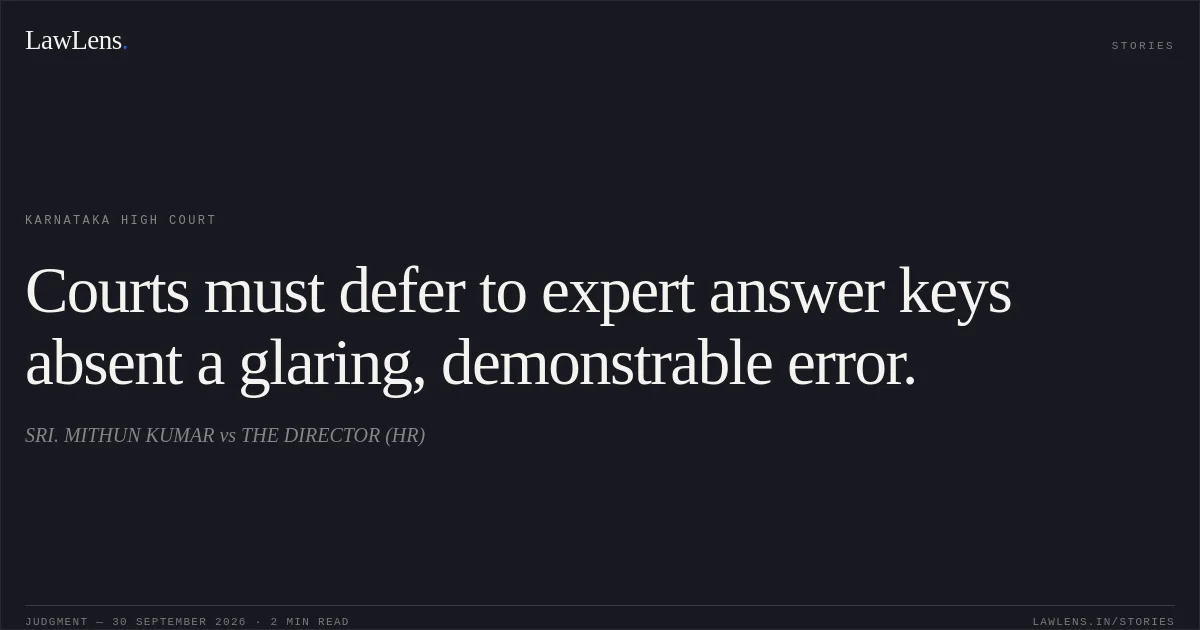
Under Articles 226 and 227, courts must exercise restraint when reviewing answer keys and examination results, as academic questions are best assessed by subject-matter experts.
Source reference: pp. 9–24Himachal Pradesh Public Service Commission v. Mukesh Thakur, (2010) 6 SCC 759, Ran Vijay Singh v. State of Uttar Pradesh, (2018) 2 SCC 357, Uttar Pradesh Public Service Commission v. Rahul Singh, (2018) 7 SCC 254, and Vikesh Kumar Gupta v. State of Rajasthan, (2021) 2 SCC 309, establish that courts should presume the answer key correct, should not themselves re-evaluate academic questions, and should interfere only where an error is clearly demonstrated without inferential reasoning; in case of doubt, the benefit goes to the examining authority.
Source reference: pp. 9–24The Court also relied on Uttar Pradesh Subordinate Service Selection Commission v. Ashok Yadav, 2026 SCC OnLine SC 1893, which reiterates that judicial review may be warranted for a glaring error or where a question admits multiple correct answers despite requiring one, but not where the examining body’s answer is reasonably sustainable.
Source reference: pp. 9–24Reasoning
The Court found that the expert committee had considered the objections and that the competing answers were supported by different textbooks.
Source reference: pp. 7–8, 24Because the question had been interpreted differently in academic sources, the dispute did not establish a glaring, self-evident error in the answer key.
Source reference: pp. 7–8, 24Determining which interpretation was preferable would require the Court to assess academic material and substitute its view for that of the expert committee, a course barred by the principles governing judicial review of examination answers.
Source reference: pp. 7–8, 24Holding
The Court answered the issues against the petitioners, holding that the expert committee’s choice of option 2 was not shown to be patently erroneous and that no basis existed to direct the award of marks or revise the petitioners’ rankings.
Both writ petitions were rejected.
Source reference: p. 24Original Court PDF
SRI. MITHUN KUMARvsTHE DIRECTOR (HR)
Click to open original judgment
Original judgment, available to read, download and summarize on LawLens.in