Facts
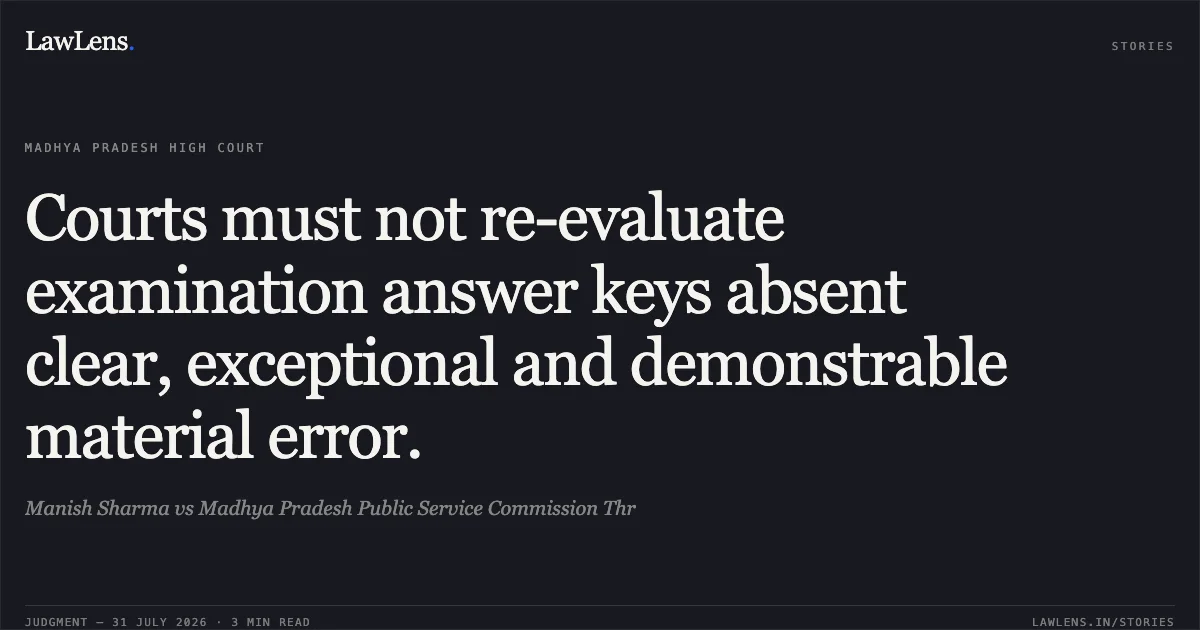
The petitioner challenged the model answer key issued by the Madhya Pradesh Public Service Commission (MPPSC) for Questions 30, 44 and 45 of Set-D of the General Studies paper. He sought correction of the answer key, award of six additional marks, reassessment of the cut-off and his marks, and consequential inclusion in the select list.
Source reference: p.1The respondents relied on the Full Bench decision in Nitin Pathak v. State of M.P., WA No. 581 of 2017, decided on 4 September 2017, which held that courts should ordinarily defer to experts in matters concerning examination answer keys and should not appoint court experts to reassess them.
Source reference: p.1The petitioner could not distinguish the facts of his case from Nitin Pathak.
Source reference: p.2Issues
1. Whether the High Court should direct MPPSC to correct the model answer key and award the petitioner six additional marks for Questions 30, 44 and 45.
Source reference: p.12. Whether the Court should direct reassessment of the cut-off and the petitioner’s marks, with consequential inclusion in the select list.
Source reference: p.13. Whether judicial review could be exercised to reassess or substitute the opinion of examination experts regarding the correctness of answer-key options.
Source reference: pp.1–4Law Applied
The Court applied the Full Bench ruling in Nitin Pathak v. State of M.P., which held that, in judicial review, courts should ordinarily not refer disputed answer keys to court-appointed experts and should defer to academicians and experts absent mala fides; the Court should not act as an appellate forum over expert opinions in academic matters, as judicial review concerns the decision-making process rather than the correctness of the decision itself.
Source reference: p.1; para. 31–32 of Nitin PathakIt further relied on Ran Vijay Singh v. State of Uttar Pradesh, (2018) 2 SCC 357, which held that reevaluation is permissible as of right only where authorised by the governing statute, rules or regulations; otherwise, judicial interference is justified only in rare or exceptional cases where the candidate clearly demonstrates, without inferential reasoning or rationalisation, that the answer key contains a material error.
Source reference: p.2The Supreme Court also cautioned that courts must not themselves reevaluate answer sheets or substitute their views for those of experts, and that examination results should not ordinarily be unsettled merely because candidates are dissatisfied.
Source reference: pp.2–4Reasoning
The petitioner sought judicial correction of three answer-key options and consequential alteration of the examination result.
Source reference: p.1However, the governing principle from Nitin Pathak required the Court to defer to the examination authority’s experts and prohibited it from functioning as an appellate body on academic correctness.
Source reference: p.1The petitioner was unable to distinguish his case from Nitin Pathak or demonstrate any exceptional, patent and material error in the answer key in the manner required by Ran Vijay Singh.
Source reference: p.2In the absence of such a clear demonstration, the Court declined to independently examine the disputed answers or order reassessment, particularly in view of the need for finality and certainty in public examinations.
Source reference: pp.2–4Holding
The Court answered the issues against the petitioner.
It held that no direction could be issued for correction of the disputed answer key, award of additional marks, reassessment of the cut-off or inclusion of the petitioner in the select list.
Source reference: p.4The writ petition was accordingly dismissed.
Source reference: p.4Original Court PDF
Manish SharmavsMadhya Pradesh Public Service Commission Thr
Click to open original judgment
Original judgment, available to read, download and summarize on LawLens.in