Facts
The petitioner appeared in the NEET-UG 2026 examination and challenged the answer keys to Questions 60 and 70.
Source reference: p.1, para. 1He contended that Question 60 had previously appeared in JEE Main 2019 and Question 70 in JEE Main 2022, but that the answers adopted in those examinations differed from the NEET-UG 2026 answer keys.
Source reference: p.1–2, para. 1The petitioner had raised objections before the National Testing Agency (NTA), which examined and rejected them, maintaining the correctness of the disputed answer keys.
Source reference: p.3, para. 5The petitioner sought reference of the questions and answer options to an expert committee, relying on Vanshika Yadav v. Union of India , 2024 (9) SCC 743.
Source reference: p.2–3, para. 4The Court noted that, despite the large number of candidates who had appeared in the examination, the petitioner appeared to be the only candidate challenging these questions.
Source reference: p.3, para. 6Issues
Whether the Court should refer the disputed NEET-UG 2026 questions and answer keys to an expert committee for determination of their correctness?
Source reference: p.3–5, paras. 4–9Whether the petitioner had established a rare or exceptional case of material error warranting judicial interference with the NTA’s answer keys?
Source reference: p.4–5, paras. 7–9Law Applied
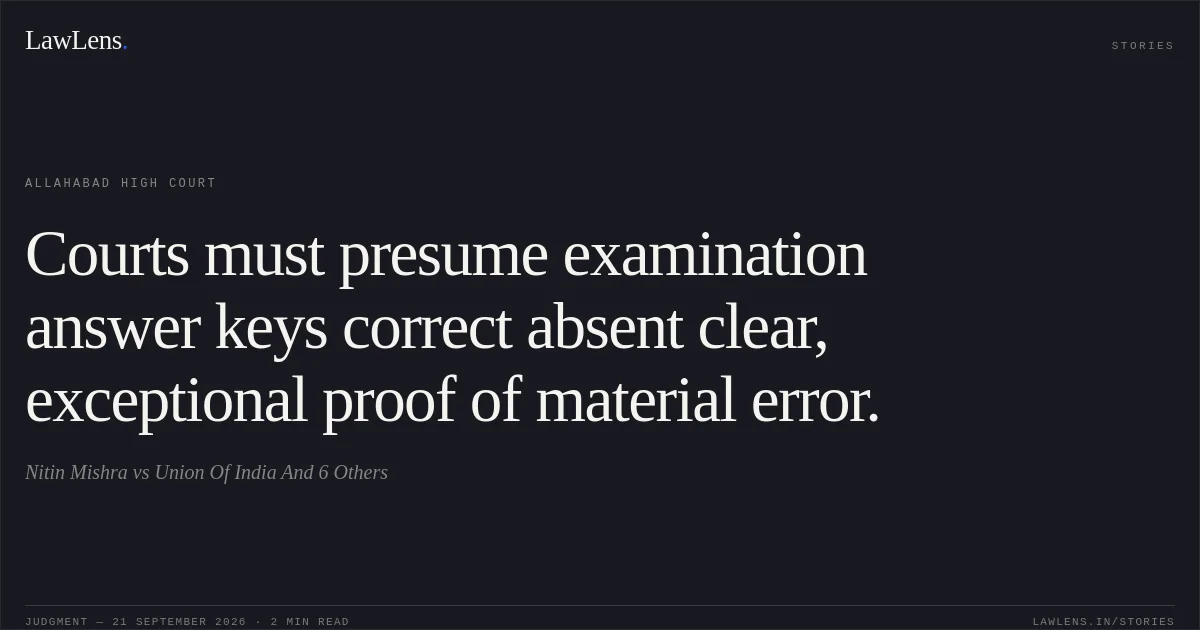
The Court applied the principles stated in UPPSC v. Rahul Singh , 2018 (7) SCC 254, namely that re-evaluation or scrutiny of examination answers may be permitted only in rare or exceptional cases where a material error is demonstrated clearly, without inferential reasoning or rationalisation; courts should not ordinarily re-evaluate answer sheets because they lack academic expertise; the correctness of the official answer key should be presumed; and, in case of doubt, the benefit should go to the examination authority rather than the candidate.
Source reference: p.4, para. 7The Court also considered Vanshika Yadav v. Union of India , 2024 (9) SCC 743, where expert examination was sought after representations had led the NTA to accept more than one answer and award marks accordingly.
Source reference: p.2–5, paras. 4, 8–9The Court interpreted Vanshika Yadav as requiring factual circumstances sufficient to justify an expert reference, rather than treating such reference as automatic.
Source reference: p.5, para. 9Reasoning
The petitioner relied principally on the fact that similar questions had appeared in earlier JEE Main examinations with different answer keys. However, the Court found that this circumstance, standing alone, did not demonstrate a clear and material error in the NEET-UG answer keys.
Source reference: p.1–2, para. 1; p.5, para. 9Unlike Vanshika Yadav , there had been no broader controversy, no indication that multiple answers were objectively correct, and no decision by the NTA to amend the answer key or award marks to candidates.
Source reference: p.4–5, paras. 8–9The NTA had considered the petitioner’s objections and reaffirmed the answer keys.
Source reference: p.3, para. 5Applying the presumption in favour of the examination authority and the principle that courts should not enter into academic evaluation absent a clear exceptional error, the Court held that the facts did not warrant an expert reference.
Source reference: p.4–5, paras. 7–9Holding
The Court answered the issues against the petitioner.
It held that the petitioner had not established a rare or exceptional case of demonstrable material error in the disputed answer keys, and that the circumstances did not justify referral to an expert committee.
Source reference: p.5, para. 9The writ petition was accordingly dismissed.
Source reference: p.6, para. 10Original Court PDF
Nitin MishravsUnion Of India And 6 Others
Click to open original judgment
Original judgment, available to read, download and summarize on LawLens.in