Facts
The petitioner/plaintiff challenged the order dated 2 September 2026 of the Commercial Court, Tis Hazari Courts, whereby its right to lead evidence in CS (COMM) No. 982 of 2025 was closed.
Source reference: para. 1The petitioner submitted that its Director was a senior citizen, had been unwell, and was consequently unable to provide timely and proper instructions for preparation and recording of evidence.
Source reference: para. 2The respondent opposed the petition, contending that the evidence had already been closed, arguments on behalf of the plaintiff had substantially been heard on 17 September 2026, and the petitioner had produced no documentary proof of the Director’s illness.
Source reference: para. 3Earlier, with the parties’ consent, three months had been fixed for completion of evidence before the Local Commissioner.
Source reference: para. 5Issues
1. Whether the petitioner’s right to lead evidence should be restored despite the earlier closure of evidence and the progress of final arguments?
Source reference: paras. 2–72. Whether, in the interests of justice, the petitioner should be granted one final opportunity to lead evidence subject to costs and a fixed procedural timetable?
Source reference: paras. 5–7Law Applied
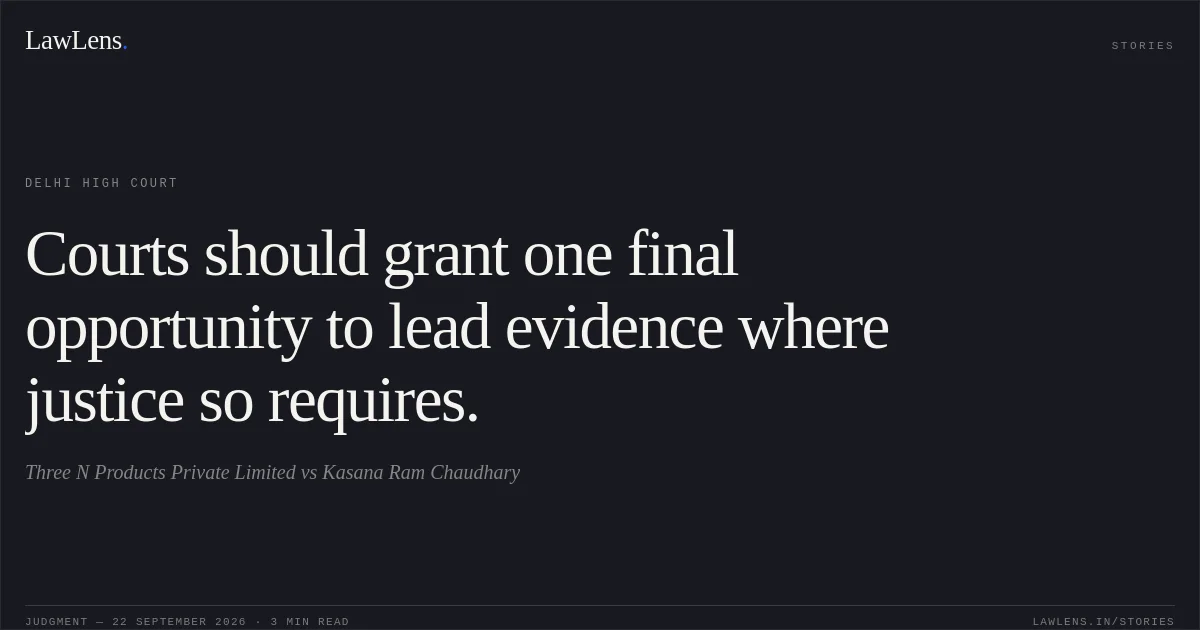
The Court applied the principle that the right to lead evidence is central to a fair trial and forms part of natural justice and fair play.
Source reference: para. 6It relied on Deepak v. Ramesh Sethi, CM(M) 306/2022, decided on 8 April 2022, which held that there is no straitjacket formula for granting opportunities to lead evidence and that courts should avoid hyper-technical denial of such opportunity unless the party has been unconscionably indolent.
Source reference: para. 6The Court also applied the discretionary principle that a final opportunity may be granted where the circumstances preventing the party from leading evidence are sufficiently explained, subject to appropriate terms and costs.
Source reference: paras. 5–7Reasoning
The Court acknowledged that the petitioner had previously been granted an opportunity to lead evidence and that the parties had agreed to a three-month period for completing evidence.
Source reference: para. 5Nevertheless, it accepted that the petitioner had explained circumstances stated to be beyond its control and concluded that the interests of justice would be better served by permitting one final opportunity.
Source reference: paras. 5–7Applying the principle in Deepak, the Court treated the right to present evidence as integral to a fair adjudication and declined to uphold closure on a rigidly technical basis.
Source reference: para. 6To balance the respondent’s prejudice and avoid further delay, the Court imposed costs and prescribed strict timelines for filing affidavits, cross-examination, and rehearing of arguments.
Source reference: paras. 6–7Holding
The petition was allowed to the extent that the petitioner’s right to lead evidence was restored and one final opportunity was granted.
The petitioner was directed to file affidavits of evidence of all witnesses before the Local Commissioner within 15 days; the respondent was permitted to file its witness affidavits within the following 15 days; and cross-examination was to be completed within one month from the respondent’s filing.
Source reference: para. 7(i)–(iii)The Commercial Court was directed to hear the arguments afresh thereafter.
Source reference: para. 7(iv)The relief was made subject to the petitioner paying ₹15,000 as costs directly to the respondent before the Local Commissioner on the next date of hearing.
Source reference: para. 7(v)The question of an amicable settlement was left open for consideration by the concerned court, and the petition and pending applications were disposed of.
Source reference: paras. 8–9Original Court PDF
Three N Products Private LimitedvsKasana Ram Chaudhary
Click to open original judgment
Original judgment, available to read, download and summarize on LawLens.in