Facts
The Municipal Corporation of Delhi (“MCD”) advertised the post of Assistant Education Officer (General), for which the selection process was conducted by the Union Public Service Commission (“UPSC”). The UPSC recommended six candidates, including Respondent No. 3, but not the Appellant.
Source reference: p.2, para. 6–7The MCD issued Respondent No. 3 a provisional offer of appointment under the Other Backward Class (“OBC”) quota, subject to verification of her credentials. Her character and antecedents, OBC certificate, and domicile certificate were verified by the Delhi Police, the MCD Vigilance Department, and the Sub-Divisional Magistrate. No adverse material was found.
Source reference: p.2–3, para. 7–8Various complaints alleged that Respondent No. 3 had fraudulently obtained her OBC certificate. These complaints were investigated and closed after verification.
Source reference: p.2–3, para. 8The Appellant subsequently filed a writ petition challenging Respondent No. 3’s appointment and continuance in service, alleging that she and her family were permanent residents of Haryana, belonged to the Jat community, and that her educational qualifications had been obtained in Haryana, where the community was allegedly not entitled to OBC reservation.
Source reference: p.3–4, paras. 9–10The learned Single Judge dismissed the writ petition, holding that the certificate had been repeatedly verified and that no perversity, mala fide, or statutory violation had been demonstrated. The Appellant preferred the present Letters Patent Appeal.
Source reference: p.4, para. 11Issues
Whether the Appellant established that Respondent No. 3’s appointment under the OBC quota was based on a fraudulently or unlawfully obtained OBC certificate?
Source reference: p.4–6, paras. 11–19Whether the Appellant had the requisite locus standi to challenge Respondent No. 3’s appointment, despite not being a UPSC-recommended candidate or a person pursuing the matter in public interest?
Source reference: p.4, para. 13; p.5, para. 14Whether the learned Single Judge was justified in declining judicial interference with the administrative determination after repeated verification of Respondent No. 3’s credentials?
Source reference: p.4–6, paras. 11, 17–19Law Applied
The Court applied the principles governing judicial review of administrative decisions, namely that interference is justified only where the decision-making process is vitiated by perversity, mala fide, or violation of statutory provisions.
Source reference: p.4, para. 11; p.6, para. 17It further applied the principle that a challenge to a public appointment, including one framed as a writ of quo warranto, must be supported by credible material showing that the office-holder lacks legal authority to hold the post; a person who is neither an affected candidate nor genuinely pursuing a public-interest challenge may lack the requisite locus.
Source reference: p.4, para. 13; p.5, para. 14The Court also relied on the administrative principle that official certificates and eligibility claims, once verified by competent authorities through proper inquiries, are not to be displaced on the basis of conjectures or unsubstantiated allegations.
Source reference: p.5–6, paras. 15–18Reasoning
The Court found that the allegation of fraud was unsupported by cogent material and rested on conjectures.
Source reference: p.4, para. 13Respondent No. 3’s OBC and domicile certificates had been verified by the competent Sub-Divisional Magistrate, while her character, antecedents, and police record had also been examined by the Delhi Police and the MCD Vigilance Department. Subsequent complaints were independently investigated and closed, with no foul play attributable to her being found.
Source reference: p.5–6, paras. 15–16In these circumstances, the Appellant failed to demonstrate perversity, mala fide, or breach of any statutory provision in the decision-making process.
Source reference: p.4, para. 11; p.6, para. 17The Court additionally held that the Appellant lacked sufficient locus because he had not been recommended by the UPSC, had not shown a personal legal injury, and had not pursued the matter before the authorities as a public-interest complainant.
Source reference: p.4–5, paras. 13–14Accordingly, there was no basis to disturb the factual determination reached after repeated verification.
Source reference: no citationHolding
The Division Bench held that the Appellant neither established that Respondent No. 3’s OBC certificate was fraudulent or invalid nor demonstrated a legally sustainable basis for challenging her appointment.
The learned Single Judge had correctly declined to interfere with the administrative findings supported by repeated verification processes.
Source reference: p.6, paras. 18–19The Letters Patent Appeal was dismissed, with no order as to costs.
Source reference: p.6, para. 19Original Court PDF
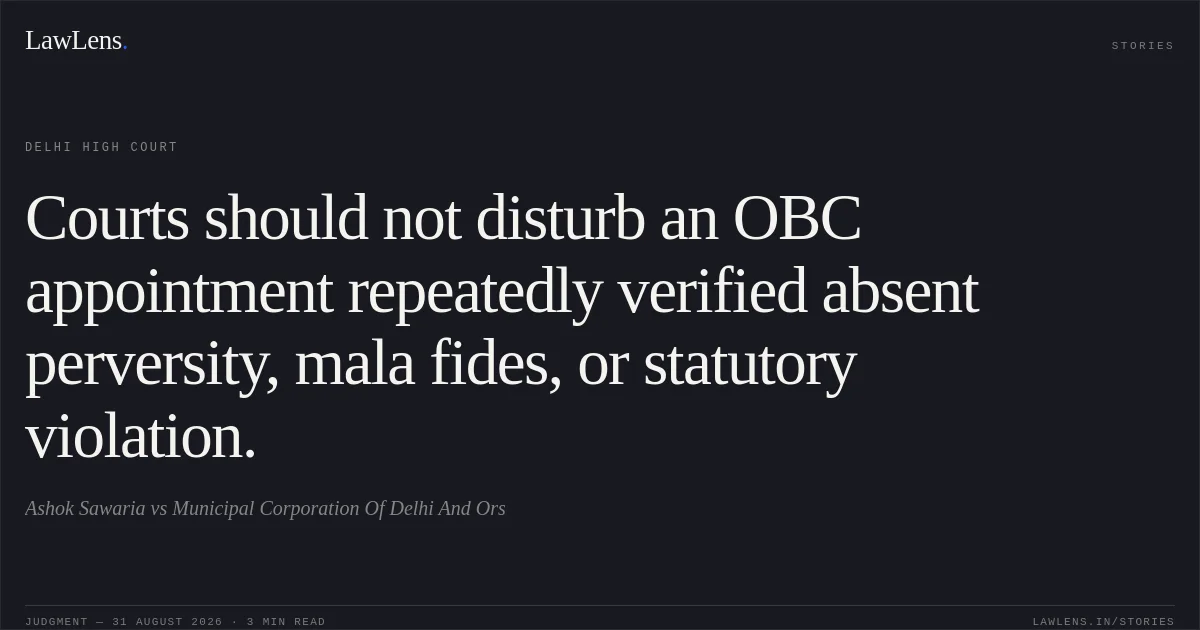
Ashok SawariavsMunicipal Corporation Of Delhi And Ors
Click to open original judgment
Original judgment, available to read, download and summarize on LawLens.in